
I used to use a Floathub to keep track of bilge pump activity and track Trouper. I had trouble getting the floathub to reliably connect to the internet, even using their mobile phone variant, mainly due to coverage issues at Birdham, Trouper’s home port.
Saillogger updated from the SignalK server, running on the Victron Cerbo GX that manages and monitors the boat’s Victron battery system, has now supplanted the floathub for everything except bilge pump monitoring. The floathub would keep track of the pump’s run time and cycles and alert you if it had run for an abnormally long time. Which was a really neat trick, and quite comforting when you are 100 miles from your boat most of the time.
Even before I added a mobile data unit to the Cerbo this spring it had been doing a better job of staying connected via the marina wifi than the floathub had. It is powered upstream of the boat’s battery isolator so stays powered on all the time. It, together with the battery management system and the bilge pump, are the only systems that remain on when Trouper is powered off – though the floathub was too.
When I bought Trouper I found that the previous owner had installed an electric bilge pump, but that it was manually operated and powered downstream of the battery isolator – which makes sense for a manual pump which needs someone to be there to turn it on. On examining the boat’s electrical drawings it became clear that an automatic electric bilge pump was about the only optional system that Trouper didn’t have. The previous owner had mainly kept her ashore when not sailing her, so his arrangement made sense. But I was going to keep Trouper afloat for 6-8 months a year and definitely wanted an automatic pump.
Happily much of the wiring for the optional pump was present, and all I had to do was add a pump and float switch. After some trials (and errors) I settled on an Air Switch to operate the new, larger, bilge pump I had installed. The neat thing about this is that the electrics all stay dry and the switch is operated by a change in air pressure in a hose generated when water levels rise in the bilge sump.
This worked well, and when I got the floathub I connected the pump, and a separate high level float switch (to act as a backstop alarm), back to the boat’s indicator panel. There were a couple of free lamps that I could use and it gave a visual indication. Even better as they just needed a 12v feed, the same as the floathub, I could simply connect the floathub in parallel and it just worked.
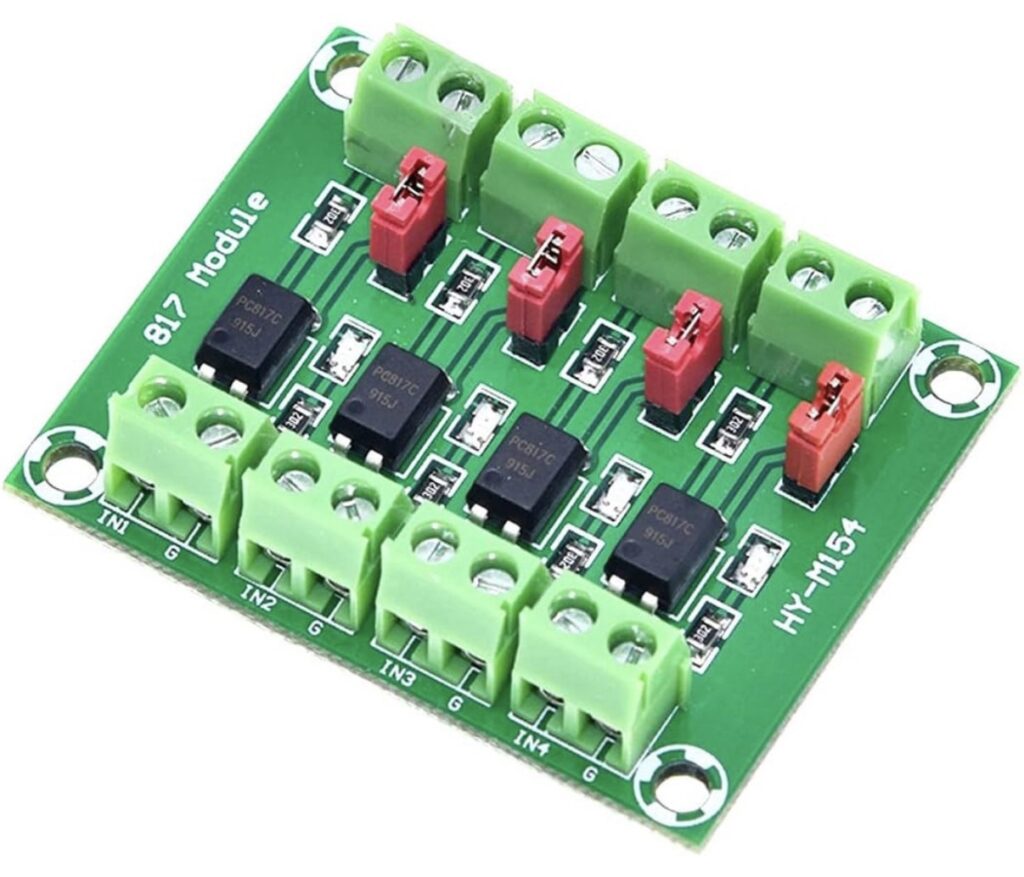
The Cerbo GX is a very flexible little computer that has lots of interface options – including 4 digital inputs. The problem is that these are floating 3.3v inputs that detect being connected to ground. I couldn’t just hook these up in the same way as the floathub. I bought a little 4 channel optoisolation board from amazon for under £5, and then 3d printed a box to put it in, with suitable cable glands and a clear cover to see its indicator LEDs through. I mounted that where the floathub had been, and powered the high level alarm from the floathub’s old maintained supply, now powering the 4G module that supports the Cerbo (with a suitable, and separate fuse, of course). It was then just a case of hooking the board’s output to the Cerbo – so I made a little cable loom up and ran it the 50cm to the Cerbo.
That got the electrical bit sorted out and, once configured, the device state was available in the Cerbo. The problem was that this information went nowhere useful. The excellent Victron VRM remote logging environment didn’t really do much by the way of sensible tracking – it could tell me the total runtime for the pump, since installed, but not tell me how long it had run that day, nor if it had been running continuously for a period – which practically are the sorts of things I care about.
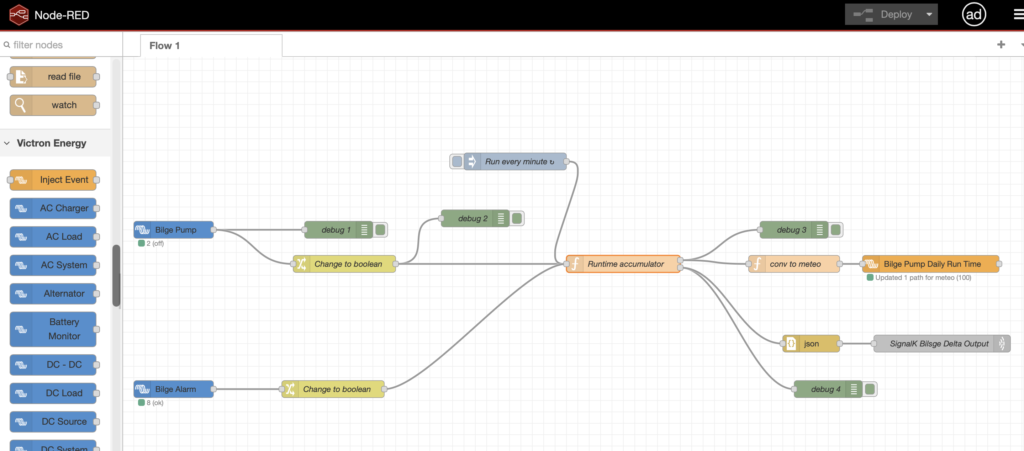
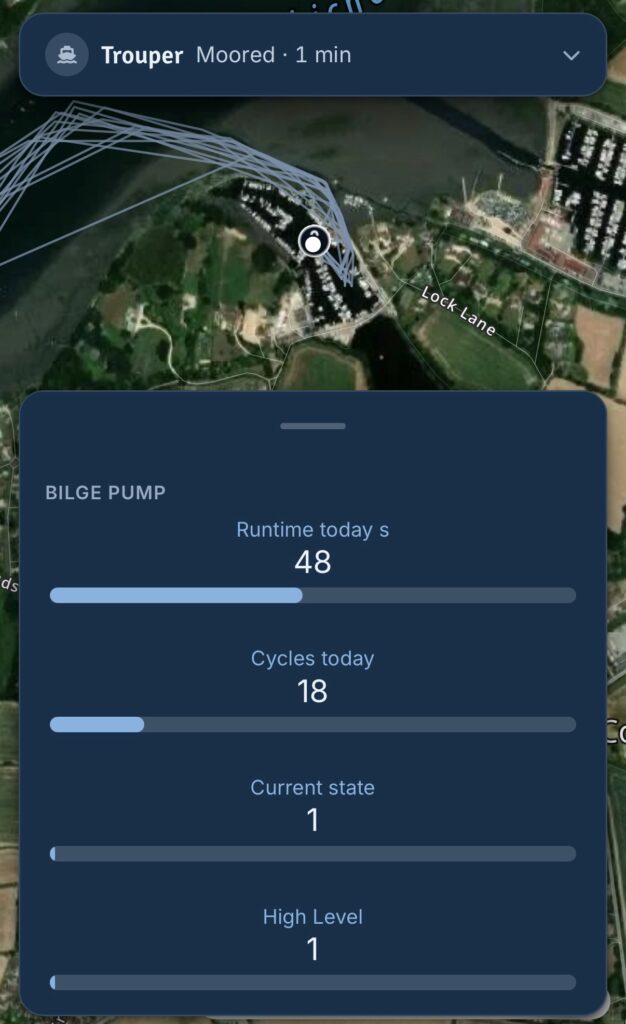
The Cerbo will also run Node-Red which is a low code workflow automation tool (and rather neat). Using this, and with a bit of AI help, I was able to create a flow that posts back the daily run time and cycle count to SignalK, where is available for reporting in Saillogger, and could even be pushed back on to the boat’s instrument system when that is running. As you can see below I’ve not quite (yet) got the presentation of the current state of the pump or alarm quite right.
I am also able to return the results into Victron’s VRM remote monitoring and logging database. Sadly that’s not quite so clean as the VRM environment doesn’t have a bilge pump object, nor does it have a configurable object. Currently I’m reporting the daily pump cycles back as a temperature in a ‘Meteo’ object. It works perfectly well but until you know better it looks like the temperature is getting up to 60C by midnight when it crashed to zero before building steadily back up the over the following day. As weather it makes little sense; but as daily pump run time in seconds it makes much more!
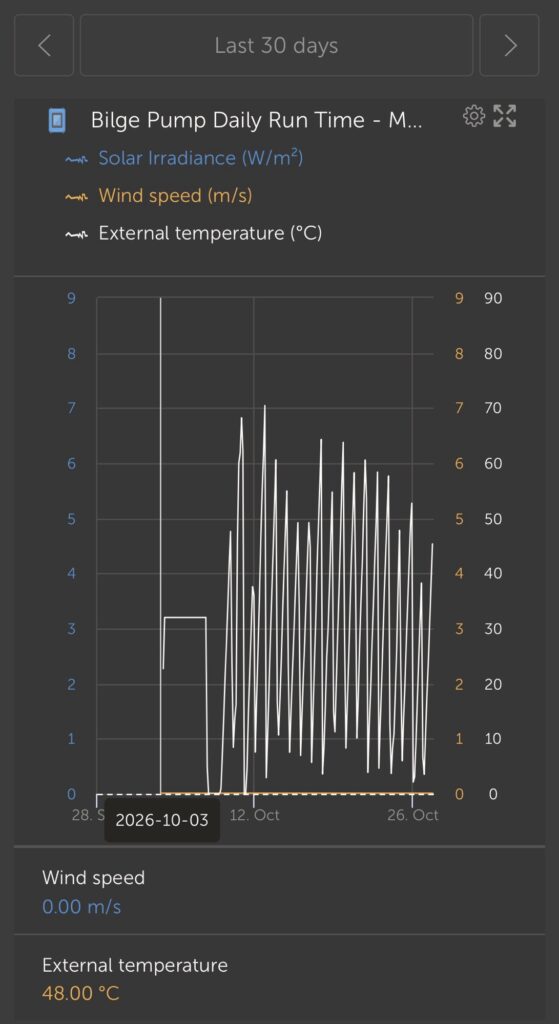
I should add, in Trouper’s defence, that she doesn’t leak. There are two causes of the pump cycling: a very slow leak from the freshwater manifold, and the long pipe run with a slightly leaky non-return valve from the centrifugal bilge pump. When the pump stops running there are several meters worth of full pipe uphill from the pump that slowly leak back. Trouper has a lovely bilge well that has a small area (perhaps 40cmx15cm) which means a small volume of water quite quickly causes a significant level change, tripping the pump.
One of the future projects is to add a low volume diaphragm pump on a separate pipe run that would have the pump near the top of the rise and keep the well properly dry.