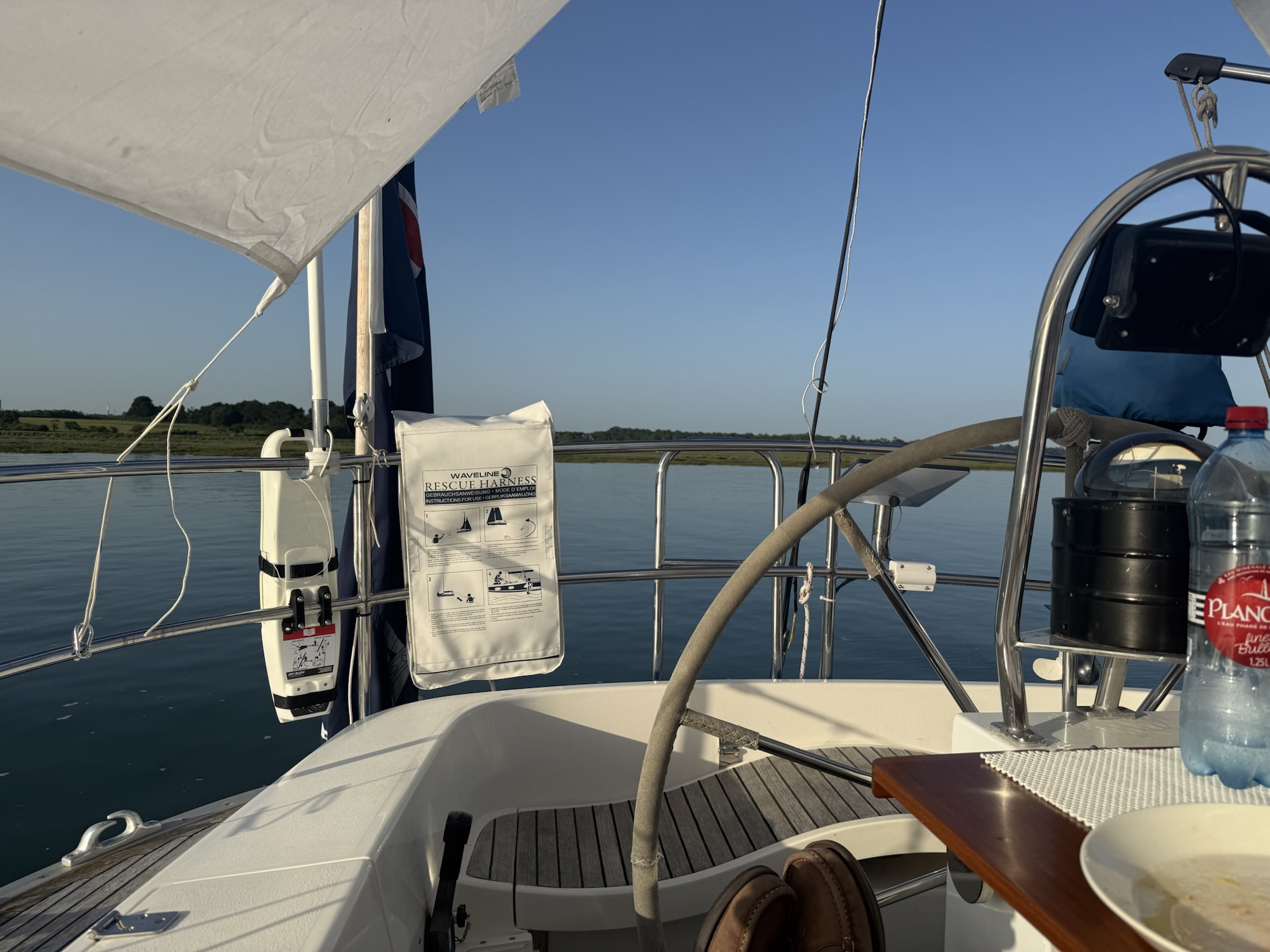
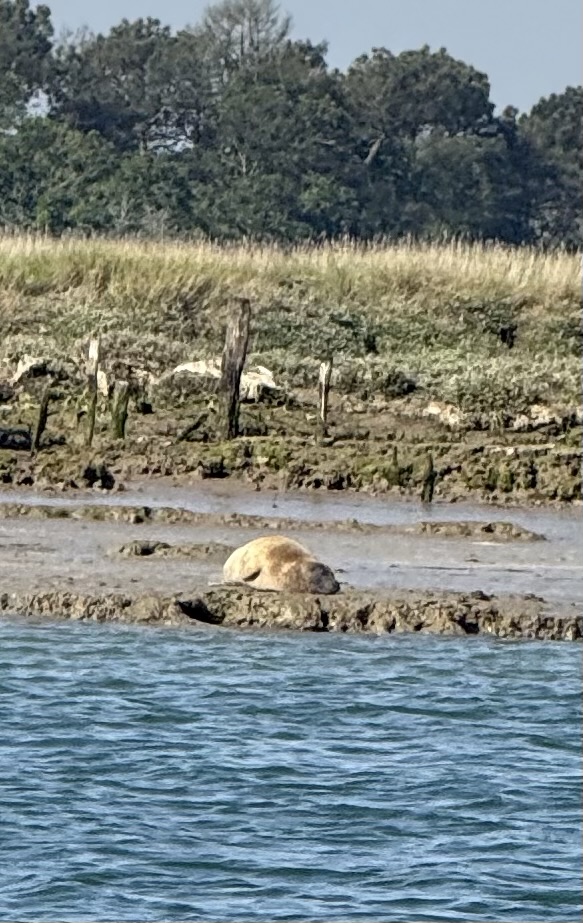
We left Poole on Monday afternoon and headed for Lymington, where we arrived in time for some excellent fish and chips. We stayed in the Yacht Haven, rather than the Berthon, as they had room. My father used to keep a boat here in the late 90s that I used to sail regularly. The marina has expanded somewhat since then and is now the home to a lot of charter power boats as well as the local sailing boats. The size of the boats, especially the powerboats is surprising, especially after the French coast where we were on the big side, and big powerboats were very scarce. Not so here…
After a day in the marina (avoiding the 25kts blowing in the western Solent), and some grocery shopping, we made our way across to Yarmouth for a night, and dinner at the Beach Hut.
The plan had been to anchor in Colwell Bay, which is opposite Hurst spit on at the western end of the Island, just before the Needles. the restaurant runs a tender service and will collect you from your boat and deliver you ashore to your table. We’d been texted the day before our booking announcing that in light of the weather forecast they’d not be running the tender service, but would collect us from Yarmouth using their minibus or landrover. This was no surprise – in the forecast weather there was no way I was going to anchor in Colwell Bay, let alone spend a night there after a nice dinner.
The Hut, Colwell Bay
The meal was lovely but twice the price of our Michelin starred meal in France, and whilst well prepared Kathryn thought that her fish was not as fresh as she’d become used to. It was, however, a lovely experience and a nice closing chapter to our trip.
We spent another day, Thursday, in Yarmouth to avoid more weather – a steady 38kts in the western Solent at one point, and made a very quick passage back to Birdham in 14-20kts on Friday. We arrived with just enough water to get to the lock and were on our berth by early afternoon. We did a quick tidy, grabbed the essentials and took the train back to our London flat, where we had a take away from our local, and excellent, Chinese, the River View.
Saturday saw us drive back down to the boat so we could load up with all the stuff to come off the boat and give her a proper clean before heading back to London on Sunday morning. We’d meant to have lunch at Itchenor sailing club with a friend from the club, but due to an ambiguous message exchange we thought he’d had to cancel and headed home. He’d meant that he couldn’t have lunch but would meet us for a drink… so we had a FaceTime chat once we were all back at our homes. He’s just had a hip replaced so I feel a bit guilty about having made him walk to the club and back. Nonetheless he’s invited me to apply to become a member of the Royal Cruising Club, which is a great honour. I may not make it through the selection process, but I’m rather pleased.
We left Treguier at about 0930 on Friday and, once clear of the river (and all its off-lying rocks), set a course for the Cap de la Hague, the South Western tip of the Cotenin peninsular. The straight line track takes you a bit close to some rocks half way to Guernsey and then straight through the Big Russel channel between Guernsey and Sark. On the way you get a good sight of pretty much all the other Channel Islands. We arrived in the Big Russell as the tide turned in our favour and started to push us towards the gap between Alderney and the mainland, known as the Alderney race.
Tides are effectively a collar of water drawn out from the planet by the gravitational pull of the sun. The collar goes round the world and the planet rotates once a day resulting in two tides a day where there is open water. Every two weeks there are larger tides (springs) when the moon is in line with the sun and its gravitational pull contributes, and in the intervening weeks the moon’s contribution drops to a minimum when the moon’s pull is at right angles to the sun’s (neaps) before increasing again until it is in line once more. The magnitude of tides is further effected by the earth’s elliptical orbit around the sun – when we are closer to the sun (the equinoxes) the gravitational effect is greater, and the tides bigger, resulting in higher high tides, and lower low tides.
We’d had to wait in Perros Guirac because the neap tide had not been high enough to reach the level of the water in the harbour held behind the sill. The following day when it did open there was only 30 minutes of open time predicted, and when the sill did open there was actually a 30mm or so difference in height of water, resulting in a huge inrush of water as boats were manoeuvring to hold position in the queue to leave. I’d seen what was happening and tucked out of the way with a couple of others, but there were a couple of collisions, one of which sounded quite substantial, from boats being swept around in ways their skippers clearly hadn’t expected.
As the collar of water, that creates the rising tide, approaches the French coast heading east, the opening for it to pass through to get to the east narrows progressively, and then it hits the Cotenin peninsular and has to all work north to get around the top and on towards Dover. This creates the Alderney race where currents of 10 knots have been recorded.
Tidal streams in the Channel Islands
I’d timed our passage so that we’d ride the tide north through the race and maximise the tidal contribution, but that meant that we’d not get to Cherbourg till about midnight. I was quite pleased that aside from some collision avoidance course changes we didn’t change course from the entrance to the Treguier river till the Cap de la Hague – some 70nm. Our ground track describes a curved track as our passage over the ground is affected by the tide sweeping us one way and then the other. The shortest distance for us is the straight line, through the water, so there’s some satisfaction to be had from getting your sums and judgements right and not to having adjust your course.
Our ground track to Cherbourg
In Treguier I’d been a but puzzled at the large number of near identical aluminium exploration yachts, all in the 45-55′ range. Looking a bit more closely they were all made by Boreal, which turn out to be made in Treguier. They look like really tough go anywhere boats of a sort I find really quite attractive – lifting keels, unpainted aluminium hull and big deck houses providing a lot of protection to the cockpit, and a great view out from inside. Very different to Trouper, but would enable a very different kind of exploration.
We got to Cherbourg and were tied up for about 1130, having made better time that we’d expected. We we both tired and had a quick shower on board and went to bed. On Saturday morning we got up, I filled Trouper up with water, and did some nav prep whilst Kathryn made a quick sortie to the boulangerie for bread and patisserie. We then settled up in the marina and joined the queue for having your passport stamped by the PAF. They turned up bang on time at 1030, and we were clear by 1035 and back to the boat which we then took to the fuelling berth and filled up with diesel (there was little wind in the forecast) and were away. It was about 1130 by the time we got out of the harbour, about an hour or two out of Cherbourg the wind filled in and we got 3 or 4 hours under sail before boat speeds started to drop and we needed to motor once more.
Our track from Cherbourg to Poole, showing the effect of the tide.
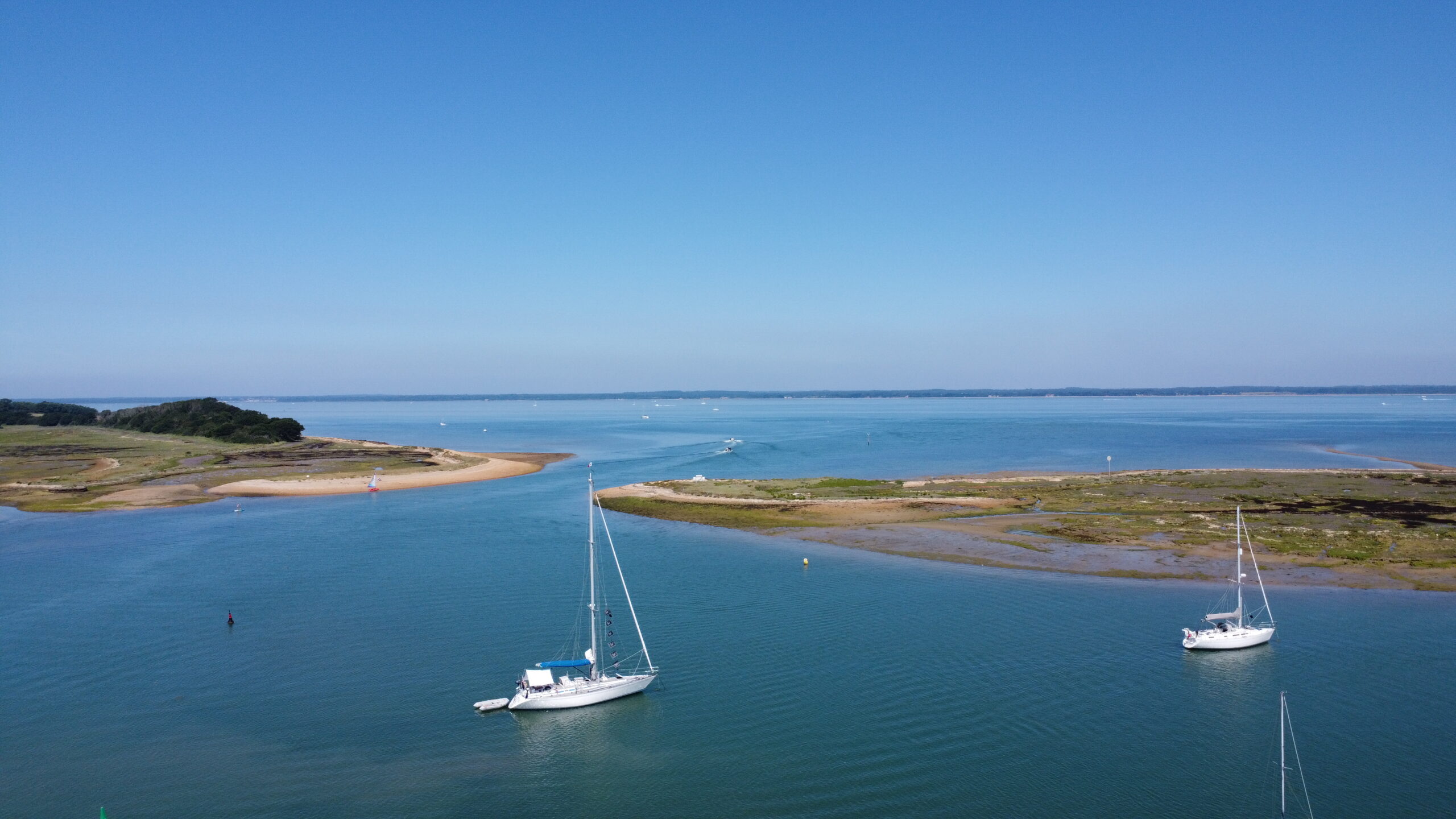
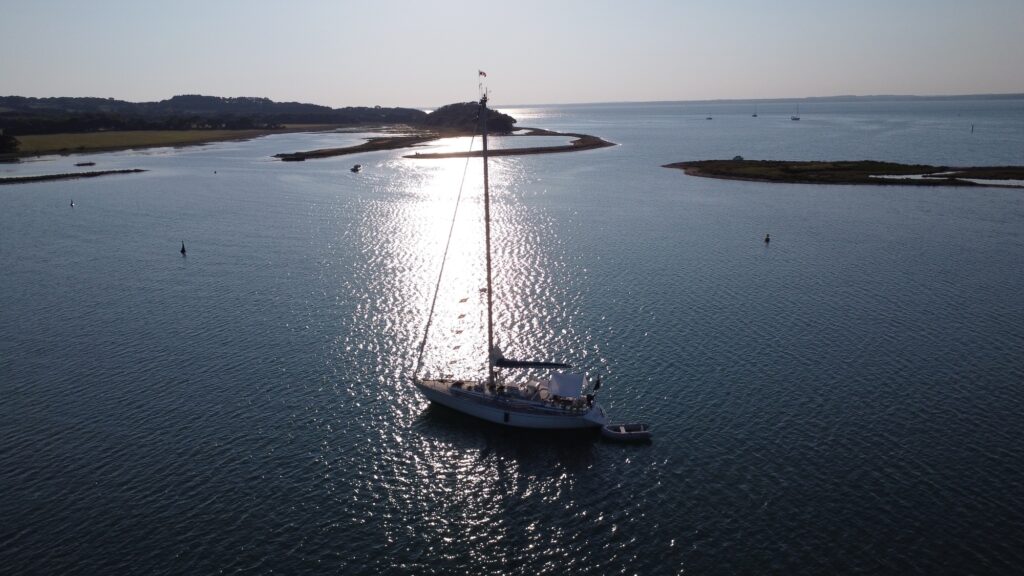
We made Poole harbour entrance with the rising tide as I’d planned and had enough water to safely get over the shallow patch off Brownsea Island and into South Deep, which is a favourite anchorage of mine. We met some good friends sailing another Swan who’d anchored there on their way from Salcombe back to the Solent. We anchored nearby and they came over by tender with a bottle of rum that they’d started earlier. A couple of very pleasant hours passed and the rum was dispatched and some of Trouper’s gin stocks were also depleted. They left Poole in the morning heading home and we took the rising tide round the corner into my favourite corner of South Deep. I blew up the SUPs and we spent another night there and left on Monday afternoon, following more SUPing, heading for the Solent.
South Deep looking to the South East.South Deep, looking to the North with Green, Furzey and Brownsea Islands.Trouper in South Deep.
Sadly my man in Lymington got back to be on the pilot remote control and said that whilst they’d have a look it wasn’t really their thing. They’ve given me the details of a guy in Croatia, so I’ll try him. But it’s got me thinking a bit about how to keep the boat’s instruments and pilot working long into the future without having to engage in a very expensive wholesale replacement.
The problem is one of history, and arguably corporate ownership. B&G are a venerable British marine electronics firms who produced the first electronic yacht instruments, starting in the 1950s. One of the best histories of marine electronics I’ve read is here, written by Nick White, the author of the truly awesome Expedition Navigation package (my only gripe with expedition is that it forces me to own a Windows PC – I’ve owned Macs since the ’80s).
B&G produced the first modern network style system and at some point in the 80s or early 90’s adopted a CAN bus technology that enables multiple devices to exchange data across a single network cable run around the boat, which they called Fastnet. It was a closed proprietary solution which allowed you to add whatever (B&G) elements you needed and have them all interoperate and display any of the data at any of the displays. In its day it was revolutionary. The modern NMEA2000 (N2K) Industry standard communications system is actually also a CAN implementation with a different messaging standard (which is irritatingly a closed standard owned by an industry body, rather than being open and public – though extensively reverse engineered these days). N2K achieves the same interoperability but across manufacturers allowing you to mix and match equipment, at least to some degree.
Trouper’s H2000 system uses this old B&G technology to connect its three processing units to 12 displays, and five fundamental measurement transducers. The fundamental measurements are depth, speed through the water, rudder angle, wind speed and direction, heading, trim, heel (and associated accelerations). The main processor combines wind and boat speed data to produce a calibrated and corrected set of both true and apparent wind values (the difference between the wind you’d feel stationary in the water, and the wind you feel as you move over the water), together with a calibrated depth (ours is set to report depth under the keel – some hold near religious views that this should be set to depth of water). The performance processor computes the boat’s performance data based upon an uploaded model of the boat’s performance (effectively the expected boat speed for different wind strengths and angles) known as the boat’s ‘polars’ to allow you to monitor your performance. It makes sail trim much easier to set as the system removes the effect of every gust and shift, so you can see if a trim change was effective. The performance processor also provides a serial comms interface to a computer (and Expedition in my case) that allows the computer to add data to the network as well as read its contents. The processor and also provides an NMEA0183 Industry standard serial interface for connecting a GPS. Finally the autopilot controller connects the heading, orientation, and ruder sensors to the network but also controls a motor unit that can move the rudder. It uses some quite clever algorithms keep the boat’s course straight – using acceleration data to create corrective inputs before the boat’s heading has changed, just as a good helmsman does. It will also sail to both true and apparent wind angles, using wind data from the network, which can be really helpful on longer passages under sail, or sailing upwind. The pilot was the first of the generation of systems to use this gyro data, and heavily used in the Open 60s of the late 90’s and early 2000s.
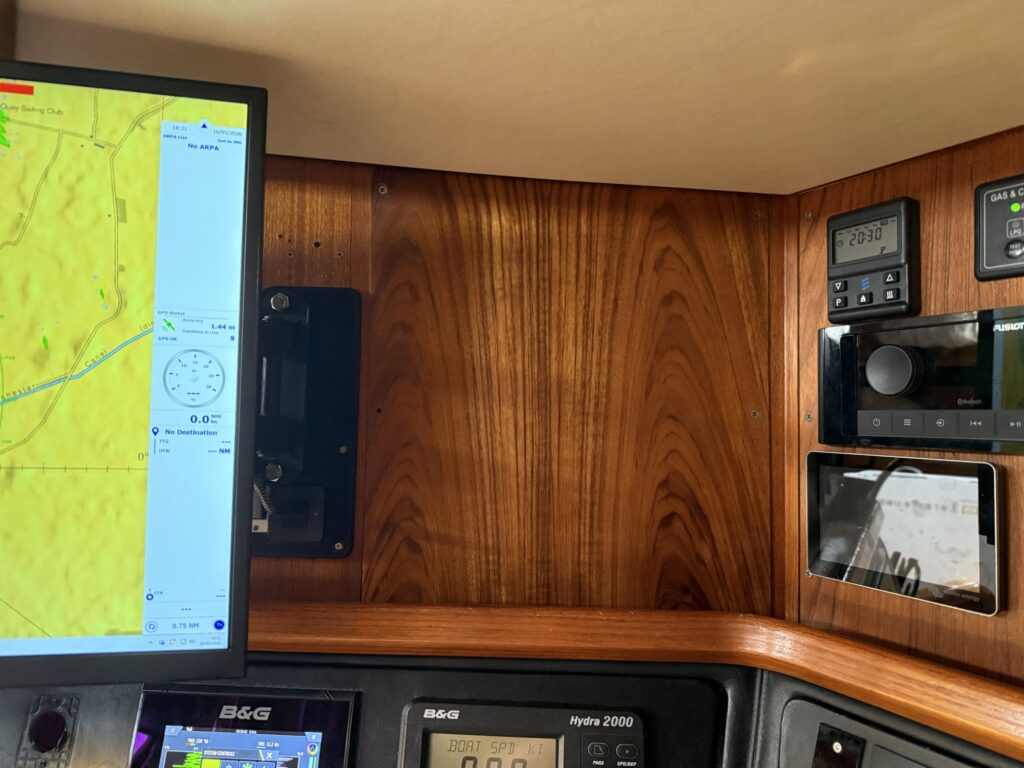
An H2000 FFD in Trouper’s Nav Station.
The remote control that has sort of died – given that it only works with the battery cover off, it’s not exactly useful on deck – was built by B&G at Ellen McArthur’s request, and she was often pictured clutching one when doing her single handed round the world record on her trimaran. It’s really handy – not only does it do pilot remote control functions but it allows you to set what data appears on the mast displays and alter system calibration and configuration settings.
The rather excellent B&G RemoteVision.
B&G ultimately ended up as part of Simrad, in turn part of Navico, which is part of Brunswick Corp, a US corporate behemoth. On the way it stepped away from the firm’s long history of incremental upgrade and backwards compatibility, and gave up on its UK manufacturing site. H3000 had replaced H2000 and everything interoperated happily using Fastnet and the displays fitted in the same holes in the boat’s deck. H5000 moved to the NMEA2000 (N2k) bus standard, supplemented by some ‘private’ proprietary messages for performance data, but dropped all interoperation with Fastnet devices and even eschewed direct connection of sensors to the processor. Even the visually similar displays required a new larger hole. If you wanted to move to H5000 you had to throw almost everything away and start again. Each of those dozen displays I mentioned is in the region of £1000.
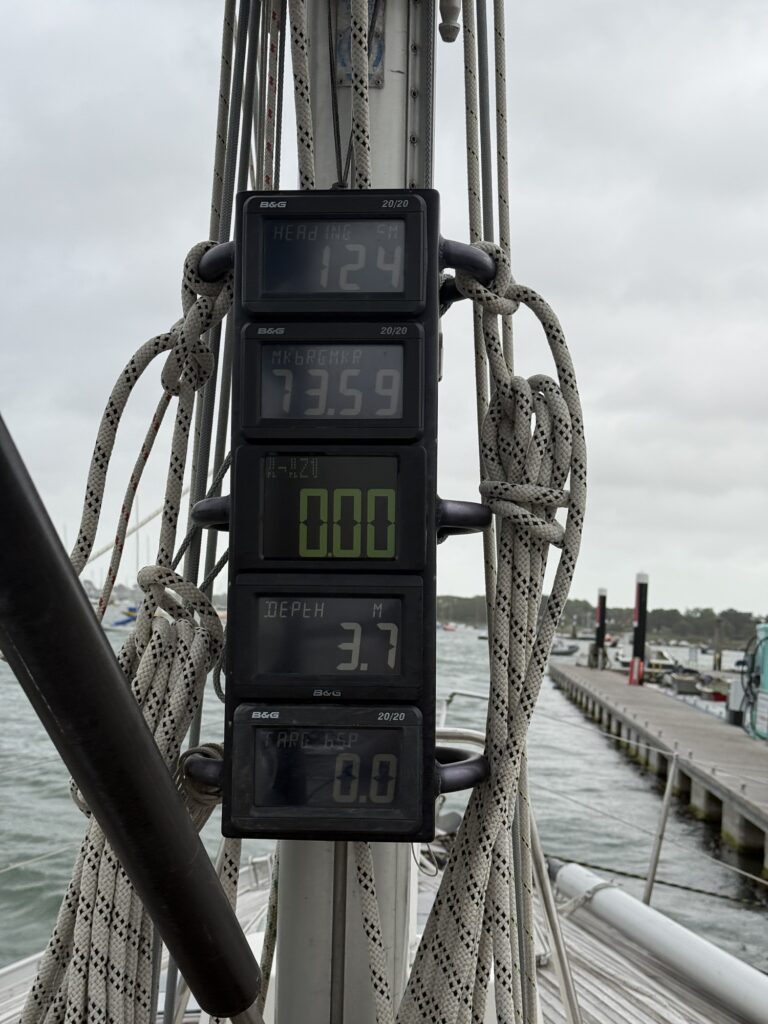
B&G 2020’s on Trouper’s mast, below the boom, facing aft.
I didn’t go that route and instead have bought up spares from ebay and now have a small stock of spare parts. Indeed everything except the pilot remote control… Many of B&G’s service team, who were based in Romsey in Hampshire, ended up at a new firm called Tinley Electronics in Lymington (my nice man). Tinley have grown into A&T Instruments and initially targeted mainly the superyacht market, but essentially people with large legacy B&G installations. They continue to repair B&G displays and processors though now also make their own displays and processor that support the Fastnet protocol and fit in the holes. Their stuff is not cheap, but it will allow me to keep Trouper’s instruments working.
After a while B&G realised the error of their ways and released the H5000 Fastnet interface. This is an irritating device as it is so close to being what everyone needs, but not quite, presumably in the (erroneous) belief that it might cannibalise sales of new kit). It is essentially a one way converter from Fastnet to N2k. You can now connect N2K displays, including the nice H5000 colour graphic display at Trouper’s helm (guess how I know that the cut out is different – I ended up buying a 3d printer to fix that problem…). The problem is it doesn’t translate all the data – none of the performance or autopilot data, for example – and it is one way. Except that hardware is not really one way as it allows changes to display brightness in both directions. So it could pass much more data from N2k to Fastnet. This would be ever so handy as it would be a clean way to integrate my modern N2K GPS with the Fastnet instruments, and it could allow you to connect N2K autopilot controllers, complete with remote controls. But it doesn’t.
H5000 GFD at Trouper’s binnacle (with 3d printed enclosure).
A&T’s public literature is a little opaque about quite how much translation their processor does between N2K and Fastnet. It supports both but I’m guessing that given that they’ve reverse engineered and reimplemented B&G’s work there will be agreements in place, or at least a little caution, about what they say in public. As far as I’m aware it doesn’t translate pilot control messages, and at £7k ex VAT it would be a somewhat extreme fix to a broken remote even if it did.
Boats attract technologists and it should be no surprise that there is a large community of people building open source software solutions for sailing boats – from navigation applications through to autopilots and instrument systems. They have reimplemented N2k in software libraries that make it simple to use and implement on small hardware devices like Arduinos. There is a powerful Arduino with two CAN interfaces. There is some public documentation of the Fastnet protocol from a few people reverse engineering it. So I got to wondering: I’ve got all the bits to set up a test rig (all those spares), why not reimplement the Fastnet to N2k gateway with support for all the missing bits? It might be possible to get hold of some Fastnet documentation but if not reverse engineering it should be fairly doable, given what already exists. It won’t be a quick project, so I’ll get it touch with the guy in Croatia and see about sourcing a spare remote control. After I’d started drafting this a RemoteVision I’m trying to negotiate a sensible price for a spare on eBay. I’ll also have a conversation with B&G Support – if nothing else it will be worth checking that they aren’t willing to do a software update for the gateway…
We’d been planning to head towards St. Malo from Treguier with a stop in Saint-Quay-Portrieux, which I spent a night in some dozen years ago during Trouper’s first summer tour. That summer Kathryn and I had been beaten by the weather in our attempts to get to the Scillies but had had a glorious time exploring Falmouth harbour, and had gone out with my family from Fowey, and hove to off Gribbin Head to scatter my father’s ashes in a bit of water he loved sailing. He never saw Trouper – but I’m very confident he’d have approved. Anyway Kathryn and I had left Trouper in Falmouth and a week later I headed down with some work friends. Three of us took Trouper back up to Fowey where we had a day walking a bit of the Cornish coast (and my friends had a swim) before we were met by two more friends that evening. We left Fowey at about 9pm, having to pause on the way out for a firework display in the harbour to finish. We sailed straight to St-Quay-Portrieux before heading on to St Malo where one of the crew left us and another joined us, necessitating a day wandering around town and swimming off the beach, before we headed North to Guernsey, and then on to Portsmouth, and thence home.
Our plan had been to retrace some of those steps and have dinner at a lovely restaurant (a Michelin happy eater…) we found in a subsequent trip with other friends in St Malo, whilst getting our passports stamped there and heading home via the Channel Islands. However, looking at the weather forecasts over the last few days (and the Met Office’s excellent ‘Deep Dive’ YouTube videos that discuss the forecast and models in detail) we’ve had a bit of a rethink. Hurricane Erin rapidly grew into a category 5 storm over last weekend and as its remains track across the north Atlantic as a mid latitude low pressure system it is generating a fair bit if uncertainty about next week’s weather. If nothing else it is clear that it’s likely to deliver some significant swell into the western approaches an on into the channel next week.
Ventusky Display of Meteo France Significant Wave Height forecast for Tuesday evening.
We’ve decided to bank the current certainty and relatively calm sea state we have at the moment, so will stay here another night, but then leave for Cherbourg tomorrow (Friday), which will be a long day as we can’t leave very early if we are to catch the fair tide at Guernsey up to Cap del la Hague. We’ll probably get into Cherbourg marina by about 1 am French time. It would make much more navigational sense to go to Guernsey and head home from there, as I did that first year with Trouper, but now we need to visit a Port of Entry to get our passports stamped to leave the EU.
Last night the marina arranged for a local diver to pop round and have a look at Trouper’s propellor. We’d felt a little bit of unusual vibration, which following the weed on the prop the other day we wanted to check out. He was a lovely guy who put two huge (approx 80cm long) fins, mask, snorkel, and a weight belt on over his wetsuit and easily outpaced the quite substantial tide to have a good look. He was quite apologetic that he couldn’t see anything, though he could feel a little movement in the prop shaft. My guess is that the issue the other day has worn the cutlass bearing in the P bracket which supports the prop shaft at the prop. Renewing that is a job for the winter, but not a big deal. I’m pleased to know there’s nothing tangled down there before a long couple of day’s where we’re likely to be motor sailing.
Once in Cherbourg we can easily get the paperwork done, as the French border police visit the marina office a couple of times a day. We might head straight across on Saturday, once the passports are stamped, but that depends on the forecast. At the moment Sunday looks a fair bit less attractive with a headwind, and rougher sea state, though Saturday will be more motor-sailing with little breeze. But we’ll review that plans in Cherbourg, the forecasts are moving about a fair bit at the moment, and whilst we can have good certainty for 36h or so much further out is shifting about a bit.
We’ll probably head back to Poole, which we’ve not been to for some years, and offers an easy all states entrance. Studland bay might be an option on the way in but we’ll have to see how it looks. The current forecast has it looking very welcoming until the small hours of Sunday when 0.8m waves will start rolling in from the South East, leaving the beach as a lee shore, which would make it anything but a restful night.
Inevitably there is paperwork to complete for our UK entry, though the Borders agency introduced quite a good online system a couple of years ago. It has the odd niggle (why will it remember the passport details of anyone I’ve ever entered, but require me to input my contact details as skipper by hand each time?) but it’s actually quite simple to use. Once in Poole we can have an easy week heading back to Chichester. Perhaps a night or two in South Deep in Poole (a favourite of mine), if there’s room on an August Bank Holiday.
We spent a single night back in Roscoff, having arrived via the passage inshore of Ile de Batz. This was a recommendation from my friend Andy who had enjoyed my account of getting caught out on the outboarnd journey, having done exactly the same himself. With a decent rise of tide the passage is simple, but you don’t want to be plugging a foul tide, as it fair whistles through the gap. Once we’d got in I found a nice description of the passage in the pilot book. I’m pleased to report that that is exactly what we’d done, figuring it out from the charts.
Ile de Batz, and the inside passage
We headed on on Thursday morning for Perros-Guirac which we’d not been to before. It’s a lovely little town with a marina tucked behind a headland and with a newly installed automatically folding sill, to replace the old lock, that lets you into the inner harbour. The approach dries entirely. In the chart extract below the underlined numbers in the green patches are the height above the lowest tide that the land is, in meters with 10’s of centimetres in the subscript.
Perros-Giurec, and its approach
Friday was spent exploring ashore where we found an excellent butchers, supermarket and patisseries. I love that even the kerbstones are made from the local pink granite.
A place in which I could get comfortable (and fat)
Friday evening saw us eat a steak supper on board, and as I was wrestling with getting the VPN working (so we could stream Bookish to our little Samsung projector on board) Kathryn discovered that there was a free concert going on just across the street. We rather liked what we could hear so went to have a listen, and bough a couple of petite beers. The band were modern Breton folk, with a pair of pipers, as well as guitar and a couple of traditional percussion. I’m not sure that I ever thought I needed amplified bag pipes in my life, but they were rather good and there was a distinctly north African feel to aspects of their music. We didn’t enjoy the main act so much so returned to the now working VPN and Bookish (which was a Marina Hyde/Richard Osmand recommendation of their podcast).
Saturday, saw the wind blowing fairly firmly from the east. It’s hardly a gale but it would be hard work to go upwind in, and our next stop is around a headland with a lot of off-lying rocks that would need to be given a respectful distance in an brisk onshore breeze with a little bit of a sea running. Sunday looks no better, but Monday did. I went to the Capitanerie to pay for an extra couple of nights to discover that it will be three nights: there is not enough water at high tide on Monday to open the sill, so we’re stuck here. It’s very much a gilded cage though (see Patisserie above).
We do now have a bit of a timeline – we need to be back for the Saturday afternoon tide at Birdham in two weeks. Plenty of time, as we keep reminding ourselves: a whole summer holiday, but nonetheless we are now starting to plan to a timeline. The other constraint is needing to get to a French Port of Entry: there are a few options but the favourite option at the moment is Carteret on the Cotenin peninsular, and on to Alderney before crossing to Poole/Studland.
Sunday was lost to books (see bibiliography) and boat cleaning. On Monday we caught a bus to Lannion, and then another on to Citie de Telecom, and the museum set around one of the first satellite ground stations, built in 1961/2 for the original Telstar. It revieved the first TV satelite broadcast from the US. Telstar 1 (and 2) was a very small low powered microwave relay satellite that took in a revieved signal and rebroadcast it on a different frequency. It was on an elliptical orbit which meant it was only in sight for 25 minutes every 2.5 hours and was spinning to stabilise itself, meaning that it could not have directional antennas. The result was the very weak signal from a fast moving source, which necessitated a very large antenna to focus the signal of a receiver, and that antenna had to track the satellite with great precision, from horizon to horizon in 20 odd minutes.
Kathryn’s picture of the dome.
The resulting machinery was in use for 20 years or so, before it was retired and declared a national monument in the late 1980s. I’d love to know if the machinery still works – our French isn’t good enough to have established it on the tour. It does look as though it might. France Telecom have a number of other ground stations near there, many retired, but still maintain a large R&D facility. The dome is clearly visible from the sea, and we’d known about it as we’d spotted it on the outbound trip and looked it up. The dome is huge enclosing a large horn shaped receiver and tracking gear. In order not to have any physical dome support structure, that might interfere with the signal, they had built the dome out of a plasticised fabric, which is held in place by air pressure. Effectively a big balloon. During the tour they were at pains to demonstrate the airflow, and you could only leave or enter via air lock type arrangements – one neatly integrated into a rotating door. Until the pressure is equalised you physically cannot open the inward opening exit door.
Inside the dome, with the huge horn shaped antenna, and machinery.
It’s a rainy Tuesday at the moment, and our current plan is a head out at 1530, when the sill opens (only for 30mins today, due to the small tidal range) and head round to Treguier, where we’ll likely spend two nights.
As someone who has spent a lot of time teaching people to use powerboats safely it is interesting to see the French approach to risk management and safety. The UK has a sad history of accidents resulting in deaths and serious injury from using powerboats, especially RIBs. That’s resulted in an approach to managing them and ‘good practice’ standards that are far removed from what I see here. To be clear I see no evidence of the French approach being dangerous, and indeed I suspect that they don’t have our history of accidents, suggesting a higher standard of safety. But what I see would have many of my UK colleagues tutting: no kill cords in use, sponson riding, indeed driving the boats from the sponson and driving whilst standing, even with tiller steered boats. And yet the standard of boat handling is consistently very high with a casual and unconsciously competent displays of excellent boat control.
More generally I can’t help but notice that the French approach tends towards less physical infrastructure and more towards people being encouraged to be sensible. Walking on the wave screen wall at Trinite there was no railing either side – just and obvious edge. Walking around an old castle there was no fence to the drop into the dry moat, just a band of about a meter of larger pebbles to delineate where the safe footpath finished. I must confess I do like the approach of expecting a bit more from people, although I’d still favour the use of kill cords – once you’re used to them they really aren’t much of a pain and are a simple mitigation to a low probability, very high impact event (ie falling out and being mown down by your own boat and propellor).
When, in a former life, I did my professional training in Occupational Health and Safety we were taught a clear hierarchy of desirability of risk mitigations: safe place was far preferable to safe person. the thinking was that in a workplace you should not need specialist knowledge or equipment to stay safe. In a controlled environment that still seems to me to be the preferred solution: you provide effective dust or fume extraction, not respirators to anyone who enters the space. But I wonder if that culture has bled out from making factories and laboratories safer workplaces into the wider public assuming that their safety will be managed for them and that they don’t need to worry about it. That might be one of the reasons why the construction industry has long struggled with its safety record – construction sites are usually difficult to control fast changing environments.
There’s been a lot of research showing that risk perception can have an outsize impact on risky behaviours: across London railings have been taken down around pedestrian crossings, and pedestrian injuries have been reduced. Car drivers are slower and more cautious around exposed pedestrians, yet the old railings afforded little real protection to the pedestrians. I wonder if the French approach to boat handling and education is more effective. But then every town we’ve visited has had huge sailing schools taking all the local children out, so familiarity with the environment is deeply ingrained knowledge.
Cameret proved to be a nice little seaside holiday town that was having a Fete for the local lifeboat, complete with helicopter winching exercises off the quay a little after we arrived. The visitors berths a quite a walk out along the breakwater (no railings…) and the sanitary facilities are a bit basic. We elected to shower on board for the two nights we were there.
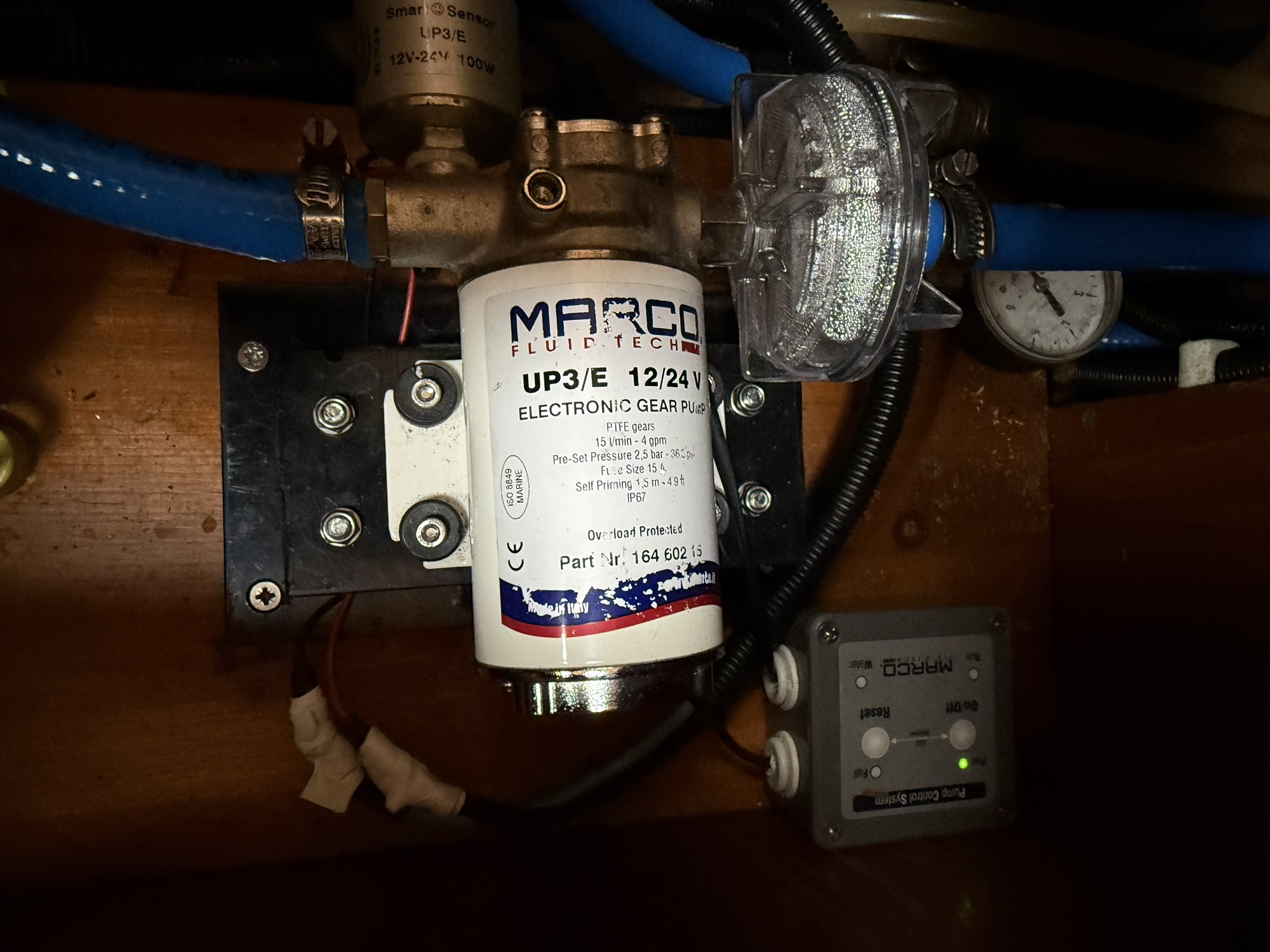
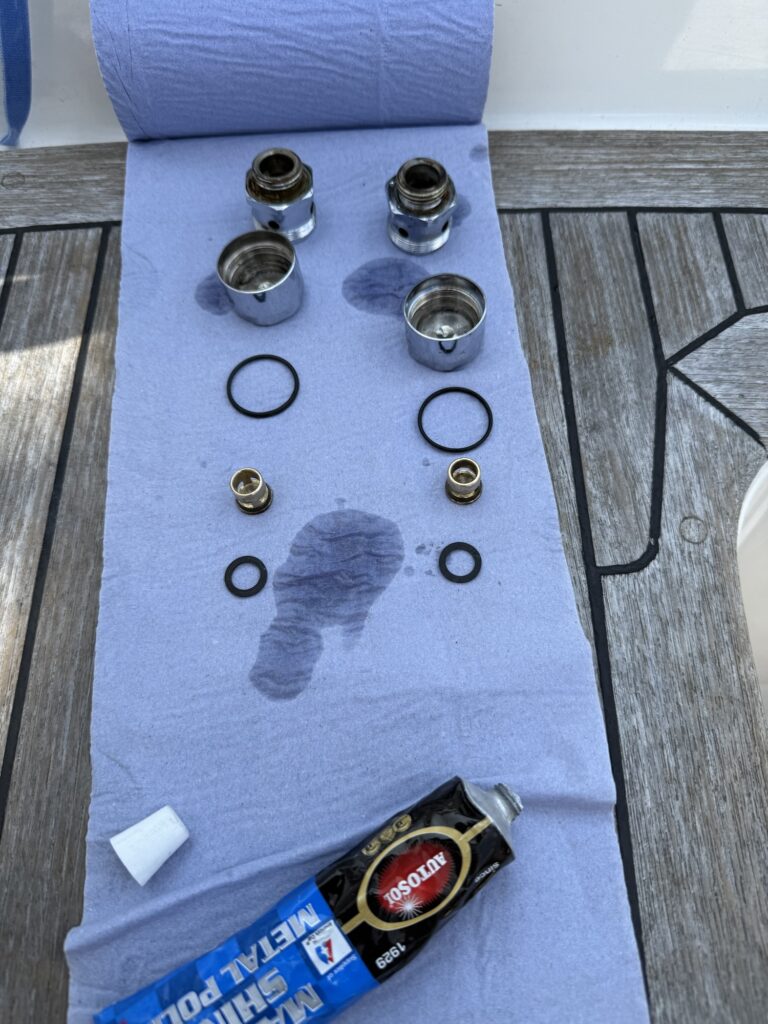
Whilst in the Morbihan we’d used the boat’s black water holding tank to capture toilet waste and then pumped out in Port Du Crouesty. The boat was built with a holding tank for the aft head, and you can choose to flush to toilet into the tank or over the side. When built the only way to discharge the tank was to pump it out (by hand) back through the toilet’s normal discharge over the side. For our trip to Holland some ten years ago I’d also fitted a deck pump out fitting allowing the tank’s contents to be pumped ashore. That turned into a bit of a mission. I couldn’t find a pump out deck fitting that visually matched the existing deck fittings for water and fuel. Finally I contacted Nautor, the makers of Swans, in Finland and they explained that the fittings on our boat were custom made to their specification. They offered to have a pump out fitting made to match. It cost about 500Euros in the end, but I felt it was worth it to keep the boat (and Swans of this vintage are sort of iconic) looking right. Anyway in the end it all seemed a little excessive as we never found anywhere on the Dutch canals with a working pump out station, despite all the warnings before we got there that it was mandatory to pump out ashore. I’ve never regretted having the option but had never actually used it before. We connected it up and pushed the button and could see liquid being extracted through the window in the hose. It took a good ten minutes to suck the 120l tank dry. Carteret saw the tank put back into service, though I pumped it out by hand once suitably offshore.
Bespoke Pump out Fitting from Nautor – it weighs about 4kg!
We had two nice dinners ashore in Carteret, and a much needed trip to their excellent SuperU to stock up before we left this morning to head North and up through the Chenal Du Four. After filling up with fuel (215l, the first since Brest) we sailed for a bit to start with before the wind died away. It was grey all day, though not at all cold.
Pte de Saint-Mathieu at the Southern entrance to the Chenal du Four.
By later afternoon we were working out way into Aber Benoit where we picked up a visitor mooring, put the kettle on and tidied up. The harbour master popped by, took 18Euros for the night and offered to take any rubbish ashore if we needed, which was welcome, though not needed.
Port Tudy drove home what I’d been noticing for some time: whilst Trouper is perhaps a little larger than average around the Solent but at 43′, she’s hardly large, and 50’+ boats are common; here we are definitely heading for outsize. When we had dinner with our friend’s brother in law, a lifelong sailor, the other week he’d suggested that there was no need for a boat larger than 10m (33’ish) south of Brest. Most ‘big’ cruising boats here are 30′-35′ and moorings are much more limited for boats over 12m (40′). Boats in the 20-30′ range are still common. This feels much more like my childhood sailing in the Solent in the 70s and 80s. At some point in the 90s boats started to get really big.
The last of my families ‘big’ cruising boats was bought in 1980, and sold in 1987 when I went to University and my father lost his crew, and was 26′. A family of four on board was snug. We had a single hand pump for a fresh water tap and no hot water beyond that the that kettle would supply. In those days a 32′ boat was a big boat and 40’ers were scarce. Given that Trouper was built in 1989 it’s clear that there were bigger boats around, but at 43′ Trouper was then far from the smallest boat in Swan’s range, and Swan were then, and still are, pretty much the definition the premium end of sailing boat construction. Swan have in the last couple of years introduced a new small boat into their cruising range at 48′ after years of not making anything much smaller than 54′.
The prevalence of smaller boats brings the costs down considerably and makes access to boating much more affordable. It is very noticeable that in my childhood boat ownership was affordable for people of reasonable means – at least two of my secondary school teachers had boats – but I can’t imagine a modern teacher being able to afford a boat in the UK these days. I suspect a combination of the early skill development and exposure to sailing, a national obsession with fishing, and more affordable boats makes mucking about in boats much less of a privileged elite’s hobby in France.
We left Port Tudy a little after 9 – when we had to go in order to let someone on the inside of the raft out. The timing suited us as I was very keen to have time in the middle of the day to have a good look at the Glenan. These islands are famous because of the sailing school set up there post war. It’s original aim was to rehabilitate former resistance fighters but it has grown and become the centre of a huge sail training operation. The Glenan’s teaching philosophy is set out in its sailing manual, that was available in the 80s and 90s in English translation, which is where I was first exposed to it by my father, who I think got his copy in the now sadly defunct nautical bookshop at Bursledon on the Hamble river. The approach is what I’d now know to describe as experiential: starting in dinghies and slowly supplying equipment such as masts, sails, centre boards, boom and ultimately rudder so that students developed a deep seated understanding of the forces that acted on a boat and the controls available. The RYA’s ‘five essentials’ in the dinghy scheme tries to deliver the equivalent knowledge. I suspect the Glenan’s approach could be resource and time intensive, but I’m sure it pays dividends – and I’ve seen plenty of sailing school groups using elements of it whilst we’ve been here.
The Glenan
We arrived in the Glenan late morning and initially anchored in about 3m of water to the west of Penfret. We had lunch and I fitted the outboard on the tender. I almost never tow the tender with an engine on, and take the engine off every night after a memorable childhood experience of waking on mid river piles at Bucklers Hard (now sadly pontoons joined to the main marina) to discover that the rear half of the Avon dinghy had deflated lowering the 2hp Yamaha 2 stroke outboard (a great little machine) into the water overnight. A fresh water flush and drying out and it was actually fine.
I took the tender up to Saint Nicholas, dodging fleet after fleet of sailing school dinghies – which felt odd given that we were are 10 miles offshore. It was a bit bumpy upwind against a small chop and with the boat on the plane at about 12-15 kts I had to sit on the floor, and play the throttle to stay secure and keep everything balanced. I was quite enjoying myself. Once in ‘La Chambre’ the moorings on the south side of the island the little chop, that was a little uncomfortable where we were anchored, eased up and, to my surprise for a Friday in August, there were many free moorings. So I motored the mile and a half back to Trouper and we lifted the hook and towed the dinghy (the first time ever with the engine on, I think!) up to the moorings. Once secure we took the tender ashore onto Saint Nicholas for a look around.
Once we’d clambered up from the side of the rough concrete jetty where we’d tied up with some other dinghies the first shock was the crowds. We got ashore as the queues started to form for the last couple of tourist boats back to the mainland, and there were hundreds of people queuing clearly keen not to miss the last ride home. Under foot it was deep soft sand which turned into wooden walkways to protect the delicate fauna once we got clear of the few buildings on the island. There were still lots of people around. After a lap of the island we retreated to the boat, had dinner and watched some of the Netflix documentary about the Tour de France – it seemed fitting.
Queue for the Verdette home.Bay on the North side with wing foil schoolWalkway to beach over dunesVerdettes queuing with dinghy fleet in the distance.
The following morning (Saturday) we picked up the anchor and headed to the east and then north of St Nicholas to regain the deep water. As we did it one of the big verdettes steamed past us heading straight for a row of rocks, only to confidently motor through a 30m wide gap at a steady 10kts. We stuck to a bigger gap.
Once clear we made our way across Benodet bay to arrive at Benodet with the start of the rise of the tide to explore the Odet river, which all the pilot books call out as very pretty indeed. Once we’d got under the 30m air draft bridge (our rig is a bit over 20m with the instruments and antennas on the top), we headed on up the river. There’d been no wind at all so we’d motored all the way, and in the process our nice big alternator has taken the battery from 65%, to over 85% at the entrance to the river. By the end of the afternoon the batteries were at 100% once more. We worked up the river on the tide and the wooded banks steepened and the river narrowed. We stopped for a late lunch on some visitors moorings but we were too big to stay there overnight and we carried on upriver to explore a little side creek, which the pilots reported as lovely spot for the night. It was gorgeous but with two other boats in there and not a lot of depth there just wasn’t room for us, so we headed back out to the main river.
Anse de St Cadou – our possible anchorage
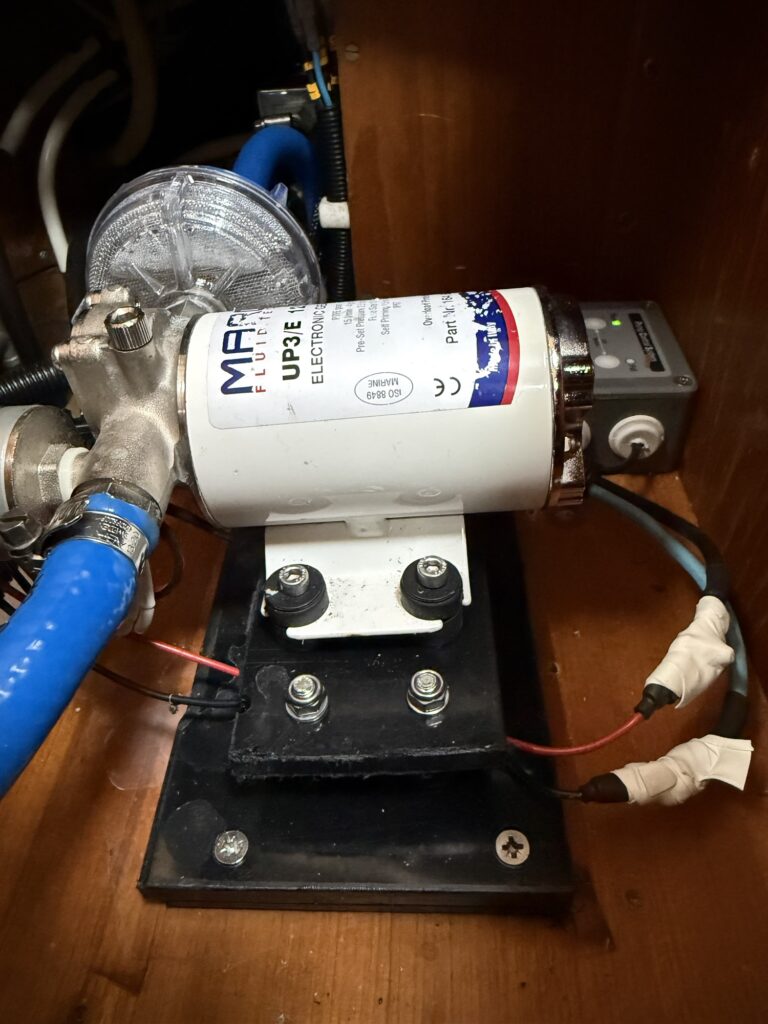
We tried to anchor in the river nearby a couple of times but the bottom was bare rock scoured clean by the tide – there is a huge flow in the river – and we couldn’t get the anchor to bite. The muddier spots were either too shallow or occupied. So we headed down river as the tide started to ease and found a spot to anchor for the night just before the bridge. I deflated the tender and stowed it back in the forepeak, which is rather full of kit and toys. As an aside when I came to use the tender in Etel I checked the pressure of the tubes and floor with the new electric pump, having inflated them by foot pump and it very quickly got them up to the proper pressure. I’ve high hopes for the new pump.
We left at about 0715 on Sunday morning to head out of Benodet bay, past Pointe de Penmarc’h and out towards the Raz du Seine. We were motor sailing in very little breeze and what little there was was on our nose once we turned north at Pointe de Penmarc’h.
Our passage plan for Sunday
Most of the way to the Raz we saw evidence of pod of dolphins hunting: lots of dorsal fins breaking the water and turning rapidly with frenzied fish jumping to the delight of packs of gulls. We also had them come and join us repeatedly, and I finally got some photos and a video – we’ve seen them at some point most days this trip.
Pair of Common Dolphins alongsideMore dolphins at the bowAnd some more dolphins..And again…
We arrived, as planned at the Raz as the tide turned in our favour, but even then it was quite bumpy for a couple of miles as the tide whistles between the island and the headland, with a ridge of rocks extending out underwater.
Trouper doing her thing when faced by an unruly wave in the Raz.The Pointe du Raz
After that it was a relatively simple 12 nm or so north and round a headland into Cameret, just before the entrance to the Rade de Brest. We’d picked up a small vibration that you could feel through the boat and was very noticeable on the wheel. We tried going astern a couple of times and the vibration intensified. Clearly there was something on the prop. I was bracing myself to get a diver or a boat lift when we got in, and trying to justify it to myself as at least we’d get the hull cleaned too (reducing drag). Approaching the marina once the sails were down I tried going astern one more time, mainly to check that I’d got manoeuvring control and after a moment of more acute vibration the vibration stopped and Kathryn reported seeing some seaweed appearing in our wash. After that all seemed well, so hopefully that problem is resolved.
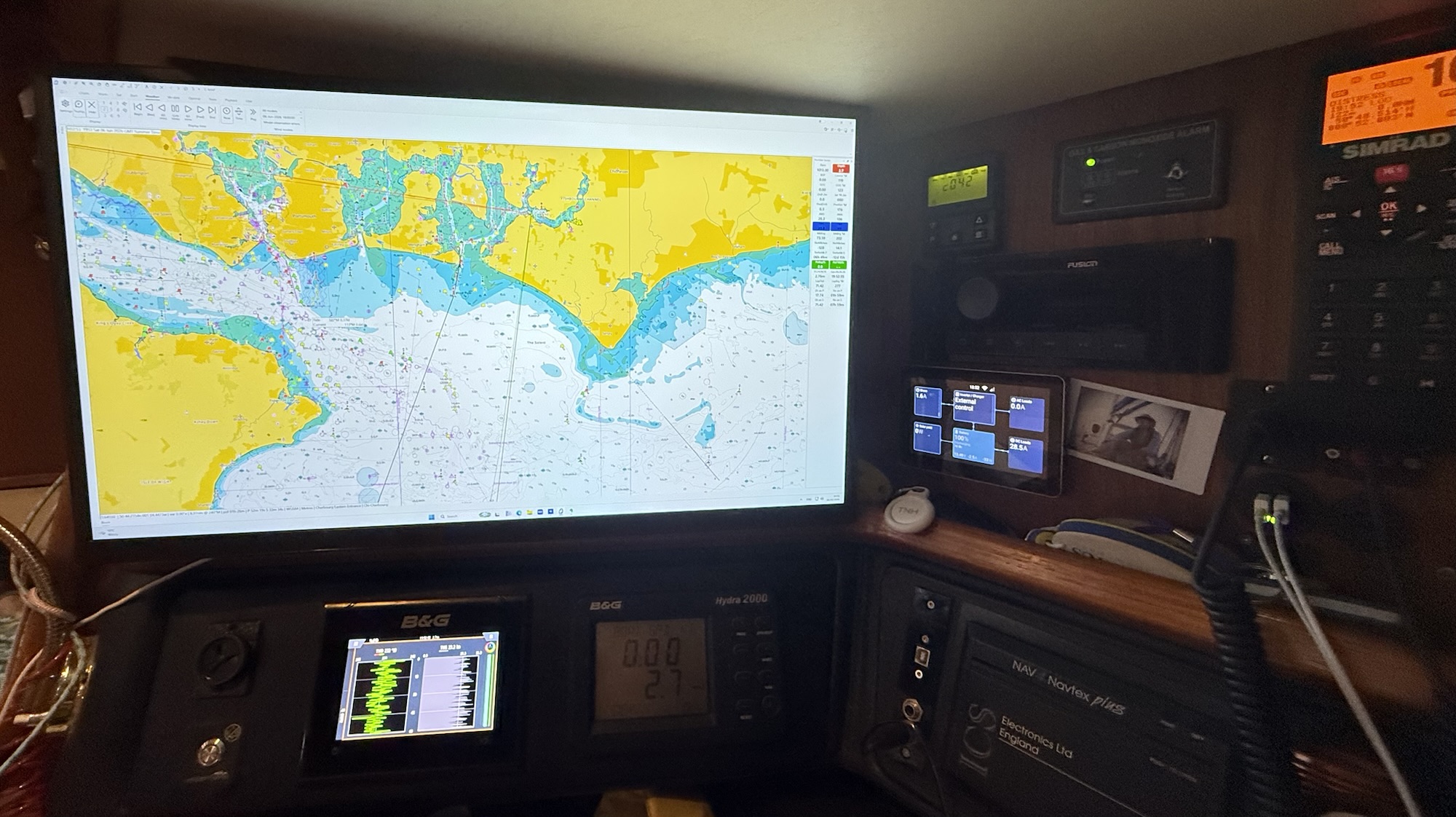
Sadly the remote control for the autopilot also stopped working during the afternoon: it turns on works when the battery cover is off, but not when it is on and the device is thus waterproof. Hardly ideal. I’ll have to see if I can get it repaired as it’s 20 years old and not readily replaceable – modern stuff works to a different set of standards and replacing the autopilot could lead you into replacing the whole instrument system as the current pilot is tightly integrated into the B&G H2000 Hercules processor. And the current displays won’t work with new processors so you could quite easily end up with a £20k bill to replace all of our, admittedly old, very high end instruments. However there is a firm in Lymington who I’m pretty sure will be able to help.
We left Trinité-Sur-Mer on Tuesday heading for Etel. Etel is to the North of the Quiberon peninsular and this marks the start of our progress back towards home and the end of our trip. But that’s not till the start of September so there’s no time pressure and we plan to meander our way back.
Etel is interesting as the entrance to the river has a shifting bar and there is a huge tidal flow that can create difficult conditions. The deep water passage moves around too much to be marked in the conventional way, with buoys, so they have a novel system with a semaphore tower. The tower is manned when there is enough water in the channel and talks you in by radio, though they retain the old pointer system for boats without radios.
Semaphore Tower at Etel, note the big red pointer on the rear tower.
The guy was very friendly and helpful, apologising that his English wasn’t great. It was better than my French – using a radio in a foreign language adds a whole new set of specialist vocabulary, and is a bit intimidating.
We had a lovely couple of days in Etel, with a nice meal out, where Kathryn had her first ‘fruits der mer’ of the trip. We took the tender across the harbour to the beach on the other side of the entrance on the second afternoon (whilst the morning’s laundry dried), and Kathryn had a swim in the rather chilly water.
Etel is a holiday town, with a long fishing history, and still has a fleet of tuna boats that head out into the Atlantic. It’s not a big racing centre, but a measure of the French obsession with offshore racing is that even here, in the fishmongers, there was a framed set of foul weather gear from a Vendee round the world race, in much the same way that you might see a football shirt in the UK.
Waterproofs from PRB’s 2020 Vendee Globe
Entertainingly I use the same foulies (probably OTT for my use) and picked up the matching jacket in Trinite-Sur-Mer where there was a North Sails store I could try them on in. North’s run a mainly mail order model and it’s hard to get the sizing right and pick over the features. I was a bit concerned that the jacket didn’t have fleece lined handwarmer pockets, which are much loved on my existing Mustos as they weren’t listed on the features, and the pared down racing ethic might have gone too far for my tastes. Happily I was able to establish that there were hand warmers, and that I needed a large (normally a medium) so a purchase was made. The colour is not to everyone’s tastes but it’s chosen to be visible in the water.
North’s are primarily a sailmaker (and made our funky high tech moulded seam free sails) but have an apparel line which in the last few years has started to include foul weather gear. Until then, in my view the best kit was made by Musto, who used to be a sailmaker (Musto and Hyde) in the 70s and 80s before the sail and clothing businesses split. My first generation HPX (their top of the line, and the first Gore-Tex sailing gear – normal Gore-Tex can’t cope with salt water) from 2000 has arguably lasted better and is more robust than my later stuff (which is a bit lighter weight, which has its virtues) and I still use it in London on the Thames. Keith Musto, the son of the founder, who I think had been an Olympic sailor, ran the clothing business which had been an awesome firm to deal with – their service team in Southend put new cuffs on my first HPX jacket in the mid 00s when I wore through them for about £30. Famously HPX came with a lifetime warranty – which has replaced both trousers and jacket of my second set when they delaminated. Manufacturing later moved abroad and in my experience the quality dropped a bit, ultimately Helly Hansen bought up Mustos in the late 2010s at some point. Last time I looked both were actually onwed by a Canadian teacher’s pension fund. Keith Musto has however reappeared, presumably after some non-compete clause had expired, as the designer of the North’s range, complete with his trademark collar system that keeps water out and your ears warm. The Norths stuff feels like the next evolution – it’s very comfortable and pared down to keep it light without sacrificing the features you actually need (like the handwarmers!). A ludicrous purchase on a sunny day when it was heading for 30Deg C, but should last me a decade or more.
Whilst in La Trinite, on 1 August (the half way point), we finished the first gas bottle on board. This has been the source of some thought when coming away. Trouper carries two 6Kg Calor Propane bottles. You effectively buy the bottle and then pay an fee to exchange it for a full one when empty. Camping Gaz operates in a similar way across Europe using a mix of propane and butane, but does not have any bottles as large as 6Kg. We have a ‘universal’ gas regulator that will accept propane, butane or a mix – essentially it’s a compromise that does all of them equally badly. We have adaptors for different bottles on board, and could switch over to Camping Gaz. But I’m not sure there is room in the locker for both and I’m loath to throw away a Calor cylinder – they are expensive and it’s hardly very green. Gas is very dangerous stuff on boats and has led to a number of nasty explosions, including one in the 90s in Poole harbour that cost someone I used to know a little their lower leg. The problem is that the gas is heavier than air and if it leaks accumulated in the boat forming an explosive mix with air. Then it just needs a spark to ignite it. We keep the gas in a sealed locker (together with the outboard fuel) that has a low level drain over the side. There is a solid copper pipe from the regulator to the cooker, and an electrically operated isolating valve at the regulator that means that the gas pipe is only pressurised when the stove is in use. There is a gas detector mounted low by the stove and it is connected to an alarm that also cuts the gas at the isolating valve. Ideally I want to have one cylinder in use and to swap the empty for a full spare as soon as possible. But Calor isn’t available here, so I was relieved that the bottle that was in use for a few weekends before we left made it to the half way point. It should mean that we can get back to the UK without needing any more – though if it starts to feel too light I might pick up a Camping Gaz as a backup – I think I can stow it safely and the prospect of not being able to make tea (or cook) is unappealing.
We left Etel on the late afternoon tide, you’re advised to leave just before high water, after two nights there and headed 10 miles (all distances are in Nautical miles – the distance described by 1 minute of arc of latitude, so a bit longer than a stature mile and about 1.8km) or so down the coast to a bay just past Lorient that had looked like a good place to spend the night before heading on a further 20 miles to the Isle Glenan the following day. Sadly the sheltered bit of the bay was now full of mooring buoys, which all looked too small for us, and outside the shelter it was a bit rolly and wouldn’t have been a pleasant night. We had backup plans, either heading into Lorient or over to Isle De Groix. we chose Port Tudy in Isle De Groix, which was about 40 minutes away, and arrived early evening. The harbour master met us in little rib (tiller steered sitting on the sponson, or standing, as is the custom here) and led us into the outer basin where boats moor rafted secured fore and aft to mooring buoys. He said once we were alongside he’d run the lines for us, though we were towing the tender so we could have been self sufficient. However the gap he led us into proved to be such a snug fit that we ended up secured alongside on both sides connecting two rafts. There was no need for lines to the buoys, which was as well as with breast ropes and springs on both sides and one longer line tied up towing the tender I was running out of mooring lines. Those who have sailed with me will know that this is a bit of an extreme event – I do like to make sure I’ve enough rope for any circumstance, as indeed did the previous owner of Trouper. Whilst I’ve retired one of his lines due to chafe damage, I’ve only added two long lines in our ownership. Following this trip and a bit of chafe in places I think one of this winter’s jobs will be making up a new set of mooring warps.
Port Tudy, before another couple of people arrived behind us.
We’d chosen the anchorage on the Auray as it was the spot favoured by George Millar in his book Oyster River about a summer cruising the Morbihan. It’s a lovely read (though out of print) describing a summer on his 50′ wooden yawl sometime in the late 50s. Both he, and his wife Isabel, are extraordinary characters. He had been captured in North Africa during the war, escaped during a prisoner transfer during the collapse of Italy, and made his way on foot across France and Spain to escape back to the UK from Portugal. Once back in the UK he joined the SOE and was dropped back into occupied France to support the resistance. He’s spending the summer recuperating following a riding accident that left him with serious internal injuries when his horse fell landing on him… so they sailed from Plymouth to the Morbihan to take it easy.
Sunday saw us gently sail back down the river under headsail alone and across the entrance to pick up a mooring that was across the headland from Port Du Crouesty on the inside of the gulf. We’d agreed to meet our friend there in the morning, and to spend the day with her on the Morbihan.
Monday morning saw me in the tender picking her up from the slipway, before we spent the day doing a lap of Ile Aux Moines, following a lunch stop at the head of Ile Ilur. One of the innovations of Sunday afternoon had been discovering the SHOM Tidal Stream Atlas that covers the gulf could be purchased as a PDF online. Having navigated the checkout and download process in French we now had the tidal information that made Monday’s tour possible. The tidal flows are huge and being only a few minutes late or early for a turn of tide can stop you in your tracks – and it did on Sunday when we were a little early at the entrance and motoring at 7kts saw us stand still until we could slide sideways into slower moving water.
SHOM tidal stream atlas of the gulf – 1 hour before high water
We spent another night on the mooring buoy before heading up to Vannes up a river off the North of the Morbihan. It proved to be a lovely town and we spent a couple of nights there, we did some laundry, and had a great meal at another happy Michelin. On Thursday we headed down the river, across the gulf and out to Port de Croesty once more. Our local friend had picked up a new electric dinghy pump for us, as our current one had died when inflating the tender up the Auray at the weekend. The old one was ten years old and a bit of research identified had been rather overtaken by technology. The new pump of choice was stocked nearby and she’d offered to collect it for us. We met up on Thursday afternoon and she announced that we’d been invited to her brother-in-laws for dinner. He is a sailor and keeps a boat in the marina. We had a lovely evening in a French home, and drank a little too much.
On Friday we headed to Trinite sur Mer, which is only a few miles away and a yachting mecca. Our favoured pilot book (written by the late Peter Cumberlidge) raves about the marina, which is an oddity as the author clearly prefers a night at anchor whenever possible. We got a snug berth tucked behind the wavescreen which has pontoons for race boats on the seaward side. There are two Ultimes, an Ocean 50 trimaran, a 50′ Offshore racer of a modern scow design, an IMOCA and half a dozen Class 40s all tied up there. I’d been struggling with a cold for a couple of days and rather crashed for a few days. We have had a little wander around the place and it is lovely – there’s the gallery of the famed French sailing/sea photographer Philip Plisson and some great gear shops, as well as sailmakers and all the usual fantastic food shops of a French town.
Class 40s (all with Starlink Mini dishes)Scow bowed 50’erSome more of the fleetOne of the Ultimes moving into her berth (with Trouper just over the wall).
The local lifeboat has been busy. They are just down the pontoon from us and were out at 0130 on Sunday for a search, then again for most of the day on an exercise (seems like Sundays are lifeboat training days the world over), and then again on Sunday evening for what looked like a Medivac from Houat, one of the offlying islands. Today (Monday) they were out again in the evening to tow a boat back into the harbour.
Sadly I also got the news this week that after about a year doing battle with cancer one of my team back at work had died. He was a lovely man whose sense of fun belied his age: he was the antithesis of the grumpy old man. Murray Stephen: you will be greatly missed.
We left Concarneau for Lorient on Tuesday, with Trouper making an easy 6 knots in a gentle breeze. Lorient is a huge harbour, behind a narrow entrance and we elected to moor in Port Louis, tucked in on the eastern side of the entrance. There’s a water taxi into the centre of town and we spent a happy day on Wednesday exploring the town. There’s a big sailing exhibition in a building named after Eric tabarly the great Breton sailor who in many ways established offshore sailing, especially short handed in French culture. The museum is adjacent to the enormous submarine pens built during the Nazi occupation. They were essentially a huge maintenance facility for U boats that were engaged in attacking the Altantic convoys resupplying the UK from the US during the battle of the Atlantic. That made their maintenance facilities a bit of a target for Allied air attack. The German solution was to built them with so much concrete that there were effectively indestructible. Reportedly the roofs are over 7m thick steel reinforced concrete. They are very imposing structures to this day. After the war the French Navy took the site over and used it to support their submarine fleet during the cold war. In the 1990’s they moved out and the area was redeveloped with the pens becoming homes to a number of marine industries and a centre for the construction and maintenance of extreme high performance composite (mainly carbon fibre) structures. Now it is home to many of the most famous French offshore sailing teams.
As we approached the back of the submarine pens we came across a canteen style cafe with a queue beginning to form at midday in the ground floor of a nondescript commercial building surrounded by industrial units. The portions were huge, the prices very fair (about 25 euros for two with hot drinks) and the food was excellent. As we munched through our lasagne and green salad the queue grew and the t shirts on display became the who’s who of high end composites manufacture and offshore racing team. Nearly half, of the now extensive, queue had IMOCA class logos on their tops. It was a nice bustling place where people had convivial lunches together. We visited the museum, and then walked down onto the public access pontoons where most of the IMOCAs had departed that morning for England and the Fastnet Race. The race runs from Cowes to the Fastnet Rock off South Western Ireland, and then back to Cherbourg (these days, it used to finish in Plymouth, but was moved to accommodate the every larger number of entrants – over 400 this year). The race runs every two years and this is its centenary edition.
Charal remained with some work going on on her rudders, and we’ve been following her since on Marine Traffic – she left on Friday morning and by Saturday morning had been hanging around going in circles at 2 knots just south of the Needles Channel for some time – clearly waiting to take the tide up the Solent, start the race, and charge back out again on the west going tide. Fastnet starts are timed to get the west going tide at the Needles. For me the challenge was always if we’d carry the fair tide to Portland on the first night, or get stuck trapped by a foul tide at Portland Bill. If you thought you weren’t going to make it, and were beating into a south westerly (the prevailing wind) the tidal strategy was to get offshore, often almost to Alderney, to avoid the foul tide and the tidal gate. But that would mean giving up the acceleration from the fair tide over St. Albans ledge that can easily put you an extra mile or so down the track… As I write this on Sunday morning the big mulithulls are approaching the rock and the IMOCAs are passing the Scillies. When I’ve done it on rather slower boats we’d expect to have been somewhere between Start Point and the Lizzard by the first morning, if all was going well. On slow races (2005) by the morning of the third day we were still off the Scillies.
Thursday saw boat admin – some laundry and I cleaned the bilges, which needed it – most boat smells can be tracked down to things lurking in the bilge. We did round the day off with a trip to a local restaurant – which has a Michelin star. the food was very good: three fixed menus, and no a la carte. We had the cheapest, 65 Euro menu and a couple of glasses of very nice wine. With the two amuse bouches there were 5 courses, though the main was too shellfish based for my tastes. Presentation is what you’d expect, and the savoury pea ice cream was exquisite.
From Lorient we headed South East on Friday, mainly motor sailing as we were heading dead downwind in a gentle breeze, until we rounded Quiberon and once through the gap between the off-lying rocks and Ile de Houat we hardened up a bit and had a nice sail in towards Port du Crouesty at he entrance to the Gulf du Morbihan. Whilst I’ve tried not to set deadlines and fix a timetable for this trip in order to luxuriate in the freedom of the time off – to Kathryn, the inveterate planner’s frustration – the Morbihan has been a target from our earliest research. It’s a bit like Poole Harbour, in that it’s a big harbour with a narrow entrance and islands, but it has much stronger tidal flows, and much more deep navigable water, and many, many more Islands (at least 60, I’m told).
We spent a night in Crouesty, meeting a French friend, we know from London, who has a house nearby, for dinner. It’s vast, congested and industrial, but had a good supermarket. We were allocated a berth rafting on alongside a big, unoccupied, Bavaria on the end of one of the hammerheads. It would have been a 2k walk to the marina office, but the harbour master boats (there are at least three) will act as ferries, and gave me a lift both ways. Dinner was in a restaurant overlooking the entrance to the gulf.
We left on Saturday morning for the entrance to the Gulf, aiming to be there at low water, and to carry the rising tide up the Auray river, on the western arm of the gulf to an anchorage off Le Rocher. We found a spot in a little pool just clear of the moorings and got the hook down and set, with a tripping buoy as I was worried about the possibility of fouling the hook with something on the bottom.
The entrance to the gulf.
After a few hours, and a turn of the tide, I was confident that we were secure, which was the cue for some locals to tun up on a small mark laying launch and make it clear that we couldn’t anchor there, despite the pilot book’s recommendations. We pulled the anchor up (it hadn’t fouled anything) and Kathryn held us alongside an empty mooring a little further up river whilst I managed to post a mooring line through the eye on it’s top by lying on the side deck at full stretch. A little while later a guy turned up to charge us for the mooring for the night, but who was also concerned that the mooring wasn’t big enough for us (which was one of the reasons I’d anchored in the first place – you never quite know what’s under a mooring buoy). He showed up to a more substantial mooring, adjacent to where I’d anchored in the first place, and helped run the mooring lines from his rib – which at least helped with all the stretching.