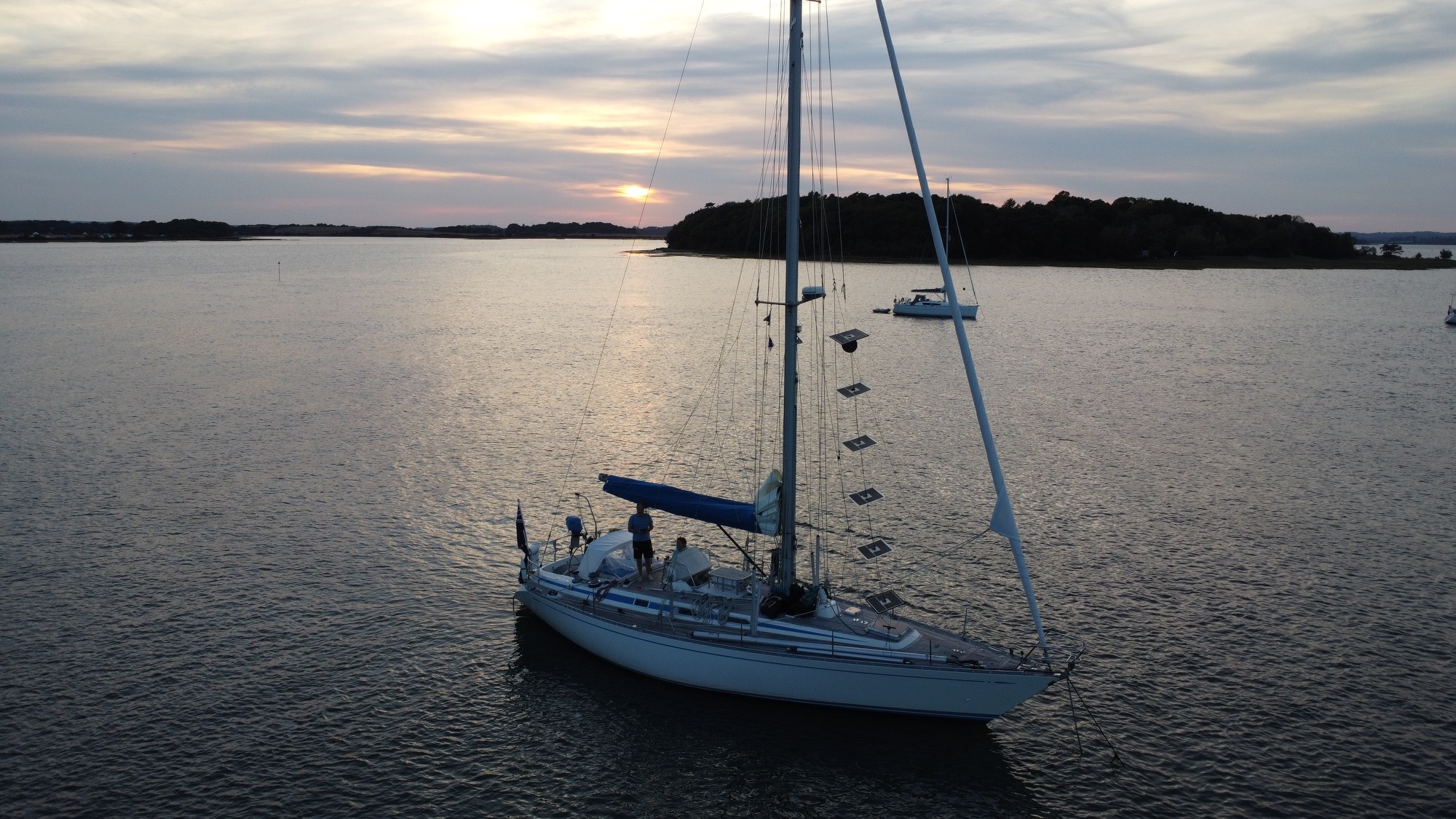
We left Poole on Monday afternoon and headed for Lymington, where we arrived in time for some excellent fish and chips. We stayed in the Yacht Haven, rather than the Berthon, as they had room. My father used to keep a boat here in the late 90s that I used to sail regularly. The marina has expanded somewhat since then and is now the home to a lot of charter power boats as well as the local sailing boats. The size of the boats, especially the powerboats is surprising, especially after the French coast where we were on the big side, and big powerboats were very scarce. Not so here…
After a day in the marina (avoiding the 25kts blowing in the western Solent), and some grocery shopping, we made our way across to Yarmouth for a night, and dinner at the Beach Hut.
The plan had been to anchor in Colwell Bay, which is opposite Hurst spit on at the western end of the Island, just before the Needles. the restaurant runs a tender service and will collect you from your boat and deliver you ashore to your table. We’d been texted the day before our booking announcing that in light of the weather forecast they’d not be running the tender service, but would collect us from Yarmouth using their minibus or landrover. This was no surprise – in the forecast weather there was no way I was going to anchor in Colwell Bay, let alone spend a night there after a nice dinner.
The Hut, Colwell Bay
The meal was lovely but twice the price of our Michelin starred meal in France, and whilst well prepared Kathryn thought that her fish was not as fresh as she’d become used to. It was, however, a lovely experience and a nice closing chapter to our trip.
We spent another day, Thursday, in Yarmouth to avoid more weather – a steady 38kts in the western Solent at one point, and made a very quick passage back to Birdham in 14-20kts on Friday. We arrived with just enough water to get to the lock and were on our berth by early afternoon. We did a quick tidy, grabbed the essentials and took the train back to our London flat, where we had a take away from our local, and excellent, Chinese, the River View.
Saturday saw us drive back down to the boat so we could load up with all the stuff to come off the boat and give her a proper clean before heading back to London on Sunday morning. We’d meant to have lunch at Itchenor sailing club with a friend from the club, but due to an ambiguous message exchange we thought he’d had to cancel and heade home. He’d meant that he couldn’t have lunch but would meet us for a drink… so we had a FaceTime chat once we were all back at our homes. He’s just had a hip replaced so I feel a bit guilty about having made him walk to the club and back. Nonetheless he’s invited me to apply to become a member of the Royal Cruising Club, which is a great honour. I may not make it through the selection process, but I’m rather pleased.
We’d chosen the anchorage on the Auray as it was the spot favoured by George Millar in his book Oyster River about a summer cruising the Morbihan. It’s a lovely read (though out of print) describing a summer on his 50′ wooden yawl sometime in the late 50s. Both he, and his wife Isabel, are extraordinary characters. He had been captured in North Africa during the war, escaped during a prisoner transfer during the collapse of Italy, and made his way on foot across France and Spain to escape back to the UK from Portugal. Once back in the UK he joined the SOE and was dropped back into occupied France to support the resistance. He’s spending the summer recuperating following a riding accident that left him with serious internal injuries when his horse fell landing on him… so they sailed from Plymouth to the Morbihan to take it easy.
Sunday saw us gently sail back down the river under headsail alone and across the entrance to pick up a mooring that was across the headland from Port Du Crouesty on the inside of the gulf. We’d agreed to meet our friend there in the morning, and to spend the day with her on the Morbihan.
Monday morning saw me in the tender picking her up from the slipway, before we spent the day doing a lap of Ile Aux Moines, following a lunch stop at the head of Ile Ilur. One of the innovations of Sunday afternoon had been discovering the SHOM Tidal Stream Atlas that covers the gulf could be purchased as a PDF online. Having navigated the checkout and download process in French we now had the tidal information that made Monday’s tour possible. The tidal flows are huge and being only a few minutes late or early for a turn of tide can stop you in your tracks – and it did on Sunday when we were a little early at the entrance and motoring at 7kts saw us stand still until we could slide sideways into slower moving water.
SHOM tidal stream atlas of the gulf – 1 hour before high water
We spent another night on the mooring buoy before heading up to Vannes up a river off the North of the Morbihan. It proved to be a lovely town and we spent a couple of nights there, we did some laundry, and had a great meal at another happy Michelin. On Thursday we headed down the river, across the gulf and out to Port de Croesty once more. Our local friend had picked up a new electric dinghy pump for us, as our current one had died when inflating the tender up the Auray at the weekend. The old one was ten years old and a bit of research identified had been rather overtaken by technology. The new pump of choice was stocked nearby and she’d offered to collect it for us. We met up on Thursday afternoon and she announced that we’d been invited to her brother-in-laws for dinner. He is a sailor and keeps a boat in the marina. We had a lovely evening in a French home, and drank a little too much.
On Friday we headed to Trinite sur Mer, which is only a few miles away and a yachting mecca. Our favoured pilot book (written by the late Peter Cumberlidge) raves about the marina, which is an oddity as the author clearly prefers a night at anchor whenever possible. We got a snug berth tucked behind the wavescreen which has pontoons for race boats on the seaward side. There are two Ultimes, an Ocean 50 trimaran, a 50′ Offshore racer of a modern scow design, an IMOCA and half a dozen Class 40s all tied up there. I’d been struggling with a cold for a couple of days and rather crashed for a few days. We have had a little wander around the place and it is lovely – there’s the gallery of the famed French sailing/sea photographer Philip Plisson and some great gear shops, as well as sailmakers and all the usual fantastic food shops of a French town.
Class 40s (all with Starlink Mini dishes)Scow bowed 50’erSome more of the fleetOne of the Ultimes moving into her berth (with Trouper just over the wall).
The local lifeboat has been busy. They are just down the pontoon from us and were out at 0130 on Sunday for a search, then again for most of the day on an exercise (seems like Sundays are lifeboat training days the world over), and then again on Sunday evening for what looked like a Medivac from Houat, one of the offlying islands. Today (Monday) they were out again in the evening to tow a boat back into the harbour.
Sadly I also got the news this week that after about a year doing battle with cancer one of my team back at work had died. He was a lovely man whose sense of fun belied his age: he was the antithesis of the grumpy old man. Murray Stephen: you will be greatly missed.
We left Concarneau for Lorient on Tuesday, with Trouper making an easy 6 knots in a gentle breeze. Lorient is a huge harbour, behind a narrow entrance and we elected to moor in Port Louis, tucked in on the eastern side of the entrance. There’s a water taxi into the centre of town and we spent a happy day on Wednesday exploring the town. There’s a big sailing exhibition in a building named after Eric tabarly the great Breton sailor who in many ways established offshore sailing, especially short handed in French culture. The museum is adjacent to the enormous submarine pens built during the Nazi occupation. They were essentially a huge maintenance facility for U boats that were engaged in attacking the Altantic convoys resupplying the UK from the US during the battle of the Atlantic. That made their maintenance facilities a bit of a target for Allied air attack. The German solution was to built them with so much concrete that there were effectively indestructible. Reportedly the roofs are over 7m thick steel reinforced concrete. They are very imposing structures to this day. After the war the French Navy took the site over and used it to support their submarine fleet during the cold war. In the 1990’s they moved out and the area was redeveloped with the pens becoming homes to a number of marine industries and a centre for the construction and maintenance of extreme high performance composite (mainly carbon fibre) structures. Now it is home to many of the most famous French offshore sailing teams.
As we approached the back of the submarine pens we came across a canteen style cafe with a queue beginning to form at midday in the ground floor of a nondescript commercial building surrounded by industrial units. The portions were huge, the prices very fair (about 25 euros for two with hot drinks) and the food was excellent. As we munched through our lasagne and green salad the queue grew and the t shirts on display became the who’s who of high end composites manufacture and offshore racing team. Nearly half, of the now extensive, queue had IMOCA class logos on their tops. It was a nice bustling place where people had convivial lunches together. We visited the museum, and then walked down onto the public access pontoons where most of the IMOCAs had departed that morning for England and the Fastnet Race. The race runs from Cowes to the Fastnet Rock off South Western Ireland, and then back to Cherbourg (these days, it used to finish in Plymouth, but was moved to accommodate the every larger number of entrants – over 400 this year). The race runs every two years and this is its centenary edition.
Charal remained with some work going on on her rudders, and we’ve been following her since on Marine Traffic – she left on Friday morning and by Saturday morning had been hanging around going in circles at 2 knots just south of the Needles Channel for some time – clearly waiting to take the tide up the Solent, start the race, and charge back out again on the west going tide. Fastnet starts are timed to get the west going tide at the Needles. For me the challenge was always if we’d carry the fair tide to Portland on the first night, or get stuck trapped by a foul tide at Portland Bill. If you thought you weren’t going to make it, and were beating into a south westerly (the prevailing wind) the tidal strategy was to get offshore, often almost to Alderney, to avoid the foul tide and the tidal gate. But that would mean giving up the acceleration from the fair tide over St. Albans ledge that can easily put you an extra mile or so down the track… As I write this on Sunday morning the big mulithulls are approaching the rock and the IMOCAs are passing the Scillies. When I’ve done it on rather slower boats we’d expect to have been somewhere between Start Point and the Lizzard by the first morning, if all was going well. On slow races (2005) by the morning of the third day we were still off the Scillies.
Thursday saw boat admin – some laundry and I cleaned the bilges, which needed it – most boat smells can be tracked down to things lurking in the bilge. We did round the day off with a trip to a local restaurant – which has a Michelin star. the food was very good: three fixed menus, and no a la carte. We had the cheapest, 65 Euro menu and a couple of glasses of very nice wine. With the two amuse bouches there were 5 courses, though the main was too shellfish based for my tastes. Presentation is what you’d expect, and the savoury pea ice cream was exquisite.
From Lorient we headed South East on Friday, mainly motor sailing as we were heading dead downwind in a gentle breeze, until we rounded Quiberon and once through the gap between the off-lying rocks and Ile de Houat we hardened up a bit and had a nice sail in towards Port du Crouesty at he entrance to the Gulf du Morbihan. Whilst I’ve tried not to set deadlines and fix a timetable for this trip in order to luxuriate in the freedom of the time off – to Kathryn, the inveterate planner’s frustration – the Morbihan has been a target from our earliest research. It’s a bit like Poole Harbour, in that it’s a big harbour with a narrow entrance and islands, but it has much stronger tidal flows, and much more deep navigable water, and many, many more Islands (at least 60, I’m told).
We spent a night in Crouesty, meeting a French friend, we know from London, who has a house nearby, for dinner. It’s vast, congested and industrial, but had a good supermarket. We were allocated a berth rafting on alongside a big, unoccupied, Bavaria on the end of one of the hammerheads. It would have been a 2k walk to the marina office, but the harbour master boats (there are at least three) will act as ferries, and gave me a lift both ways. Dinner was in a restaurant overlooking the entrance to the gulf.
We left on Saturday morning for the entrance to the Gulf, aiming to be there at low water, and to carry the rising tide up the Auray river, on the western arm of the gulf to an anchorage off Le Rocher. We found a spot in a little pool just clear of the moorings and got the hook down and set, with a tripping buoy as I was worried about the possibility of fouling the hook with something on the bottom.
The entrance to the gulf.
After a few hours, and a turn of the tide, I was confident that we were secure, which was the cue for some locals to tun up on a small mark laying launch and make it clear that we couldn’t anchor there, despite the pilot book’s recommendations. We pulled the anchor up (it hadn’t fouled anything) and Kathryn held us alongside an empty mooring a little further up river whilst I managed to post a mooring line through the eye on it’s top by lying on the side deck at full stretch. A little while later a guy turned up to charge us for the mooring for the night, but who was also concerned that the mooring wasn’t big enough for us (which was one of the reasons I’d anchored in the first place – you never quite know what’s under a mooring buoy). He showed us to a more substantial mooring, adjacent to where I’d anchored in the first place, and helped run the mooring lines from his rib – which at least helped with all the stretching.
Friday evening saw one of Kathryn’s former work colleagues and her new partner join us for a few days – carrying two very welcome spare belts for the engine. Whilst chasing the coolant leak I’d noticed that the belt that drives the coolant pump and engine alternator was looking a little frayed and discovered that I’d not, as I thought, got a couple of spares on board. In the end the simplest solution was to have a couple delivered to them.
We’d moved the boat into one of Brest’s main two marinas on Friday morning and after a bit of boat admin had set off across town to have lunch in a restaurant I’d booked via the Michelin guide. It didn’t have a star, which I can find to be a little too fussy, but did have my favourite designation: bib gourmand (or Happy Michelin in our house). Fair to say it was stunning; and extraordinary value at 35 Euros a head, including all drinks, plus an extra 5 Euros for a glass of wine. If they did this in London there’d be a queue to Brest! We ate at a bar facing into the kitchen and watched them prepare our meal. It was stunning. Kathryn took some pictures:
Happy MichelinStarter: Seared water melon with frozen ricottaMain: Hake, green beans, mash and sauce with capersDesert: Baked apricot with apricot and thyme sorbet (amongst other delicious things).
If you’re ever in Brest try and visit Peck and Co: you’ll not be disappointed. The afternoon was all glamour with the laundry to do before our friends arrived. The boat just ahead of us in the marina was another Swan – a Frers designed 53′ from 1988. One of the crew had had a chat earlier in the day, and it turned out the nice woman I’d befriended at the laundry earlier was the owner’s wife. The owner popped round to Trouper as we we all sat in the cockpit and we did reciprocal tours. His boat is a beast and cosmetically it needs some work. He’d only bought it last week, it having completed the Ocean Globe (round the world) race in 2023 as ‘Sterna’, and all the important systems and structures were well maintained and in good order. They were taking her home to Finland over the next 3 weeks to tackle the cosmetics, get to grips with her, and then potentially cruise around the world in a year or two, as I write this they are in Guernsey, so making good progress.
Sterna – A Frers Swan 53
Saturday saw us leave Brest and head out into the bay where we had a lovely gentle sail to Morgat, where we anchored off in the bay and inflated the tender and SUPs. A trip ashore by tender saw us reprovisioned at the SuperU and allowed us to have a BBQ on board and a lovely evening in the cockpit rounded off by a game of Quirkle at the cockpit table. Morgat had a very busy beach and sailing school and was apparently established as a resort town by the founder of Peugeot as a holiday destination for is executives.
Anchored off Morgat
Sunday morning saw me dash ashore before the others were up (yes really) to obtain fresh croissants and bread for breakfast, before a leisurely sail across the bay to Douarnenez. After a quick explore ashore it became clear that there was a bit of a festival on that evening and our dinner plans shifted to sausage, tuna and moules (all with frites and Bretton Cidre), eaten at communal tables and benches filling the square whilst bands played. To round it off there was then an improbably long firework display, from a barge. It just so happened that our boat was perfectly positioned to provide the prime viewing platform for the fireworks.
On Monday are our guests left, heading back home, and we did some boat cleaning (a cockpit locker and some blocks). I was somewhat distracted by the very French, and excellent, sailing school operating around us with strings of optimists and a fleet of catamaran dinghies – it brought back lots of happy memories of spending summers working further south along this coast for Rockley Watersports in my early 20s. I also found and, I hope fixed, the source of the nasty smell in the forwards heads – the bolt that attaches the pump diaphragm to the motor system was loose and some effluent was dribbling out. So that was a bit more cleaning. In less good news the engine coolant level has dropped a bit further – which suggests I’ve not yet fixed the leak.