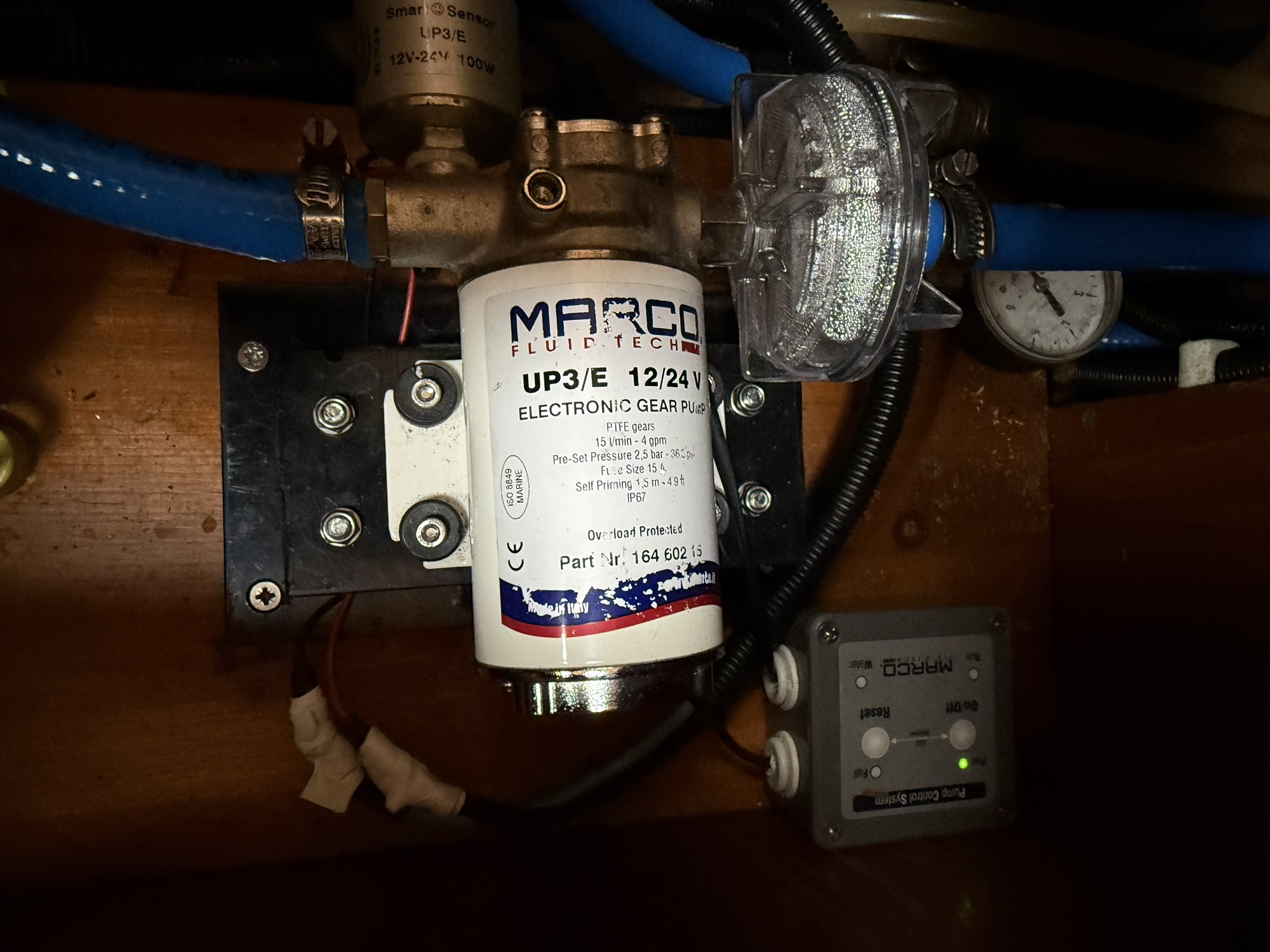
One of the spring jobs that I’d not written up but what has made a huge difference is some work on our freshwater pump. We have a Marco UP3/e gear based pump. It’s excellent and varies it’s speed to match the flow demand. I’d hoped it would self prime, but in our installation it doesn’t and needs a knurled bleed screw opening for a moment when we change tanks.
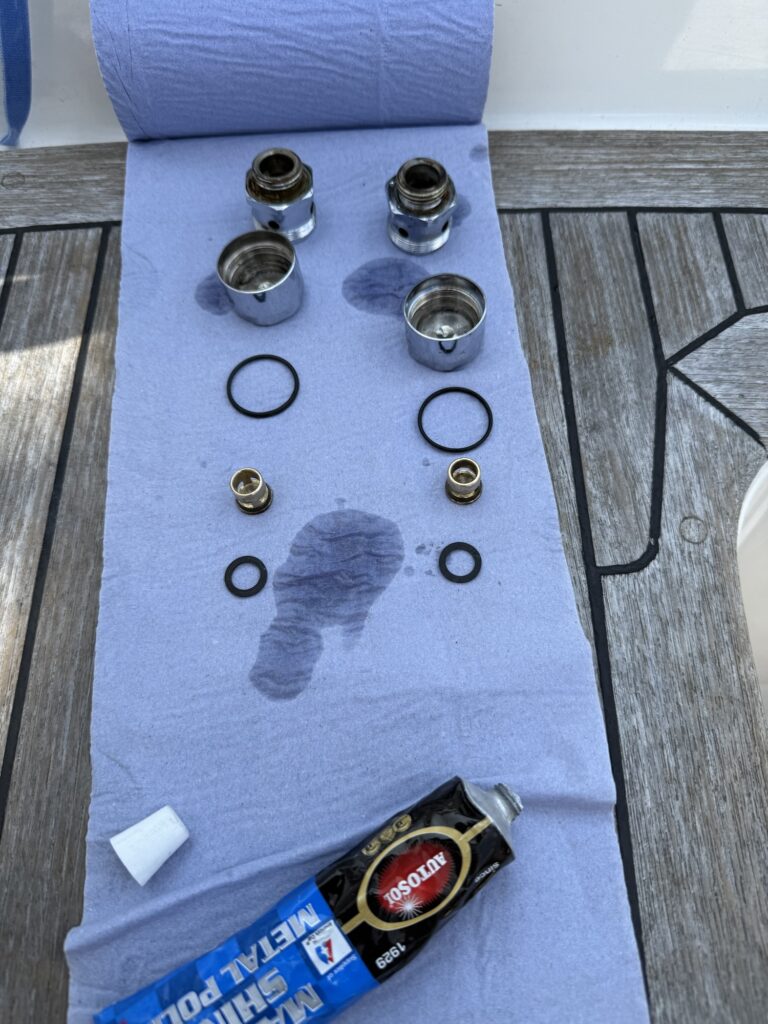
After six or more years use the need to prime it had increased and it might struggle to empty the tanks. That was partly due to some deposits on the valves on the breather lines, but stripping and polishing those in May 2025 didn’t entirely resolve the issue.
Cleaning and polishing the breather valves
This spring I bought a service kit for the pump – essentially two new helical gears, an O ring and new face plate. It was pretty trivial to install – though the gotcha is not to tighten the faceplate too hard, as over compressing the seal presses on the end face of the gears and prevents them from turning.
The pump had always been rather noisy with a high pitched whine. It was it’s Achille’s heel for us: I love the robust, durable pump, and variable flow but the noise was an irritant. It didn’t help that the pump was mounted to a shelf inside a locker under the saloon sofa that acted as a sounding board amplifying the noise.
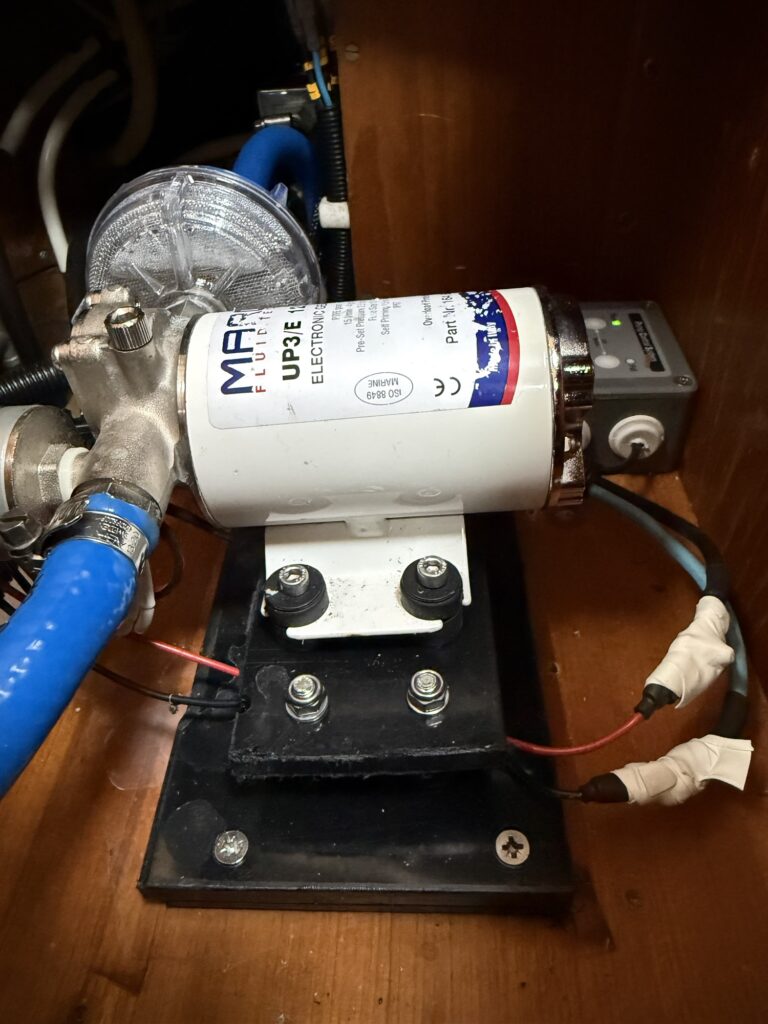
This spring I pointed my AI agent of choice, Perplexity, at the problem and it came back with a pile of sensible suggestions about installing the pump on a noise isolating raft. £10, including postage, got me four rubber mounting bushes, each with an M4 thread protruding on both sides. I used them to fix an 8mm offcut of HDPE sheet floating above another that with some spacers under it could be fixed to the original shelf, whilst the pump was mounted to the floating raft, plumbed in with flexible hose.
The noise isolated raft and pump.
It was a huge success. The noise levels dropped dramatically. Still audible but there was no longer a need to raise your voice or wait till it stopped.
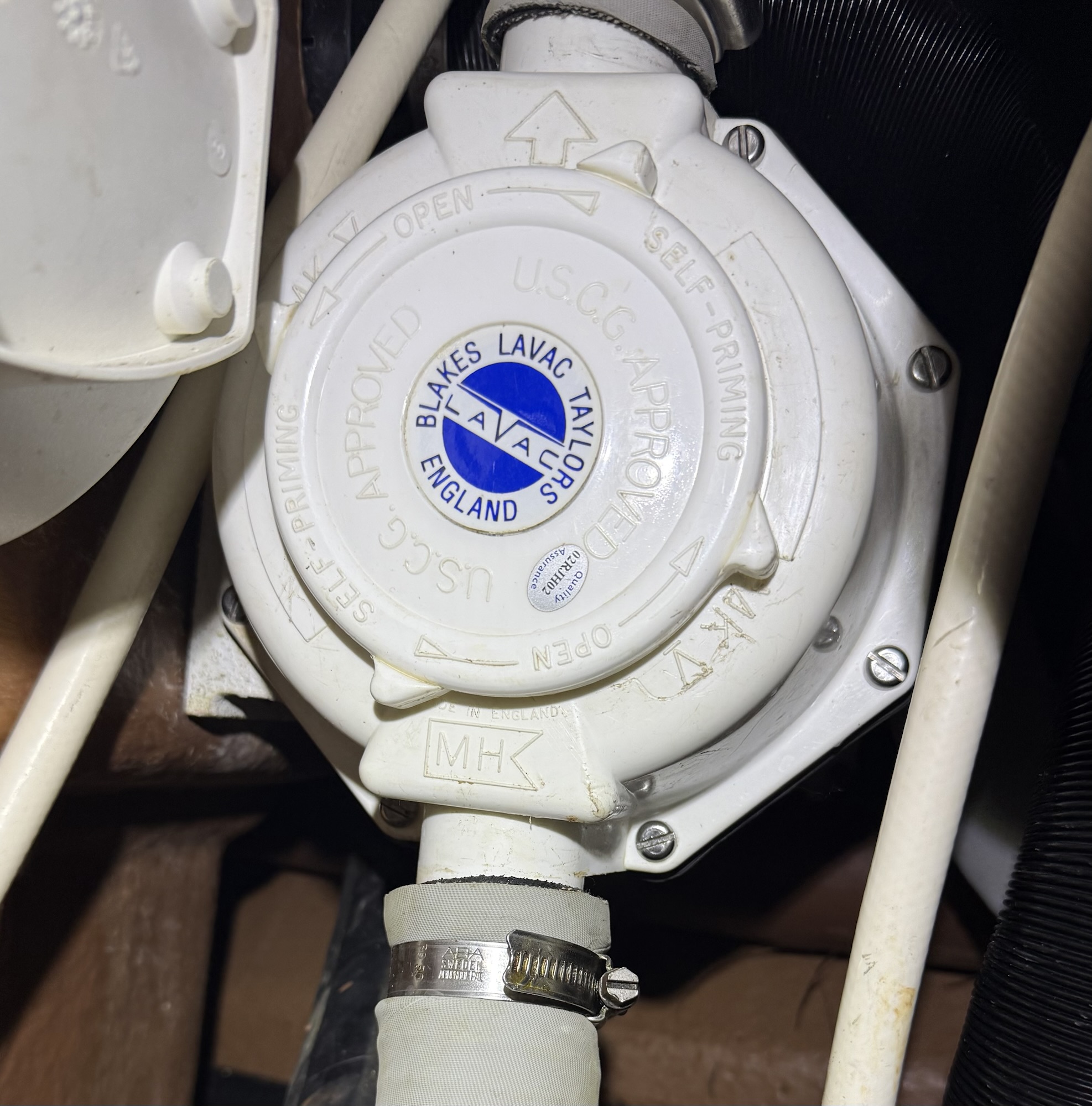
Trouper has rather clever Blakes Lavac toilets. Unlike the more common Jabsco marine toilets there is no change over valve between flush and rinse. The Lavac design simply has a large diaphragm pump on the discharge side, a high loop with a small vent on the inlet side and seals under the list and seat. When the pump runs it creates a vacuum in the bowl and draws seawater in to flush it. When the pump stops the vent breaks the seal after a little while and the lid can be raised. The beauty is in the simplicity – and is best appreciated by those who’ve tried to strip and rebuild the Jabsco ones at sea: they are not only full of small parts, including springs, but the pump itself is notorious for cracking at its base and they are prone to clogging, due to some small openings.
Trouper not only has two of these Lavacs, adding a little redundancy, as well as ensuring that at sea one is always on the downhill side at sea, but they are also electrically operated.
I rebuilt the aft one about 8 years ago, and the forward one’s motor failed in 2022. When the forward one failed I also rebuilt it with new valves and diaphragm together with repainting the aluminium body. It was looking as though I was going to have to replace the pump with the newer design they now supply as the parts are no longer available. This was going to be quite expensive and would need some new brackets and reorganised plumbing to accommodate it as they weren’t the same shape as the old ones. In desperation I looked hard at the old motor unit and spotted what turned out to be a Bosch part code stamped into its body. The previous owner had told me that he’d installed that motor and it had never seemed quite right to him as it operated very slowly – he’d even wondered if it was a mislabelled 24v version. Armed with Bosch part code I went internet shopping: it turned out to be the windscreen wiper motor and gearbox from a 1990 vintage Mercedes Sprinter van. I ordered a new one for about £40 (the replacement pump, that wouldn’t fit, was well over £250) and it fitted perfectly. When I came to wire it up I discovered that there are 3 positive terminals and one negative. They are for intermittent, slow and fast wipe settings. It turns out the old one had been connected to the slow wipe setting!
When we were in France at the start of the month Kathryn had spotted a dribble on the aft head hose that turned out to be from the pump diaphragm leaking. So last weekend, in sweltering heat, of course, I stripped and rebuilt the pump. When I first bought the boat I’d tried doing this in situ under the after heads sink working through a tiny cupboard door. It took all day and didn’t last long as I’d not got it all together straight, which resulted in the rebuild about 8 years ago. I’d been driven to this as I was worried about reinstalling the pump, but when I rebuilt it I did take it out and discovered how to reinstall it easily. Trouper’s heads have a shower head and hose that is stowed in a hole in the counter top of the sink. If you pass a loop of sting through that you can use that to support the bit of the pump you can’t reach in place chest you put the fixing bolts in place. After that it’s two hoses and an electrical plug.
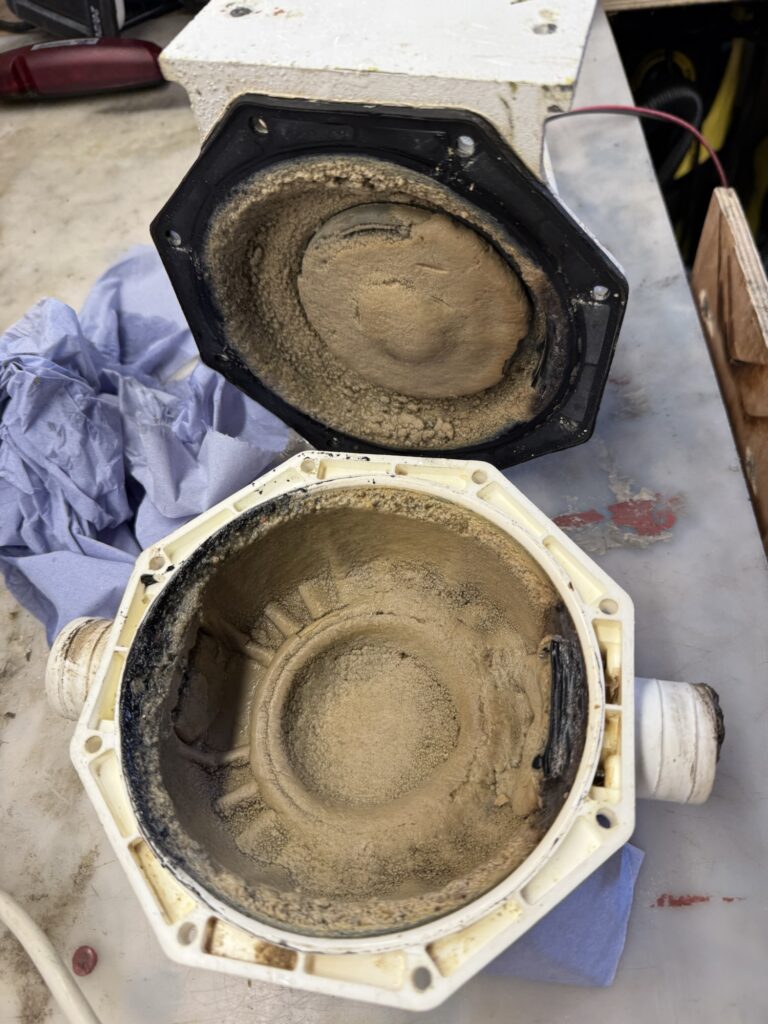
So this time I took the pump out with some confidence (having flushed it with a lot of seawater first) and took it off to the bench in my workshop. Once apart it needed quite a clean – there’s an unfortunate reaction between salt water and urine that forms a crystalline deposit, and 8 years use had created a fair bit of that.
Inside of the pump body before cleaning.
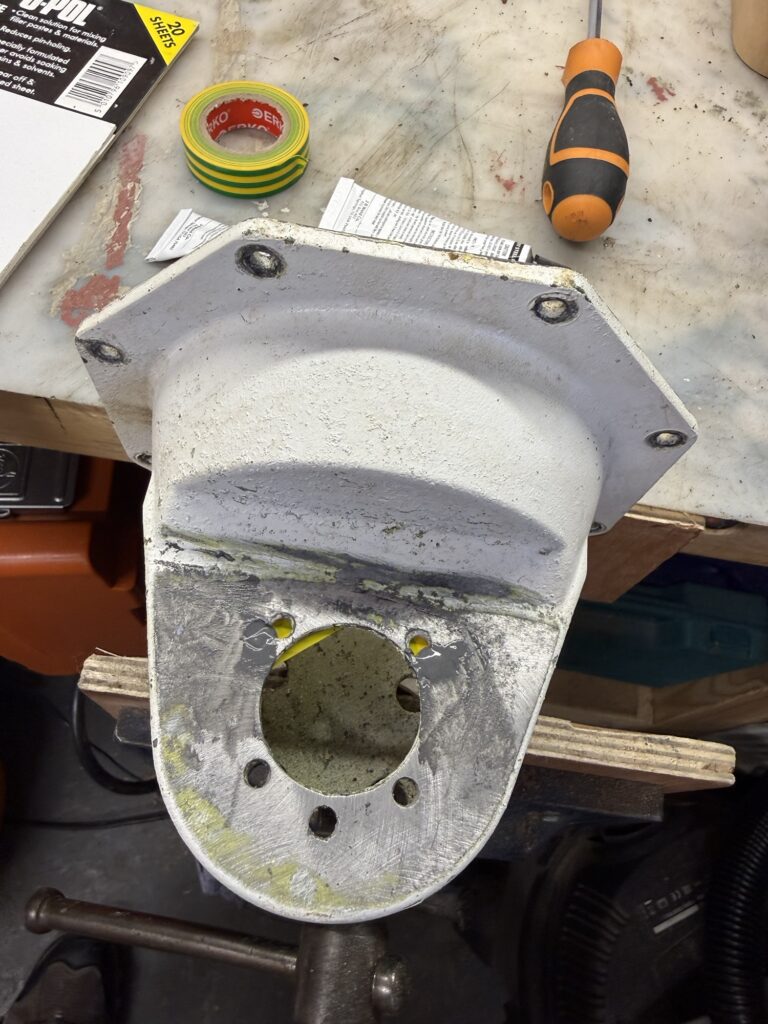
The paint from 8 years ago was in quite good condition (the metal painted bit should be on the dry side of the diaphragm and hold the motor assembly in place) so I just repainted a couple of patches that were most in need, and filled some corrosion damage with JB Weld.
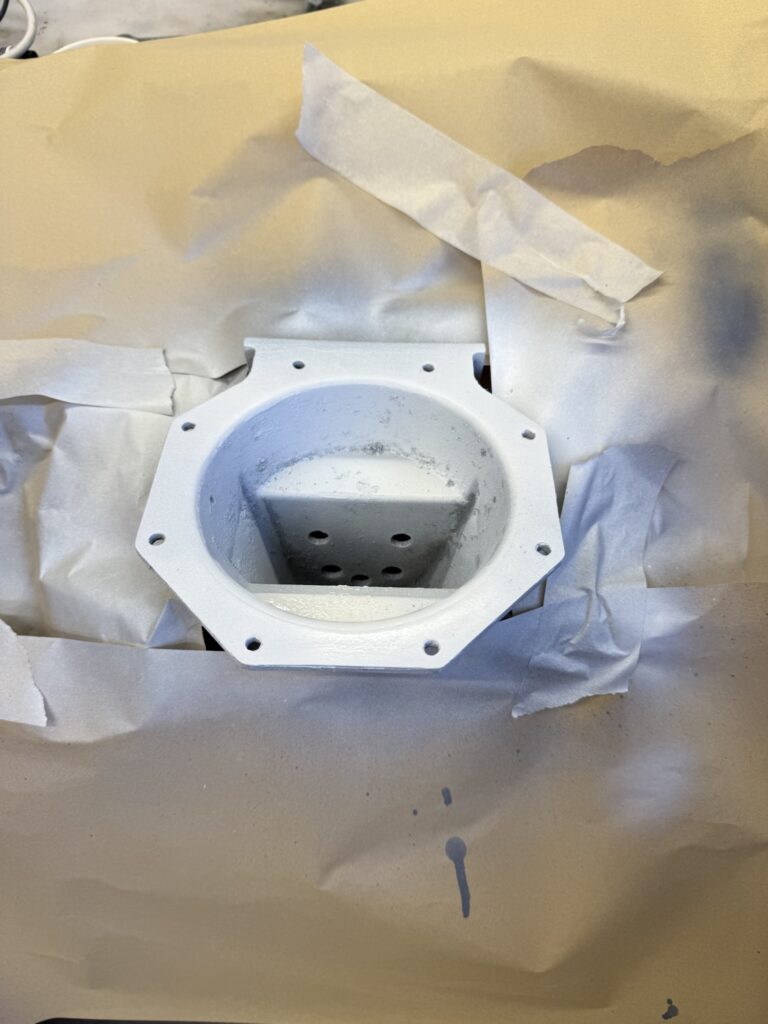
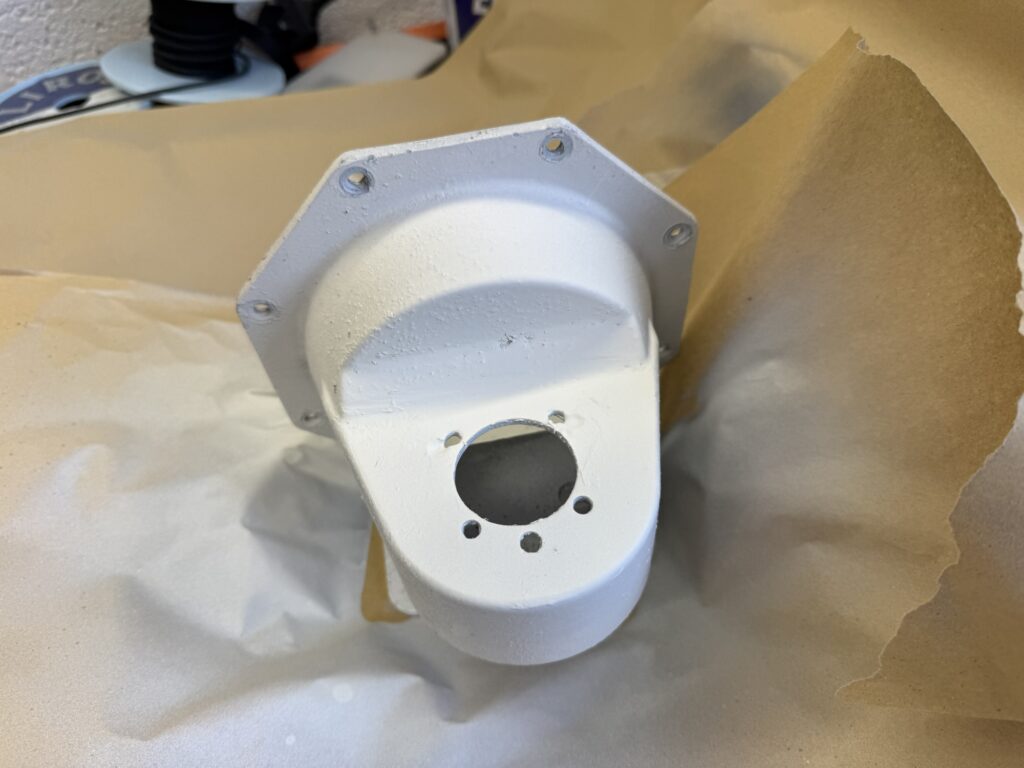
Ground back awaiting primingTop coat going on Finished job, before remounting the motor.
I primed it with two coats of an acid etch primer, and then gave it three coats of top coat – with the last two either side of a much needed early evening shower.
On Sunday morning I reassembled it with a new diaphragm and valves and reinstalled it. The reinstallation was a bit fiddlier than I hoped as I needed to tidy up the end of the inlet hose which was a bit battered. I trimmed about 20mm off it, and then removed the spiral steel reinforcement for about 30 mm to make it soft enough to mate on the pump and clamp tight.
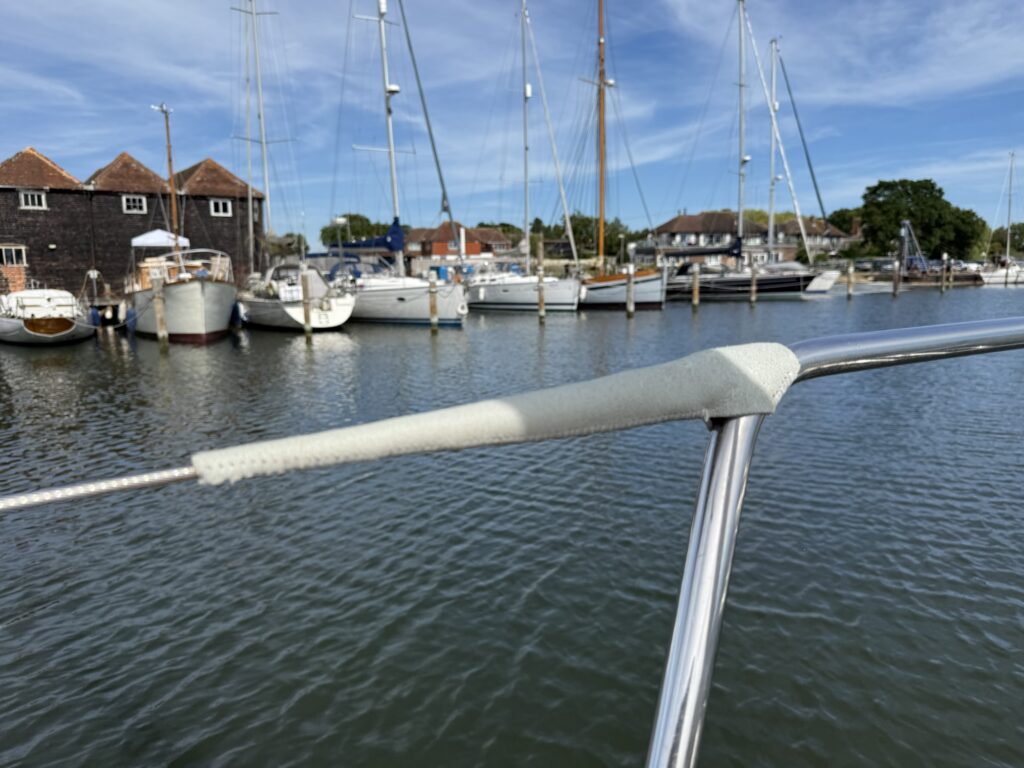
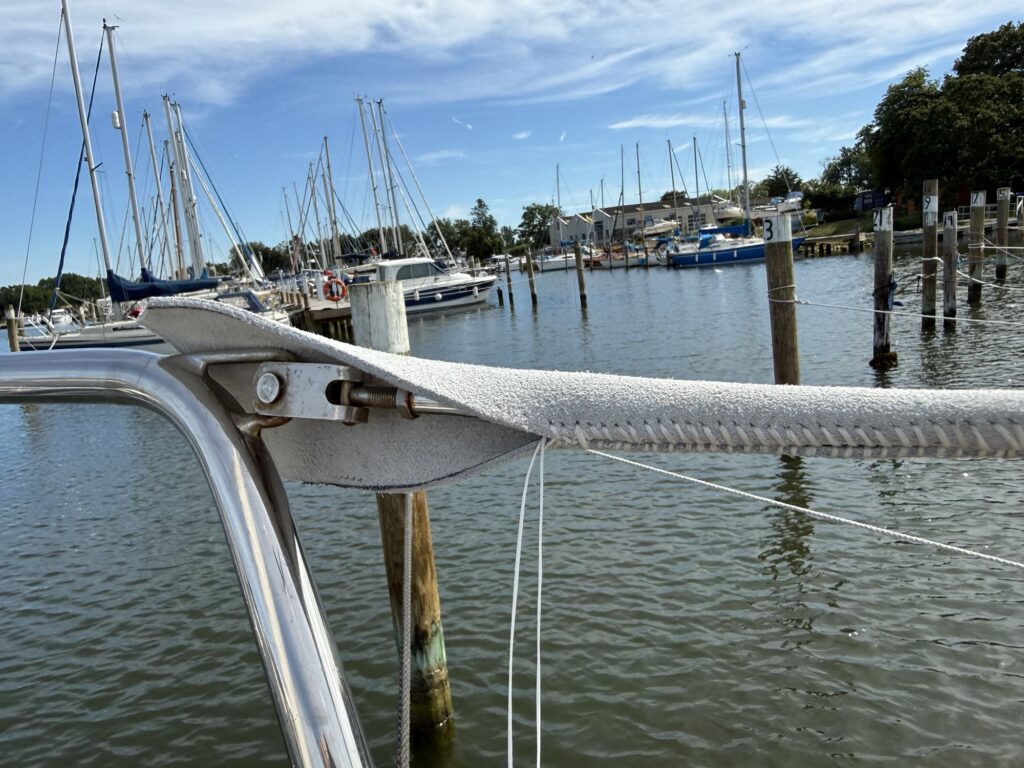
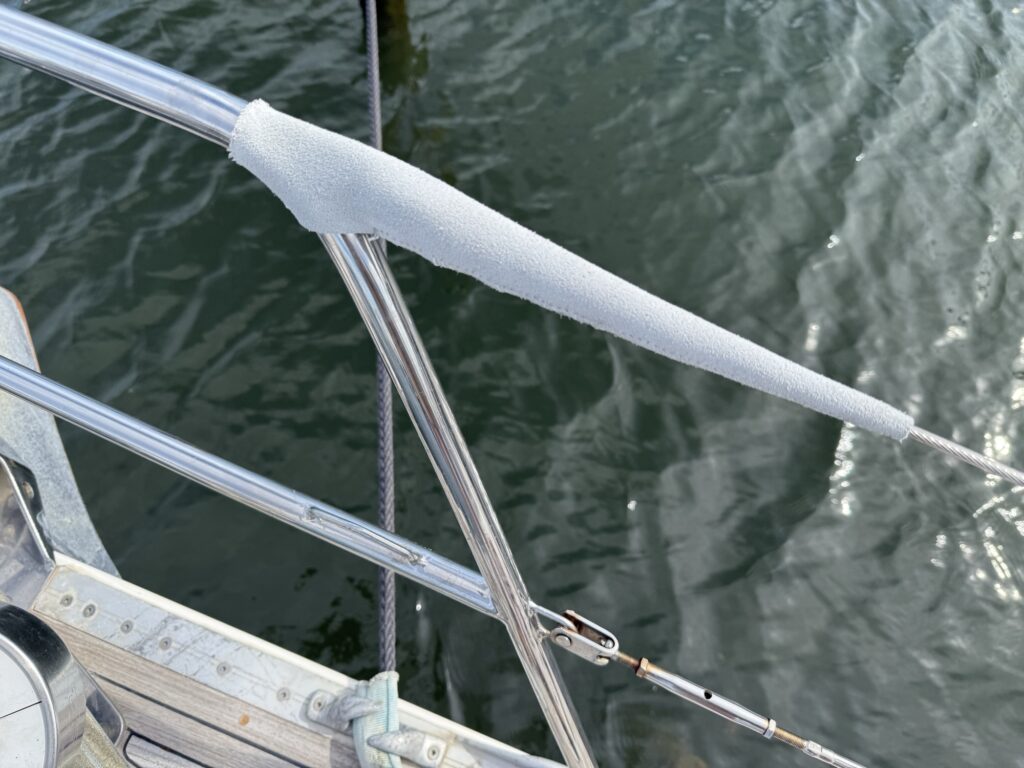
I also finished fitting the new leather boot to the lifeline to protect the headsail, that I’d started in Cherbourg.
The one I did in cherbourgWork in progress stitching it in placeFinished job.
I did a little, very much needed, workshop tidying too, and assembled and tested Mk2 of the Pig Stick and fitted a new brighter B&G 2020 HV Mast display. All in all it felt like a very productive 36 hours at the boat.
Before we could get away for the late may Bank holiday there was a pile of work to be done: the usual spring clean below and cleaning all the upholstery.
I was also able to finally fix the forward bunk hinges. One had failed on each side and Nautor had supplied some replacements over the winter. Sadly they were close but not quite the same with two of the screw holes slghtly smaller and with a different spacing. These screwed into a tapped 5mm thick stainless plate that is in turn bolted to the bunk frame and acts as a spacer. I’d spoken to Rob, the local marine fabricator, about making up some new plates but he had a better and cheaper plan: he’d simply weld up the existing holes and then redrill and tap the plate. He promised me I’d not be able to tell where the old holes were. Suffice it to say he was right and they allowed me to put it all back together.
One of the over winter projects was tackling the vibration we’d noticed from the propellor last summer. It had got bad enough that we’d had a diver check that it wasn’t fouled.
We have a Max Prop. It’s a clever feathering prop design, where the pitch can be adjusted – and even be different ahead and astern. It can also be easily adjusted between left and right handed rotation. When under sail the prop will automatically feather to a very low drag configuration, and the pitch is wound back on when the engine is put in gear.
Once we got Trouper out of the water it was obvious that the Max Prop was badly worn, The prop was original and dated from 1989, and had been serviced twice before, once by me. That had cost about £600 some ten years ago so I wasn’t looking forward to the bill. Worse still the advice at the time had been that it could be done a third time but that was likely to be a shorter lived repair.
Armed with this knowledge I got in touch with Max Prop, who’d been very helpful with new settings for the prop when we replaced the engine, a couple of years ago. They were really helpful and offered a part exchange replacement for their new model, that features simpler adjustment, for ‘only’ €1300 plus UK import duties. A new one retails for several times this.
So just before Christmas I got the old one off – which proved to be quite a job after I rounded a hex socket on one of the bolts and had to drill it out. It took both a bearing puller and a blow lamp to get the core of the prop that has a taper and keyway in it to match the taper and key on the shaft off. It was duly packaged off and couriered to Max Prop in Italy before we went to Canada for five weeks. It never got there, and it appears that it was lost in Italian customs. At this point I was a bit worried that without the old one I was in for the price of a new one – and of course the carrier insurance proved to be worthless as you had to show the purchase invoice for the lost item, not it’s replacement.
Max Prop however rose to the occasion and agreed to honour the deal – despite not receiving the 14kg of scrap bronze in exchange. They shipped a new prop with a taper and thread to the specification of the original drawings. Beyond a little adjustment of the key it fitted properly and was on in time for the boat to be launched.
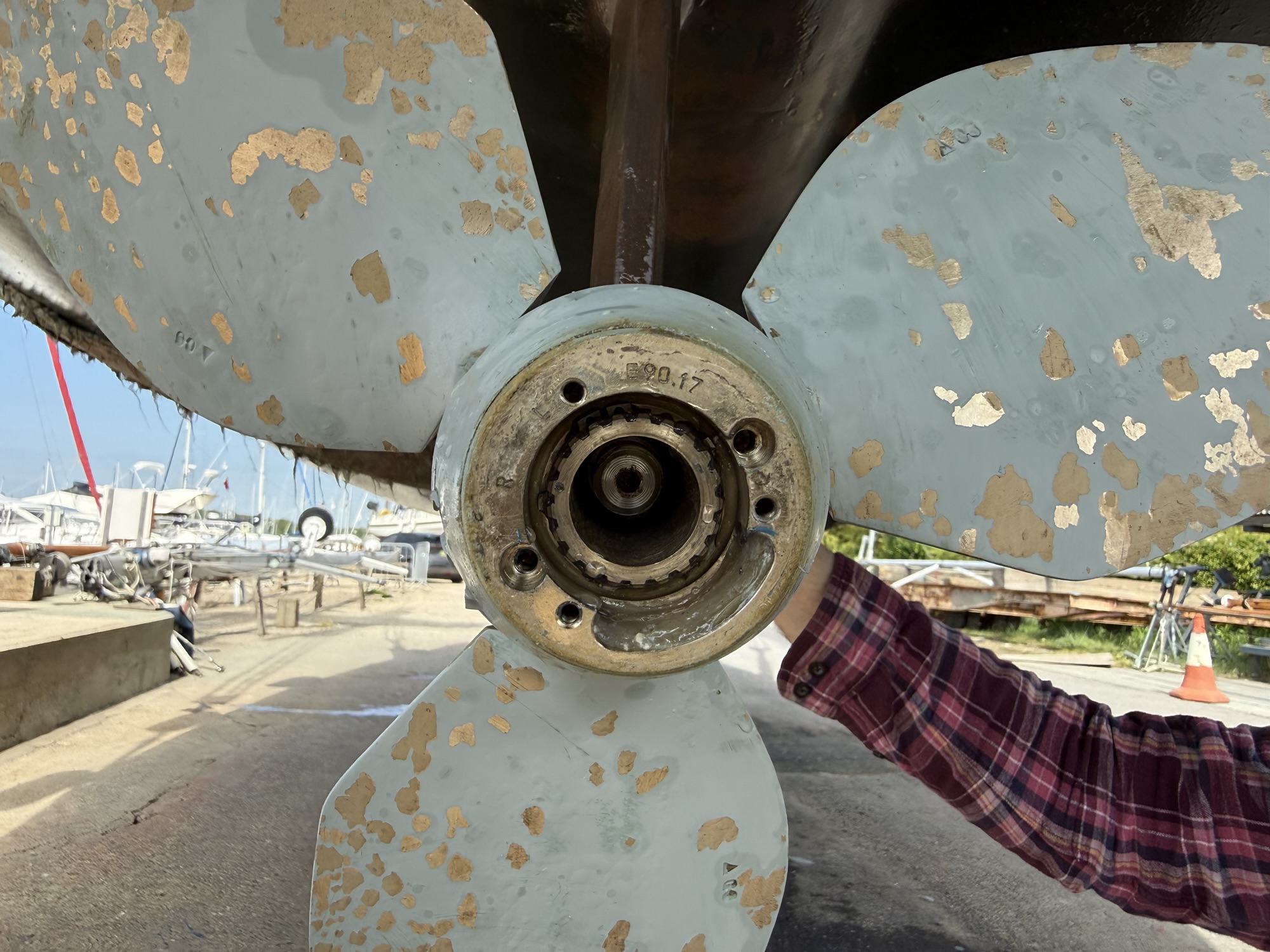
Once afloat I recommissioned the engine (after sorting out some other stuff) and discovered on putting it in gear on the berth that we went astern when ahead was engaged and astern when ahead was engaged, We have a conventional right handed rotation, but I suspected that we’d been shipped a prop set for left handed rotation. A quick google established that on the max prop easy that we now had it was a simple adjustment to change from one to another. I got in touch with Max Prop and they agreed that this was the likely cause, so I booked a lift for the following Friday where the boat would be held out of the water whilst I adjusted the prop.
The video above shows what we found, and the general operation of the max prop, together with the evidence that I really need to try harder at antifouling the prop.
Unfortunately what this also shows all too clearly is that the prop is set for right handed rotation. The dot on the inner ring is clearly aligned with the R stamped into the outer ring. It was at this point that I realised that the Italian’s take their May day bank holiday on the Friday, not the Monday as we do. I coulnd’t get hold of them at all. So we put the boat into the yard ashore and I took the prop off and home, giving up on any idea of going out on the boat for the Bank holiday.
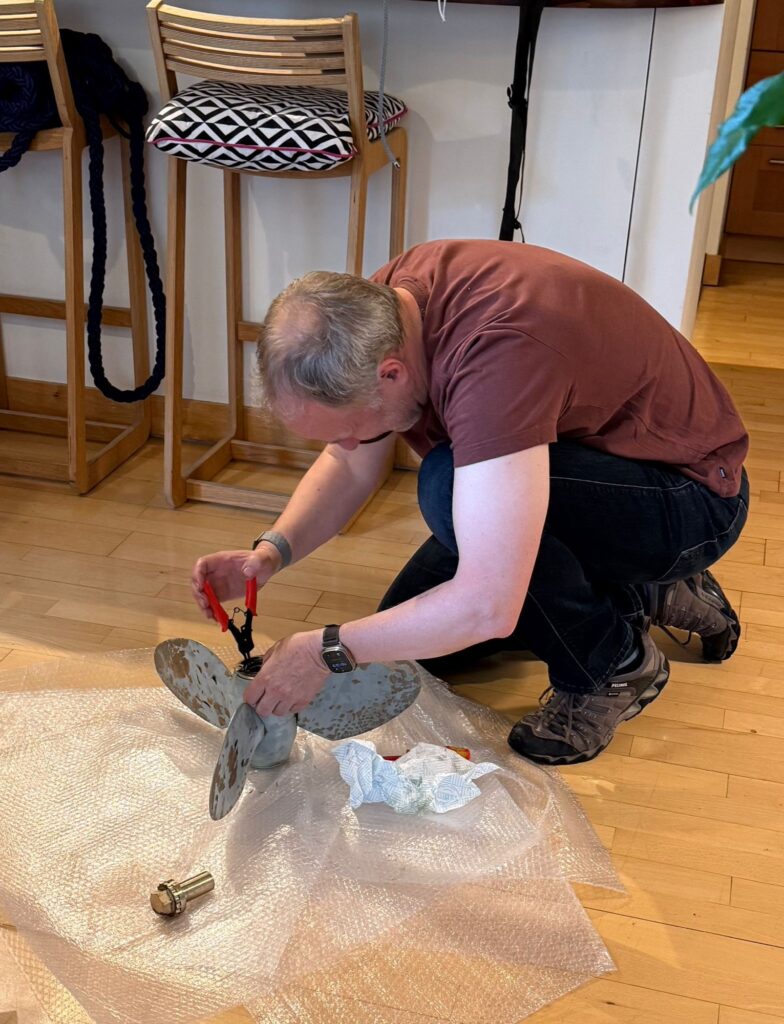
On the Monday Max Prop got in touch and we were reluctantly getting ready to ship it back to them in Italy – all very conscious of the lost prop last time and the likely 2 week delay at best. As a last measure we all got on a whatsApp video call and they examined the prop whilst asking me to move the blade positions. They spotted a problem – the inner sleeve appeared to be out by one notch. After a trip to screwfix for me to buy some circlip pliers (mine were all at the boat yard, I don’t commonly need them in London) it was a fairly quick and easy job fix it with them showing me what to do using another prop on their bench in Italy.
Adjustment underway
Then it was just the matter of another Friday off work, and another crane lift to put her back in the water and test that all was working as it should. Max prop had been so good around the lost parts at the start of the year that I decided that I’d not try to recover the cost of the lifts – it seemed as though one good deed deserved another.
Being lifted into the water – I never like this bit.
Thankfully I could drive her back onto her berth without a problem: it was fixed, and will hopefully now last another 35 years or more.
Trouper went into Nautor’s Hamble yard for a mini-refit in late October 2025. The main job was to remove the rig and renew the rather elderly rod rigging. There were a few jobs that it made sense otherwise do at the same time, such as replacing the radar, as it is only possible to re-run that cable with the rig out of the boat.
Rod – this was all renewed, with new bottle screws. Unfortunately the rigging subcontractor got their sums a bit wrong and has made the rods that run from the lower spreaders to the deck and the lower diagonals too short. Currently there is an interim solution using some extra toggles at deck level in place, and they’ll be swapping in new sections in the spring.
Compass – this has been a problem for some years. Id thought it just needed correcting. The Nautor guys arranged to swing the compass with a compass adjustor on board (much easier to arrange in Hamble, than Birdham). They identified that the problem was not the need for correction but rather that the bearing that the compass rose tuns on was sticking. Nautor managed to find a firm in Newcastle who appear to be the last people in the country able to rebuild compasses. I could have bought a new one, but ones as large as Trouper’s are no longer available, and critically the current one has the Swan logo on the compass rose. Happily the compass is now rebuilt – and for less than the cost of a new good quality one. Unfortunately the lamps were lost in the process, but Nautor are sorting out replacements for me.
The wire checkstays were changed for Dyneema. I wanted this to reduce chafe on both the mainsail and the boom as the checkstays are often rubbing against them when under sail. We decided to replace the babystay and backstay with dyneema too. The backstay went on whilst with Nautor but the babystay will be added in the spring when they sortout the shroud length issues.
After much deliberation I decided to replace the radar with the modern Furuno model. This had the great virtue of the same bolt fixing pattern as the old one, and they have a reputation for making stuff that works for ever. I’ll write a separate post on my experiences of using it. In the end I chose to use a computer software display solution for it rather than a dedicated display.
Nautor also commissioned an electrician to inspect our Victorn Lithium battery and charging system that I’d installed as our insurer had asked for something. They’d said an email was fine – what we got back was a rather grander pdf covered in logos but I was a bit smug to read that they thought it was a good installation, to a high standard.
I’ve subsequently tackled a few more jobs.
The Nautor guys pointed out that my halyards, especially the spinnaker ones, were really rather tatty. This was a big ticket item as I ended up replacing both spinaker halyards, one of the jib halyards, and one of the main halyards. I was able to buy a drum of 12mm dyneema cored rope and make up the halyards myself, which helped on the costs, though the rope itself was expensive.
The lazy jacks were also looking a bit tatty after 7 years uses so I bought 100m of the Lyros lazy jack line and remade those, which was a fairly quick job, and replaced all the fender lines whilst I was at it as they are made of the same stuff and were a bit tatty.
Last summer we’d added to the chafe damage on the mooring lines that had come with the boat. It was a good set of nice lines but they are probably 15 or more years old and with chafe damage usually in the middle we had fewer and fewer long ones and ever more short ones. I’d been eyeing up what to use for new ones and had settled on a lyros product that is designed to be especially stretchy which will help in windy or bumpy conditions. I used the halyard rope order as a chance to get a bit of a discount on 100m of that two, whcih I’ve cut down into 2x10m, 4x15m and 2x7m lines all with a decent sized eye splice at one end. I’ve used whippings on the unspliced end to indicate the length which should help finding the ones you want in the locker. We still have two 25m long shore lines in the locker too, so we’re very well proivded for now.
Replacing the worn Max Prop. This turned into a bit of a saga so gets its own post.
Patching the copper coat where some has come loose. That turned out to be a simpler job than I’d feared – as ever decent suface preparation and then following the instructions did the trick.
Our 12 year old liferaft failed it’s 3 yearly inspection, as it no longer maintained it’s pressure over 24 hours. Wouldn’t have stopped it working if we’d needed it but it marked the end of it’s useful life. Suffolk Marine safety sorted out a suitable replacement for a reasonable price. I want a robust well specified one (if you ever need it you’d regret penny pinching) capable of taking six people, and it has to fit inot the storage cage on Trouper’s coachroof.
We’d chosen the anchorage on the Auray as it was the spot favoured by George Millar in his book Oyster River about a summer cruising the Morbihan. It’s a lovely read (though out of print) describing a summer on his 50′ wooden yawl sometime in the late 50s. Both he, and his wife Isabel, are extraordinary characters. He had been captured in North Africa during the war, escaped during a prisoner transfer during the collapse of Italy, and made his way on foot across France and Spain to escape back to the UK from Portugal. Once back in the UK he joined the SOE and was dropped back into occupied France to support the resistance. He’s spending the summer recuperating following a riding accident that left him with serious internal injuries when his horse fell landing on him… so they sailed from Plymouth to the Morbihan to take it easy.
Sunday saw us gently sail back down the river under headsail alone and across the entrance to pick up a mooring that was across the headland from Port Du Crouesty on the inside of the gulf. We’d agreed to meet our friend there in the morning, and to spend the day with her on the Morbihan.
Monday morning saw me in the tender picking her up from the slipway, before we spent the day doing a lap of Ile Aux Moines, following a lunch stop at the head of Ile Ilur. One of the innovations of Sunday afternoon had been discovering the SHOM Tidal Stream Atlas that covers the gulf could be purchased as a PDF online. Having navigated the checkout and download process in French we now had the tidal information that made Monday’s tour possible. The tidal flows are huge and being only a few minutes late or early for a turn of tide can stop you in your tracks – and it did on Sunday when we were a little early at the entrance and motoring at 7kts saw us stand still until we could slide sideways into slower moving water.
SHOM tidal stream atlas of the gulf – 1 hour before high water
We spent another night on the mooring buoy before heading up to Vannes up a river off the North of the Morbihan. It proved to be a lovely town and we spent a couple of nights there, we did some laundry, and had a great meal at another happy Michelin. On Thursday we headed down the river, across the gulf and out to Port de Croesty once more. Our local friend had picked up a new electric dinghy pump for us, as our current one had died when inflating the tender up the Auray at the weekend. The old one was ten years old and a bit of research identified had been rather overtaken by technology. The new pump of choice was stocked nearby and she’d offered to collect it for us. We met up on Thursday afternoon and she announced that we’d been invited to her brother-in-laws for dinner. He is a sailor and keeps a boat in the marina. We had a lovely evening in a French home, and drank a little too much.
On Friday we headed to Trinite sur Mer, which is only a few miles away and a yachting mecca. Our favoured pilot book (written by the late Peter Cumberlidge) raves about the marina, which is an oddity as the author clearly prefers a night at anchor whenever possible. We got a snug berth tucked behind the wavescreen which has pontoons for race boats on the seaward side. There are two Ultimes, an Ocean 50 trimaran, a 50′ Offshore racer of a modern scow design, an IMOCA and half a dozen Class 40s all tied up there. I’d been struggling with a cold for a couple of days and rather crashed for a few days. We have had a little wander around the place and it is lovely – there’s the gallery of the famed French sailing/sea photographer Philip Plisson and some great gear shops, as well as sailmakers and all the usual fantastic food shops of a French town.
Class 40s (all with Starlink Mini dishes)Scow bowed 50’erSome more of the fleetOne of the Ultimes moving into her berth (with Trouper just over the wall).
The local lifeboat has been busy. They are just down the pontoon from us and were out at 0130 on Sunday for a search, then again for most of the day on an exercise (seems like Sundays are lifeboat training days the world over), and then again on Sunday evening for what looked like a Medivac from Houat, one of the offlying islands. Today (Monday) they were out again in the evening to tow a boat back into the harbour.
Sadly I also got the news this week that after about a year doing battle with cancer one of my team back at work had died. He was a lovely man whose sense of fun belied his age: he was the antithesis of the grumpy old man. Murray Stephen: you will be greatly missed.