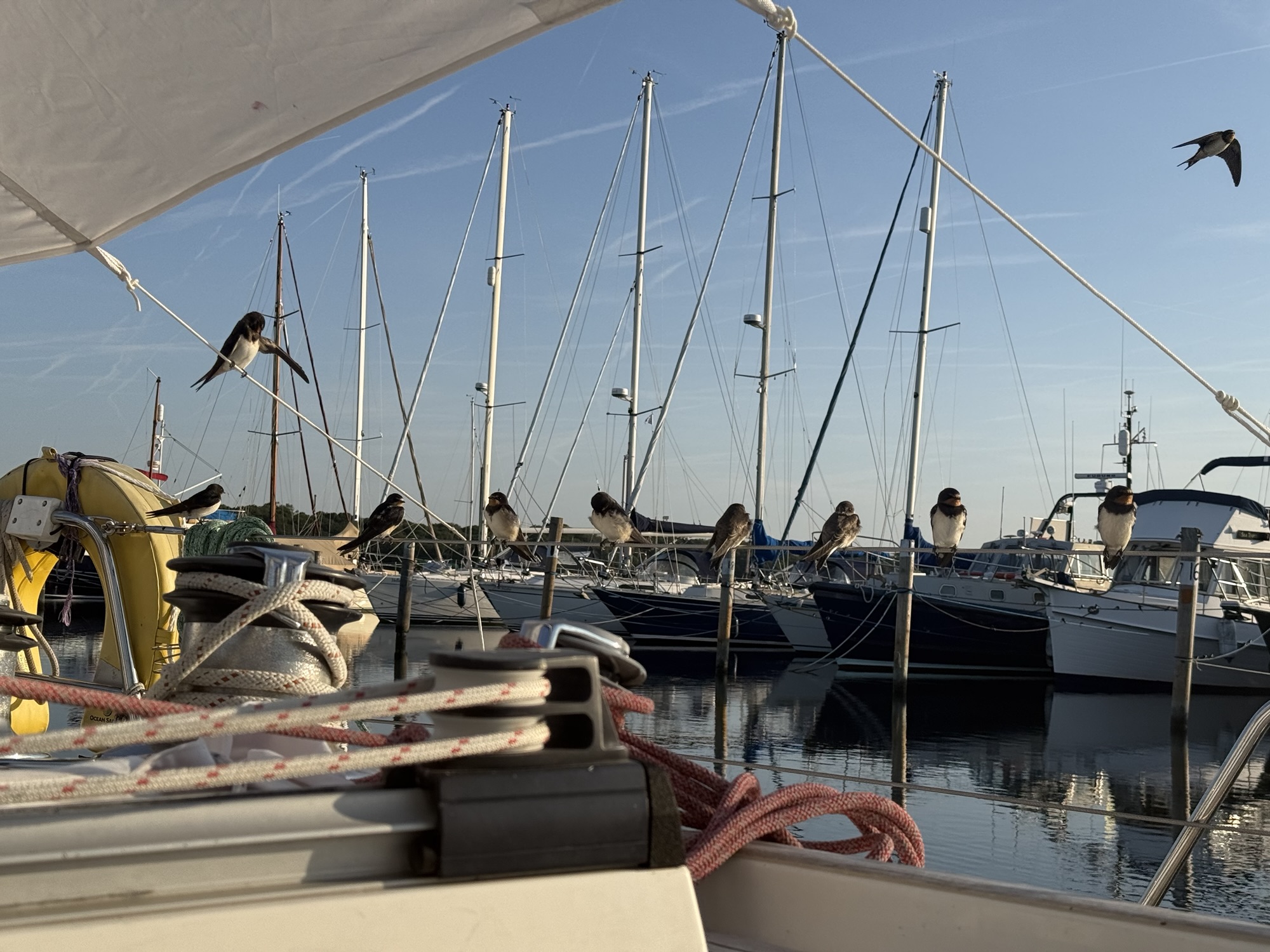
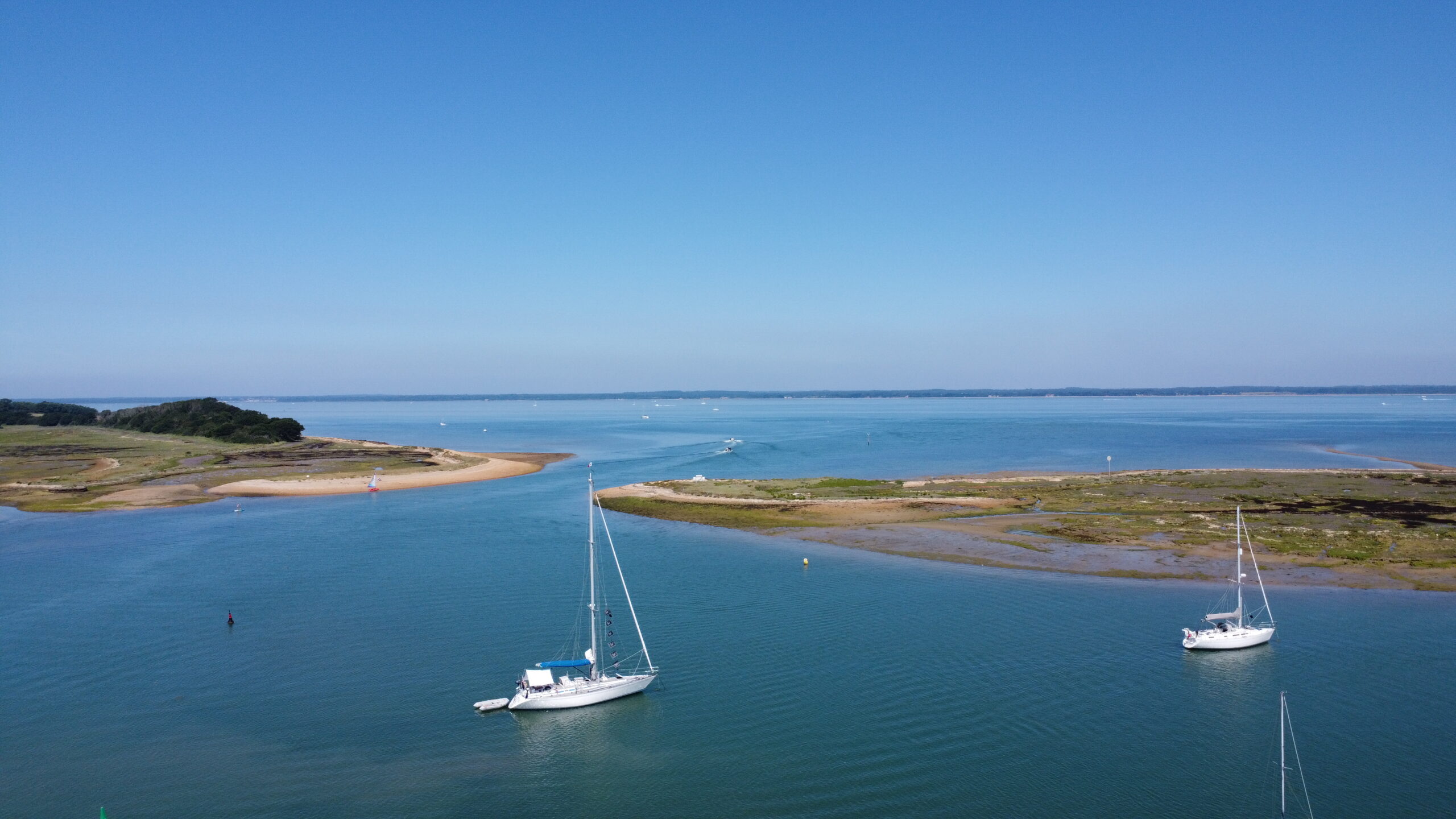
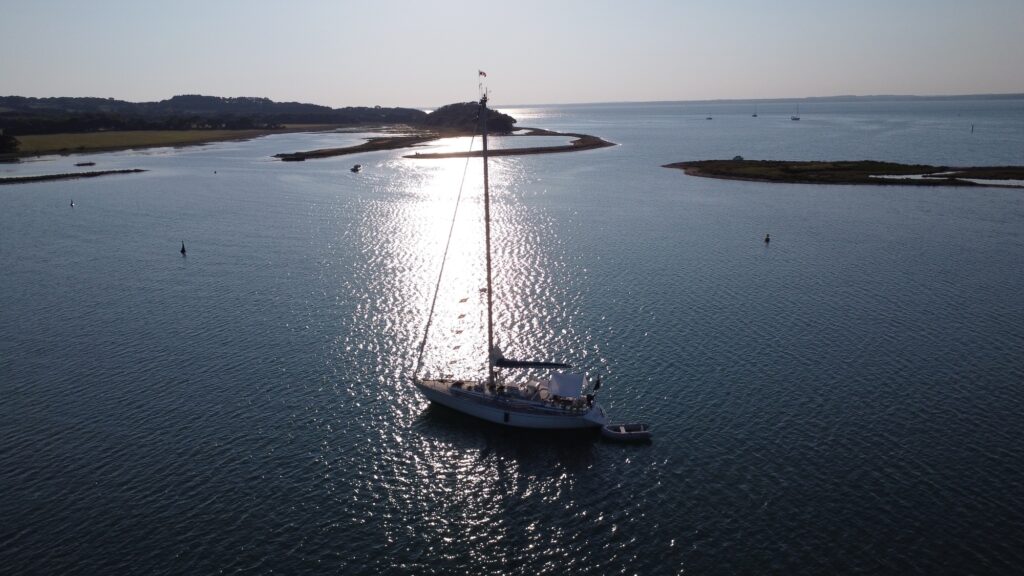
The start of our summer trip has been a bit leisurely: I’ve been slowly recovering from having been ill for most of July, so we’ve been taking it slowly. On the first Sunday morning, whilst still in Birdham, we were awoken by a lot of Swallow song. I got up to put the kettle on and was somewhat taken aback to meet a swallow in the saloon, who’d just flown in via the foredeck hatch. He (it was foolhardy enough for me to assume it was male) saw me, and gently turned and retreated back to the forepeak and back out of the hatch.
Foredeck hatch view
When he, or one of his friends, returned I had my phone ready.
Swallow investigating the forepeak
One of the morning tasks was cleaning the deck. To be fair to the swallows they weren’t really the culprit. The Starlings that had been gorging on blackberries and then perching in large numbers on our mast head were much more of a (messy) issue.
We spent the first full week of July trying to hide from the heat in London on the boat. Sunday 5/7 saw us leave Birdham for the Beaulieu river, where we exercised our RCC membership perk of a free mooring in the river. We stayed a couple of nights and on the Monday night took the tender ashore at the Royal Southampton Yacht Club’s Gin’s Farm landing for a nice walk ashore where we got to watch some farm workers rounding up cattle in the marsh, in order to put ear tags on the newest calves.
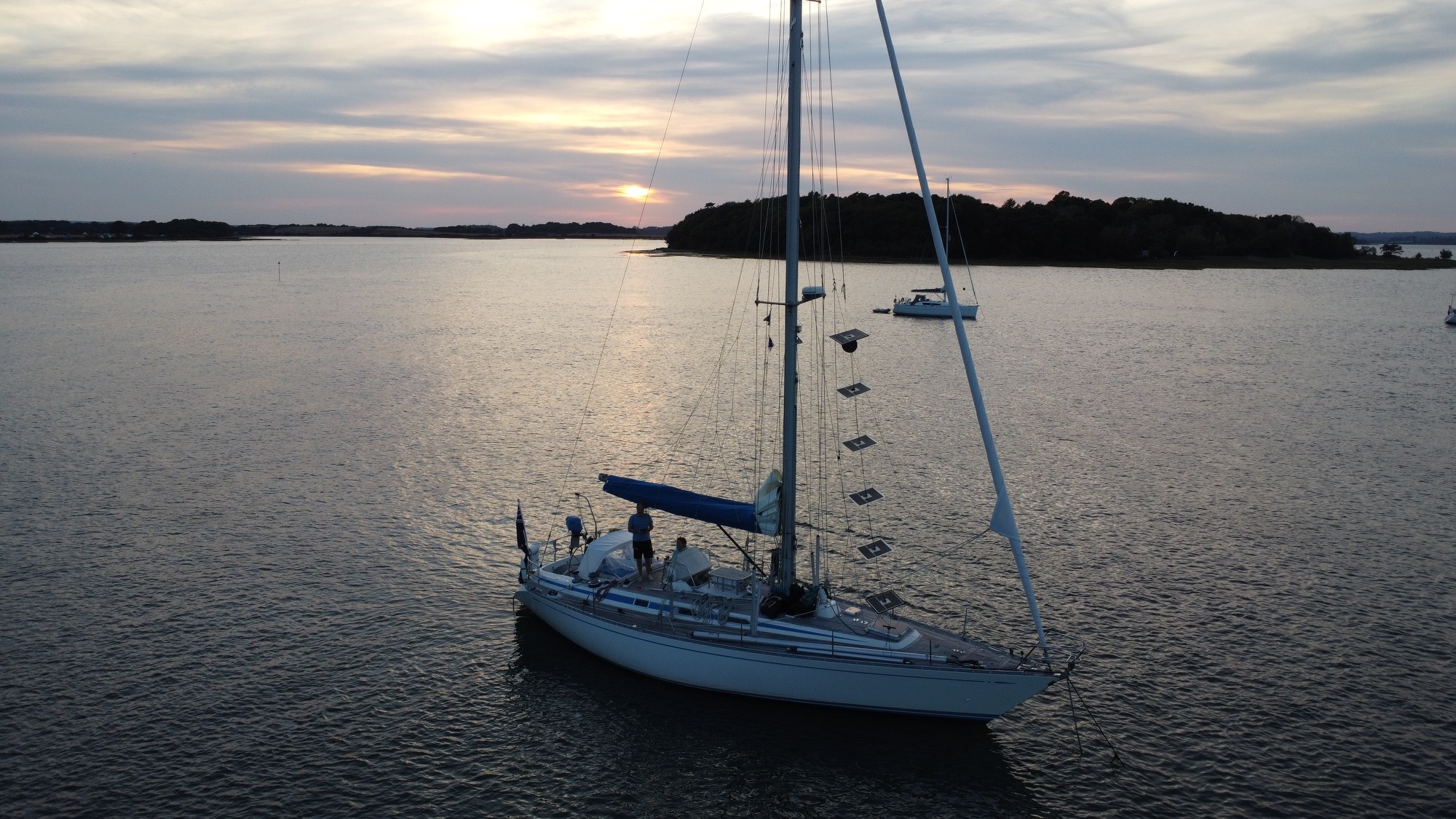
We were both working, courtesy of the Starlink, so could only move the boat outside office hours, meaning that it was late afternoon on Tuesday when we were able to sneak across the Solent, towing the tender, to anchor in Newtown Creek, where we spent a further couple of nights. We found that our solar array offset most of our daytime power consumption and even charged the batteries a bit, so we had no concerns about power all week, which is areal vindication of the system.
Anchored in Newtown
I’d been struggling for a while with what turned out to be a return of the Post Viral Fatigue that has plagued me since I had Covid quite badly in 2020, and a secondary infection that was affecting my ears. The idea had been to have a gentle week and rest up to recover, but by the end of the week I was no longer in a fit state to work. We headed back to Buckler’s Hard for Thursday evening, and spent the nigh in the Marina, filling the near empty water tanks (turns out we use about 40l/head/day when eating and showering aboard) and taking the opportunity to fill with diesel on Friday morning, after I’d had a teams call with my consultant.
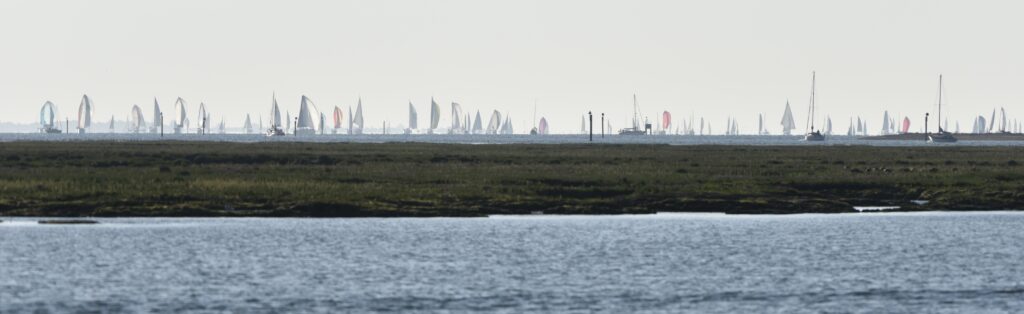
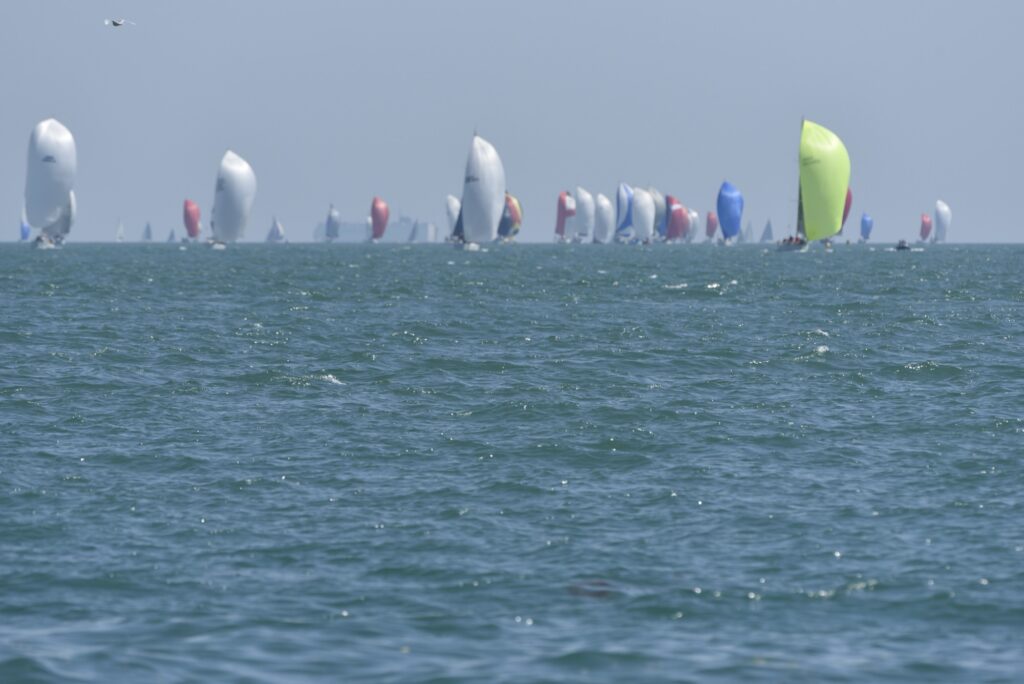
We spent Friday night back on a mooring down river and saw the start of the Round the Island Race pass the Beaulieu river on Saturday morning.
RTI Start
We headed home on Saturday, passing the returning RTI fleet off Bembridge.
RTI off Bembridge
We paused briefly in the Thorney Channel, but decided that the increasing forecast made it more sensible to lock back into Birdham that evening, and returning to London in the morning.
We’ve been members of Itchenor SC for about 15 years. We joined when we got involved in sailing XODs – wonderful Edwardian day boats that are raced very hard indeed. We’ve remained members partly because I’ve always planned to go back to sailing XODs when I get time, but also to support the place as it is the most extraordinary dinghy club. I’m used to places like the Hythe sailing club of my teenage years, or Wilsonian on the Medway from my 20s. These are basic places (Wilsonan didn’t even have mains electricity) with big dinghy parks and catering, bar and racing all run by the members. Wilsonian’s start line was a garden shed installed on a platform built on top of a WWII pill box. I may have helped build the shuttering and pour the concrete for part of the seawall by it.
Itchenor has a full time staff team, hotel standard en-suite rooms, if needed, lovely bar and excellent food. We were won over by the dayboat racing finishing in time to be back to the club for tea and (excellent) cake. It has a fleet of 6 or 7 RIBs, and three committee boats, the largest of which, Betivuka, is good sized 28′ launch, with excellent facilities.
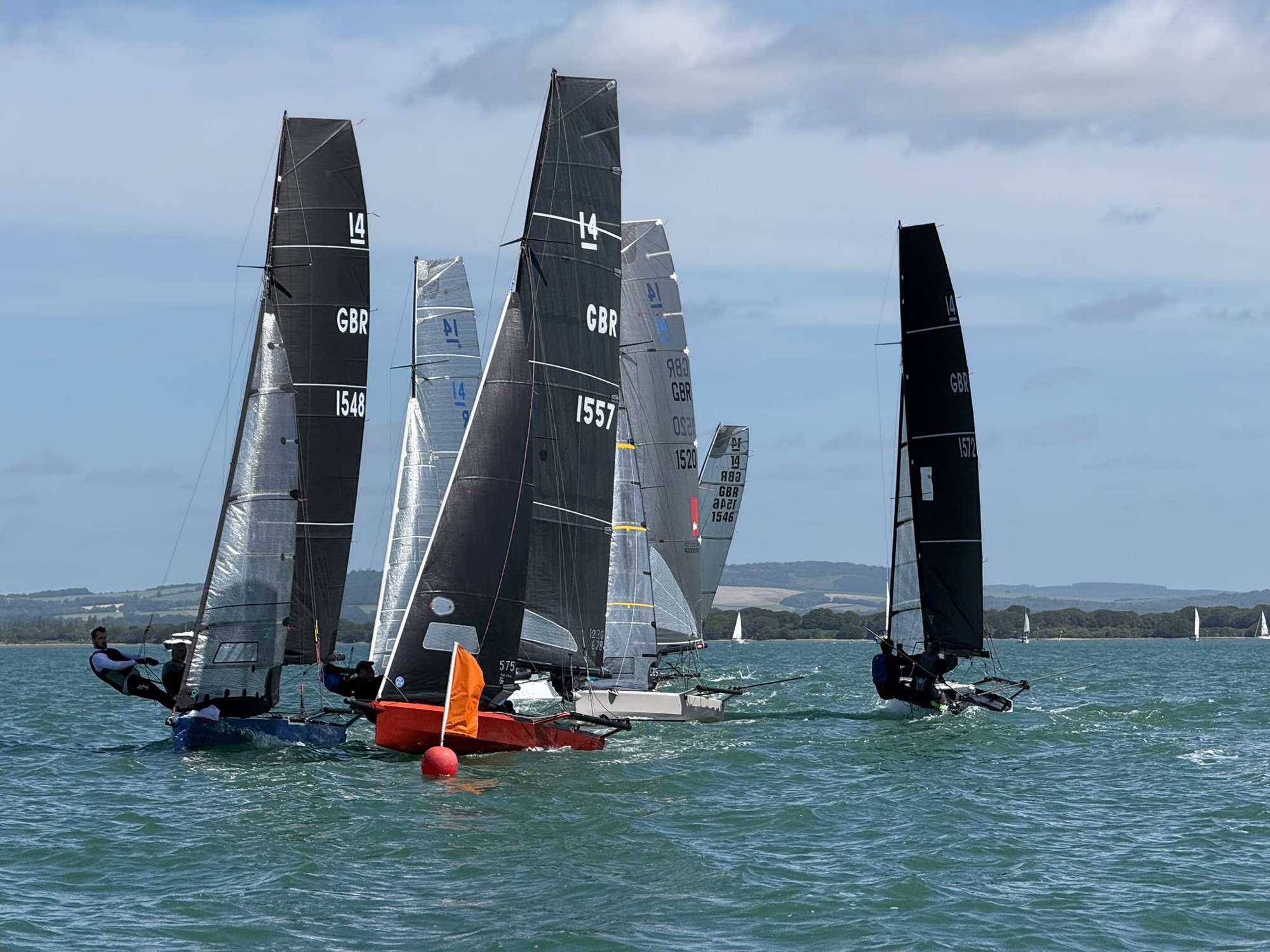
Whilst most of Itchenor is run by a very professional staff team, there are nonetheless on the water duties for members to run the racing operations – either on the committee boat or the RIBS. We try to get our duty days each year to align with a day when the 14s are racing out of the harbour – as I find it much more fun and the 14s can really stretch their legs on open water. The club, like many, has a number of class fleets, and no handicap racing. The International 14 is the highest performance boat in the club and they are fantastic machines. They are a development class, so any boat that meets a set of design parameters is class legal, resulting on a fair bit of variety. The boats have evolved very significantly over the near 100 years of the class – a modern 14 is a very low profile carbon skiff hull, with racks, twin trapeze, a carbon mast and retractable bowsprit that almost doubles the boat’s 14′ length. The rudder is a T foil that is actually used not for lift, but to hold the transom in the water off the wind. They can exceed 20kts off the wind. The club is home to one of the UK’s larger fleets, and includes a few internationally dominant sailors.
Mid June saw our duty weekend roll round. Sadly the racing was in the harbour as not enough boats had confirmed in time to commit the resources needed to race out of the harbour. Nonetheless it there was some great sailing, and I rather enjoyed looking after the mark laying for the fleet, and providing safety cover.
14s rounding the top mark – yes the mark needed a heavier sinker!
Saturday saw a westerly that allowed a windward leeward course from the Itchenor channel up past Hayling, and then a reach into the Emsworth channel; whilst Sunday saw a southwesterly that backed southerly during the first race, resulting in a hasty re-laying of the windward mark on the eastern edge of the East Head anchorage. The video above is from the second race with the repositioned top mark.
The harbour authorities have been cracking down on powerboat speed in the harbour – in many ways with good cause – but this has now extended to club safety boats. We may now only exceed the speed limit of 8kts if we believe someone is in trouble and in need of urgent assistance. I think that the huge problem with this is that with a fairly small number of boats in a fast fleet (like 10 Int 14s), that need a large course area, you just can’t stay close enough at 8kts (the speed limit) to even know if they are in trouble. I lost sight of one and only realised it had capsized when they’d recovered themselves and emerged from behind some moored craft. At 8kts you can’t keep up, or even open up the angles to keep them in sight as they navigate the harbour. 9 times out of 10 a 14 capsize is routine, and the last thing they want is you getting in the way, but as twin trapeze boats with no air pocket when inverted the risks of entrapment and drowning are very real. As a (very?) experienced safety boat cox I want to have good eyes on and be counting heads long before the 3 minutes post capsize that could mark the start of irreversible brain damage from hypoxia.
I appreciate the harbourmaster’s dilemma. Not many of the people doing their club duties have my experience – last year I had to help a different club’s safety boat recover a swamped capsized dinghy as they didn’t know how. But equally I felt very uncomfortable on the Saturday with a big course, where I couldn’t keep sight of what was going on. You might think that the solution is zonal safety boats each looking after a portion of the course. That would work but would have needed at least six safety boats for a 10 boat Int 14 fleet on Saturday. On Sunday there was a bit less breeze and with that and the wind angles the course area was smaller, which helped.
Even then, on Sunday I did break the speed limit. A Laser 2000, that was not part of the Itchenor fleet, had passed me with a father and two sub teen children on board. The boat looked like a sailing club rental boat, and wasn’t part of a fleet, just out for a lovely sail. Just after one of the last 14s rounded the top mark there was a gust that saw them overpowered as they hoisted their kite, and they went swimming. The Laser 2000 had their kite up too, and wasn’t able to depower fast enough either. Both were about 500m from me, and about the same distance apart. I got the safety boat up on the plane, checked for heads on the 14 (who were fine) and headed for the Laser 2000. They were Ok too, with the daughter not just with dry hair but also clutching a collection of water bottles and stuff that had floated out of the boat. She clearly hadn’t been put off! I stood by to windward and ultimately held their bowsprit to let the boat blow out to leeward once they’d got it righted but hadn’t yet got back on board. The father thanked me and said he’d been very pleased to see me there.
It was all looking so good – we just got onto the platform at Waterloo on time to catch the 1705 to Southampton Airport Parkway and on to Universals where we had a table booked for dinner at Riverside Social at 1945. We put our bags in the rack and sat down, just in time for the guard to announce that a person had just been hit by a train near Vauxhall and the power was off all lines out of Waterloo to allow the emergency services access. Someone else and their family was clearly having a much worse Friday evening, but it left us replanning.
We decided to head back to the flat and drive to the yard and then we could relocate the car to Birdham on Saturday. We were even only 20 minutes late for dinner. Saturday saw us take the morning tide round to Royal Clarence in Portsmouth harbour, where we get a free berth as it is the sister marina of Birdham. Once Trouper was tied up we took an taxi back to Universals to collect the car.
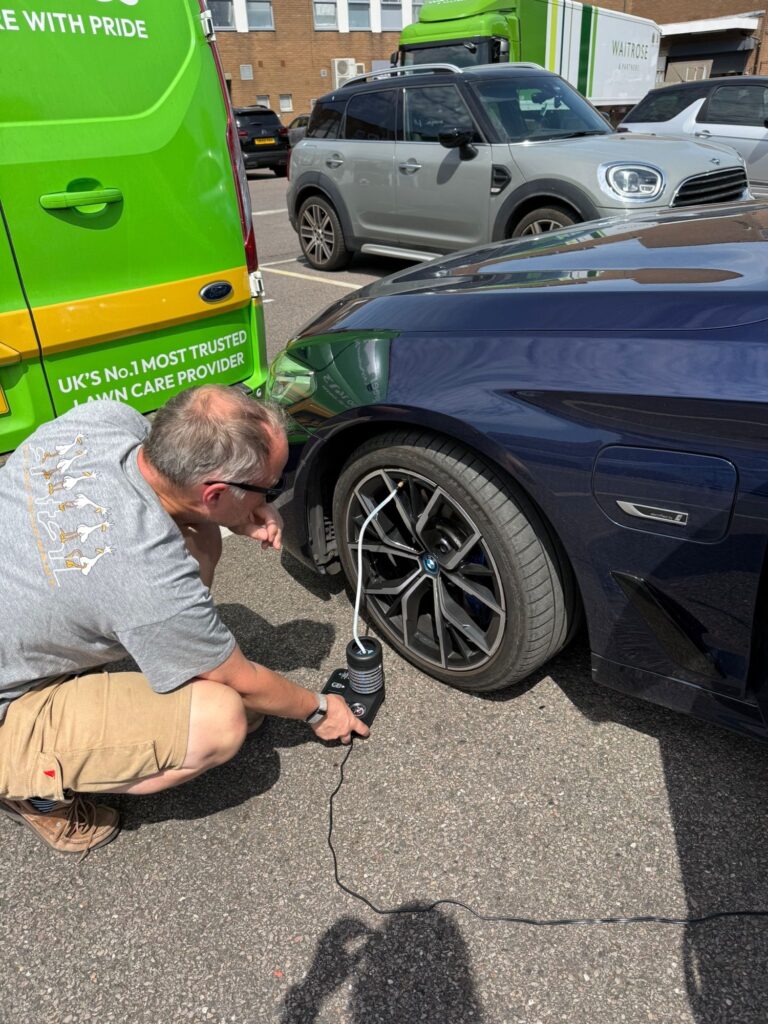
From there we headed to Gosport and Waitrose to provision for the trip to France we had planned. Unfortunately as we left the car park I realised that we had a flat front nearside tyre. I used the BMW supplied temporary repair kit to get the car drivable, dropped Kathryn at the boat, and headed to Birdham to leave the car, and where Graham was going to pick me up and take me back to Gosport. The reason for the trip was to deliver Graham and his partner, and a load of stuff, to Cherbourg to join her eldest son’s new boat on its delivery to Valetta via Lisbon.
Temporary tyre repair
Saturday evening saw us have dinner in the Marina with another friend who lives on the Hamble and we left for Cherbourg early on Sunday morning. It was a motor to start with and then the wind built with the second half of the trip hard on the wind with 20kts over the deck, and a reef in the main and a few rolls tucked away on the genoa. We got in early evening to be met on the pontoon by the delivery crew and proud new boat owner. We went for an excellent dinner in the yacht club on top of the marina office. I’d never been before as it always looked closed from the outside. The furniture was a bit dilapidated with torn covers on chairs, but the food was excellent and there was a super hot charcoal grill that delivered me some fantastic lamb cutlets.
The new boat was in Cherbourg for a 1000nm service by the Nautor Swan Global Service team from Hamble, who’d been working on Trouper the week before. A couple of minor problems had been found during the delivery from Finland, and the rig was due a check. They were due on Tuesday.
Monday saw fair weather, although Kathryn who’d just finished a course of antibiotics for a chest infection was really quite unwell and stayed in bed all day. The rest of us took the new boat, a Swan 51, out for a couple of hours for a quick sail. It’s a beast – and effortlessly quick, but huge.
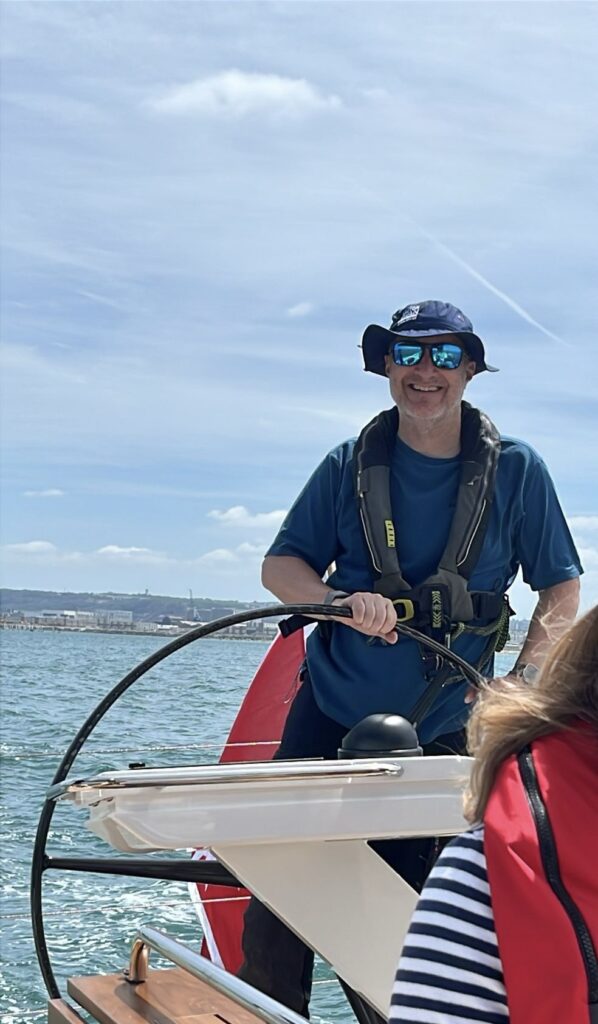
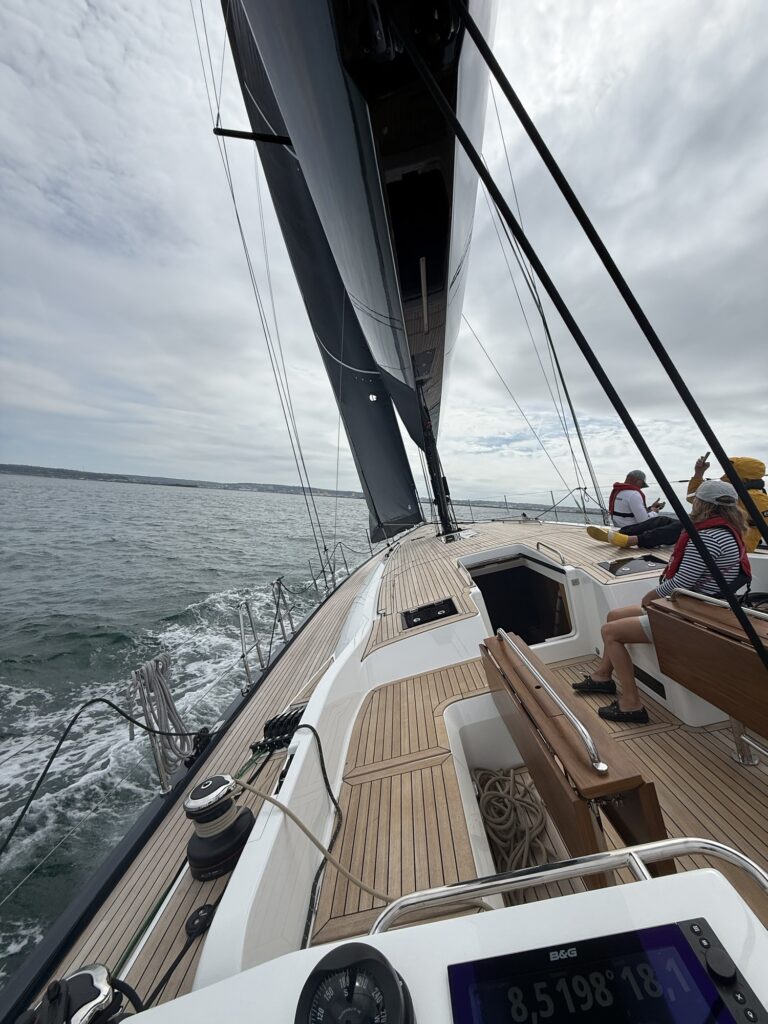
Big grin whilst having a driveSwan 51 Deck
Tuesday saw the weather turn with drizzle and over 20kts of breeze. By the time I was heading out for Croissants at half past eight the Swan team were already most of the way through the rig check with one of the team up the rig. Later in the day they were also able to fix the nagging electronics issue that had put the bow and stern thruster out of action – much to the relief of the delivery skipper. I was really impressed by him – he runs a sailing school in Montenegro, and does a few new boat deliveries every year. He and I had a bit of a laugh on Monday when we met heading for the same rope in anticipation of the same possible problem (that never came). He was saying that he wants to come back to the Channel area to cruise as it is unfamiliar ground for him but looks really interesting and demanding. He said, much to my entertainment, that you can have too much sailing in hot weather with no tide. He’s got my details and I’ll be happy to offer him what advice I can if he does come back.
The Swan guys also had a look at our dyneema backstay as it seemed to have stretched a bit – it’s due to to be replaced with new rod once we’re back in the UK, but in the meantime we do need to get back home! They checked the splices, which seem secure and I then wound the bottle screw so that we could get some tension as we’d hit the limit of the backstay hydraulic ram’s range.
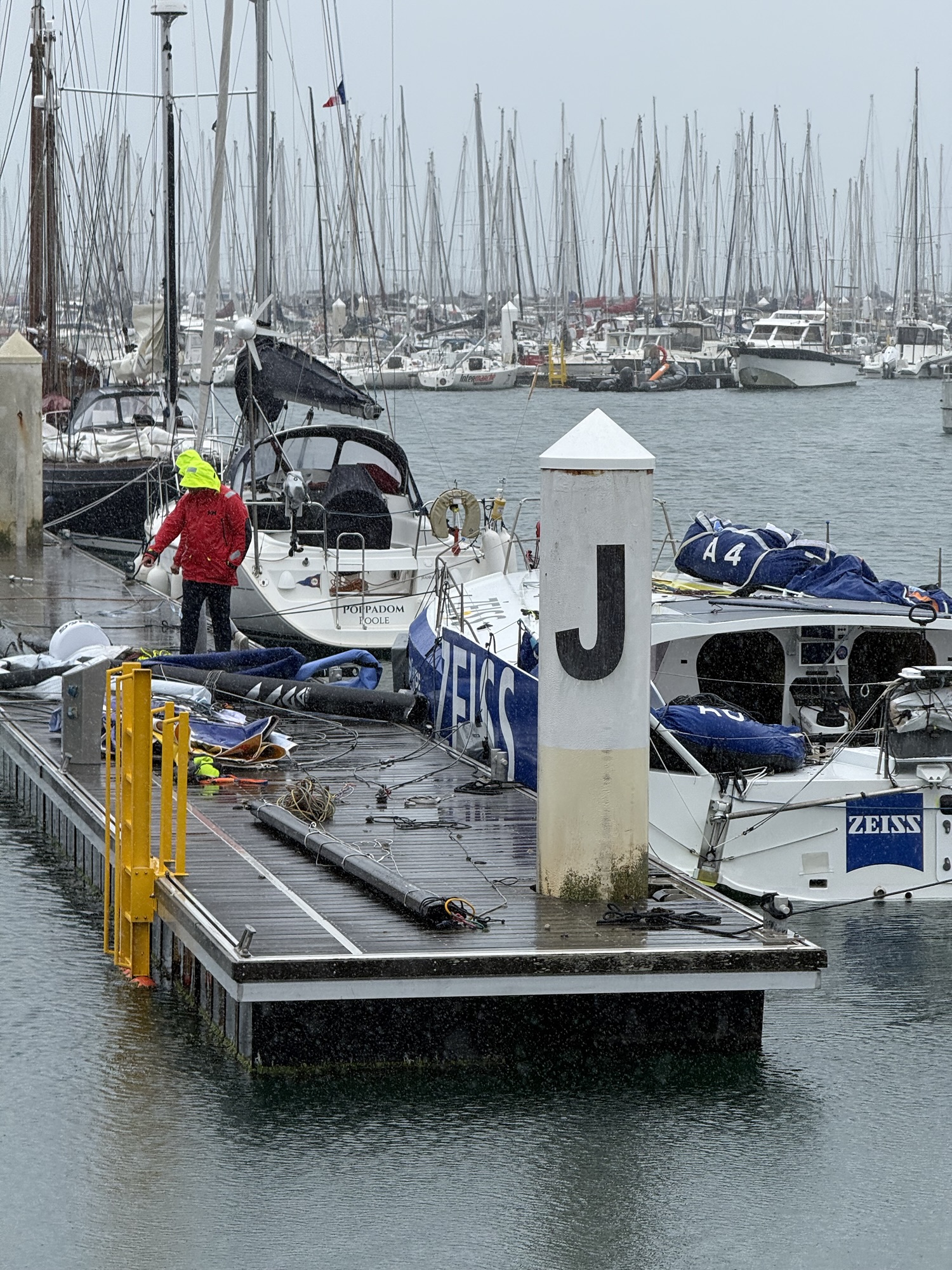
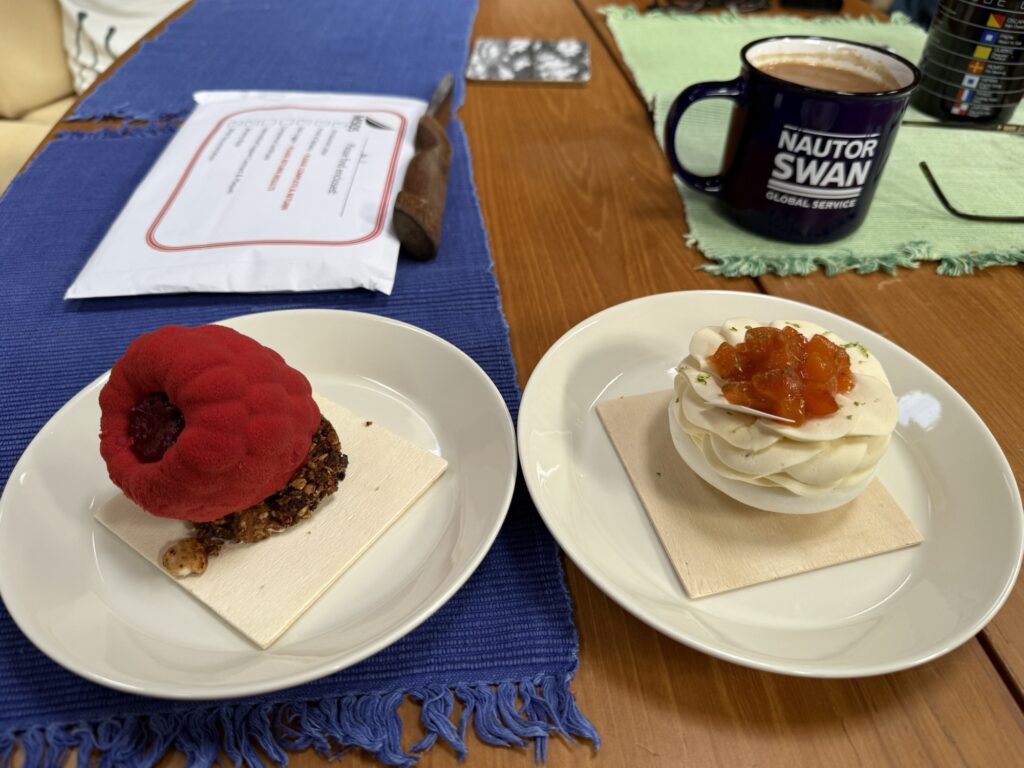
On Wednesday and Thursday we were very definitely weathered in – although the local sailing school was still taking out fleets of 10 year olds in Oppies. The harbour steadily filled with broken boats: a Class 40 race took a bit of a pounding from the weather. We took it easy, did some boat chores, a Carrefour run, and I reworked this Website. Pâtisserie might have been consumed.
Excellent Pâtisserie
One of the boat chores was making up new leather covers for the lifeline bottle-screws where they join the pulpit at the bows. These protect the headsails from being damaged by the sharp edges. I cut two but only stitched one in place before the rain returned – the other is next weekend’s job.
Friday saw a weather window for both crews. The new Swan left at about 0200 French time for Roscoff, going north of Alderney and tacking back just off the Casquettes TSS. They got into Roscoff at about 1800, having motor sailed. We left at 1000 French time and made Chichester at about 2000 UK time after an uneventful passage also motor sailed, in an about 12-16kts of SWly. It wasn’t quite enough breeze to keep up a decent passage speed under sail… If we had the top down furling asymmetric that’s on my wish list it would be a different story. We steered 020 from the Cherbourg breakwater until past Bembridge, when I thought we were a bit too far to the East for the west going tide to sweep us home.
By 2030 we were on the Itchenor walk ashore pontoon, and could see the wall of cloud as the next weather system rolled in. Saturday saw us go for a short walk along the harbour path before being discouraged by the rain and returning to our books, and this website. It was properly windy. We saw over 40kts in the gusts and the Nab reported over 50kts. We elected to stay where we were given the weather, as trying to get Trouper into Birdham’s lock, which is a bit of a squeeze at the best of times, seemed like an unnecessary risk with huge gusts beam on – especially once the lovely Sara, the duty lock keeper, had offered to come in early for us on Sunday. She very kindly came in at 0530 so we could lock in an hour after HW. There wasn’t a lot of water under us, and I felt vindicated in my rule of thumb of not trying to get in after HW+1, but we were secure on our berth by 0550 and back to bed for 90 minutes.
Once Trouper was back afloat with a working propeller I was keen to get her off the mooring and to actually start to make use of her this year.
Before we could leave on the Saturday there was a chunk of last minute work to be done that I’ve described in Last minute maintenance and New Displays.
That filled most of Saturday but we did manage to creep out into the Harbour on the evening tide after dinner and spend the night at anchor in Thorney Channel – one of my favourite spots in the harbour.
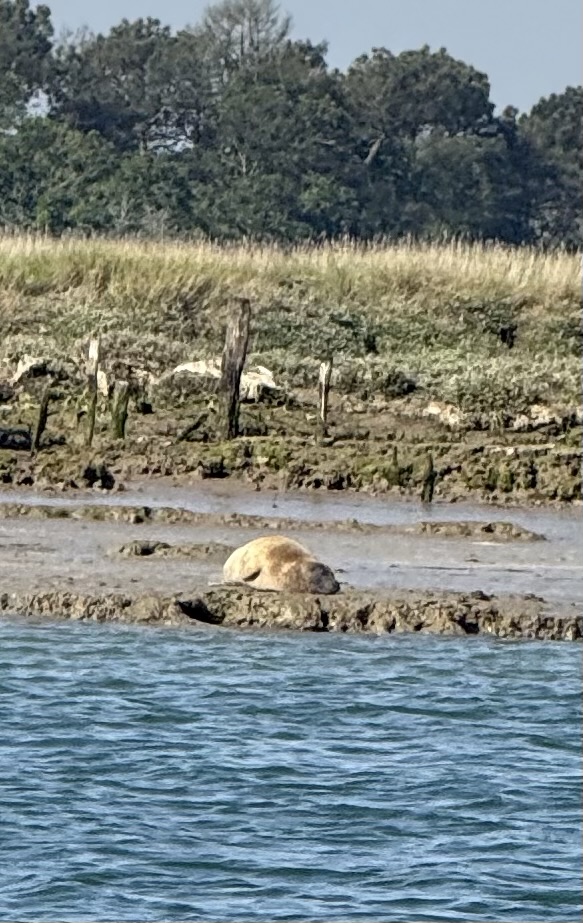
On Sunday we left in the morning, after stopping for a chat with our friend Graham who’d anchored his Swan 36 at East Head for the night. We then drifted and motored to the Beaulieu river when we picked up a mooring, put up the sun awning and set about testing the theory that RCC members get upto three nights free on a visitors buoy. In the morning the harbour master turned up in his dory and confirmed that it was true. Overnight this guy hauled out next to us – and snored quite badly.
Seal
We left the Beaulieu River late Monday morning and popped round the corner to Universal Marina on the Hamble where we left Trouper for the rest of the week with Nautor Swan for them to finish the rig work from the previous winter. They fitted the new burgee crane allowing us to fly our RCC burgee from the truck (see Overengineering a pig stick for more on this) and their sub contractor replaced the underlength D1s and V1s from last winter. Whilst she was there we agreed to switch out the new dyneema backstay for a rod one. It’s a long story but in the end we all agreed that rod was a better option and they’ve been very good about the cost. We also agreed to revert to the wire babystay, and the refund for that and the backstay covers almost all the cost of the rod backstay. I might swap out the babystay myself later, as a more flexible material would help with stowing it when it is not in use. They’ll fit the new backstay whilst the boat on its berth at Birdham. Overall they’ve been very good to deal with.
We left Poole on Monday afternoon and headed for Lymington, where we arrived in time for some excellent fish and chips. We stayed in the Yacht Haven, rather than the Berthon, as they had room. My father used to keep a boat here in the late 90s that I used to sail regularly. The marina has expanded somewhat since then and is now the home to a lot of charter power boats as well as the local sailing boats. The size of the boats, especially the powerboats is surprising, especially after the French coast where we were on the big side, and big powerboats were very scarce. Not so here…
After a day in the marina (avoiding the 25kts blowing in the western Solent), and some grocery shopping, we made our way across to Yarmouth for a night, and dinner at the Beach Hut.
The plan had been to anchor in Colwell Bay, which is opposite Hurst spit on at the western end of the Island, just before the Needles. the restaurant runs a tender service and will collect you from your boat and deliver you ashore to your table. We’d been texted the day before our booking announcing that in light of the weather forecast they’d not be running the tender service, but would collect us from Yarmouth using their minibus or landrover. This was no surprise – in the forecast weather there was no way I was going to anchor in Colwell Bay, let alone spend a night there after a nice dinner.
The Hut, Colwell Bay
The meal was lovely but twice the price of our Michelin starred meal in France, and whilst well prepared Kathryn thought that her fish was not as fresh as she’d become used to. It was, however, a lovely experience and a nice closing chapter to our trip.
We spent another day, Thursday, in Yarmouth to avoid more weather – a steady 38kts in the western Solent at one point, and made a very quick passage back to Birdham in 14-20kts on Friday. We arrived with just enough water to get to the lock and were on our berth by early afternoon. We did a quick tidy, grabbed the essentials and took the train back to our London flat, where we had a take away from our local, and excellent, Chinese, the River View.
Saturday saw us drive back down to the boat so we could load up with all the stuff to come off the boat and give her a proper clean before heading back to London on Sunday morning. We’d meant to have lunch at Itchenor sailing club with a friend from the club, but due to an ambiguous message exchange we thought he’d had to cancel and heade home. He’d meant that he couldn’t have lunch but would meet us for a drink… so we had a FaceTime chat once we were all back at our homes. He’s just had a hip replaced so I feel a bit guilty about having made him walk to the club and back. Nonetheless he’s invited me to apply to become a member of the Royal Cruising Club, which is a great honour. I may not make it through the selection process, but I’m rather pleased.
We left Treguier at about 0930 on Friday and, once clear of the river (and all its off-lying rocks), set a course for the Cap de la Hague, the South Western tip of the Cotenin peninsular. The straight line track takes you a bit close to some rocks half way to Guernsey and then straight through the Big Russel channel between Guernsey and Sark. On the way you get a good sight of pretty much all the other Channel Islands. We arrived in the Big Russell as the tide turned in our favour and started to push us towards the gap between Alderney and the mainland, known as the Alderney race.
Tides are effectively a collar of water drawn out from the planet by the gravitational pull of the sun. The collar goes round the world and the planet rotates once a day resulting in two tides a day where there is open water. Every two weeks there are larger tides (springs) when the moon is in line with the sun and its gravitational pull contributes, and in the intervening weeks the moon’s contribution drops to a minimum when the moon’s pull is at right angles to the sun’s (neaps) before increasing again until it is in line once more. The magnitude of tides is further effected by the earth’s elliptical orbit around the sun – when we are closer to the sun (the equinoxes) the gravitational effect is greater, and the tides bigger, resulting in higher high tides, and lower low tides.
We’d had to wait in Perros Guirac because the neap tide had not been high enough to reach the level of the water in the harbour held behind the sill. The following day when it did open there was only 30 minutes of open time predicted, and when the sill did open there was actually a 30mm or so difference in height of water, resulting in a huge inrush of water as boats were manoeuvring to hold position in the queue to leave. I’d seen what was happening and tucked out of the way with a couple of others, but there were a couple of collisions, one of which sounded quite substantial, from boats being swept around in ways their skippers clearly hadn’t expected.
As the collar of water, that creates the rising tide, approaches the French coast heading east, the opening for it to pass through to get to the east narrows progressively, and then it hits the Cotenin peninsular and has to all work north to get around the top and on towards Dover. This creates the Alderney race where currents of 10 knots have been recorded.
Tidal streams in the Channel Islands
I’d timed our passage so that we’d ride the tide north through the race and maximise the tidal contribution, but that meant that we’d not get to Cherbourg till about midnight. I was quite pleased that aside from some collision avoidance course changes we didn’t change course from the entrance to the Treguier river till the Cap de la Hague – some 70nm. Our ground track describes a curved track as our passage over the ground is affected by the tide sweeping us one way and then the other. The shortest distance for us is the straight line, through the water, so there’s some satisfaction to be had from getting your sums and judgements right and not to having adjust your course.
Our ground track to Cherbourg
In Treguier I’d been a but puzzled at the large number of near identical aluminium exploration yachts, all in the 45-55′ range. Looking a bit more closely they were all made by Boreal, which turn out to be made in Treguier. They look like really tough go anywhere boats of a sort I find really quite attractive – lifting keels, unpainted aluminium hull and big deck houses providing a lot of protection to the cockpit, and a great view out from inside. Very different to Trouper, but would enable a very different kind of exploration.
We got to Cherbourg and were tied up for about 1130, having made better time that we’d expected. We we both tired and had a quick shower on board and went to bed. On Saturday morning we got up, I filled Trouper up with water, and did some nav prep whilst Kathryn made a quick sortie to the boulangerie for bread and patisserie. We then settled up in the marina and joined the queue for having your passport stamped by the PAF. They turned up bang on time at 1030, and we were clear by 1035 and back to the boat which we then took to the fuelling berth and filled up with diesel (there was little wind in the forecast) and were away. It was about 1130 by the time we got out of the harbour, about an hour or two out of Cherbourg the wind filled in and we got 3 or 4 hours under sail before boat speeds started to drop and we needed to motor once more.
Our track from Cherbourg to Poole, showing the effect of the tide.
We made Poole harbour entrance with the rising tide as I’d planned and had enough water to safely get over the shallow patch off Brownsea Island and into South Deep, which is a favourite anchorage of mine. We met some good friends sailing another Swan who’d anchored there on their way from Salcombe back to the Solent. We anchored nearby and they came over by tender with a bottle of rum that they’d started earlier. A couple of very pleasant hours passed and the rum was dispatched and some of Trouper’s gin stocks were also depleted. They left Poole in the morning heading home and we took the rising tide round the corner into my favourite corner of South Deep. I blew up the SUPs and we spent another night there and left on Monday afternoon, following more SUPing, heading for the Solent.
South Deep looking to the South East.South Deep, looking to the North with Green, Furzey and Brownsea Islands.Trouper in South Deep.
We’d been planning to head towards St. Malo from Treguier with a stop in Saint-Quay-Portrieux, which I spent a night in some dozen years ago during Trouper’s first summer tour. That summer Kathryn and I had been beaten by the weather in our attempts to get to the Scillies but had had a glorious time exploring Falmouth harbour, and had gone out with my family from Fowey, and hove to off Gribbin Head to scatter my father’s ashes in a bit of water he loved sailing. He never saw Trouper – but I’m very confident he’d have approved. Anyway Kathryn and I had left Trouper in Falmouth and a week later I headed down with some work friends. Three of us took Trouper back up to Fowey where we had a day walking a bit of the Cornish coast (and my friends had a swim) before we were met by two more friends that evening. We left Fowey at about 9pm, having to pause on the way out for a firework display in the harbour to finish. We sailed straight to St-Quay-Portrieux before heading on to St Malo where one of the crew left us and another joined us, necessitating a day wandering around town and swimming off the beach, before we headed North to Guernsey, and then on to Portsmouth, and thence home.
Our plan had been to retrace some of those steps and have dinner at a lovely restaurant (a Michelin happy eater…) we found in a subsequent trip with other friends in St Malo, whilst getting our passports stamped there and heading home via the Channel Islands. However, looking at the weather forecasts over the last few days (and the Met Office’s excellent ‘Deep Dive’ YouTube videos that discuss the forecast and models in detail) we’ve had a bit of a rethink. Hurricane Erin rapidly grew into a category 5 storm over last weekend and as its remains track across the north Atlantic as a mid latitude low pressure system it is generating a fair bit if uncertainty about next week’s weather. If nothing else it is clear that it’s likely to deliver some significant swell into the western approaches an on into the channel next week.
Ventusky Display of Meteo France Significant Wave Height forecast for Tuesday evening.
We’ve decided to bank the current certainty and relatively calm sea state we have at the moment, so will stay here another night, but then leave for Cherbourg tomorrow (Friday), which will be a long day as we can’t leave very early if we are to catch the fair tide at Guernsey up to Cap del la Hague. We’ll probably get into Cherbourg marina by about 1 am French time. It would make much more navigational sense to go to Guernsey and head home from there, as I did that first year with Trouper, but now we need to visit a Port of Entry to get our passports stamped to leave the EU.
Last night the marina arranged for a local diver to pop round and have a look at Trouper’s propellor. We’d felt a little bit of unusual vibration, which following the weed on the prop the other day we wanted to check out. He was a lovely guy who put two huge (approx 80cm long) fins, mask, snorkel, and a weight belt on over his wetsuit and easily outpaced the quite substantial tide to have a good look. He was quite apologetic that he couldn’t see anything, though he could feel a little movement in the prop shaft. My guess is that the issue the other day has worn the cutlass bearing in the P bracket which supports the prop shaft at the prop. Renewing that is a job for the winter, but not a big deal. I’m pleased to know there’s nothing tangled down there before a long couple of day’s where we’re likely to be motor sailing.
Once in Cherbourg we can easily get the paperwork done, as the French border police visit the marina office a couple of times a day. We might head straight across on Saturday, once the passports are stamped, but that depends on the forecast. At the moment Sunday looks a fair bit less attractive with a headwind, and rougher sea state, though Saturday will be more motor-sailing with little breeze. But we’ll review that plans in Cherbourg, the forecasts are moving about a fair bit at the moment, and whilst we can have good certainty for 36h or so much further out is shifting about a bit.
We’ll probably head back to Poole, which we’ve not been to for some years, and offers an easy all states entrance. Studland bay might be an option on the way in but we’ll have to see how it looks. The current forecast has it looking very welcoming until the small hours of Sunday when 0.8m waves will start rolling in from the South East, leaving the beach as a lee shore, which would make it anything but a restful night.
Inevitably there is paperwork to complete for our UK entry, though the Borders agency introduced quite a good online system a couple of years ago. It has the odd niggle (why will it remember the passport details of anyone I’ve ever entered, but require me to input my contact details as skipper by hand each time?) but it’s actually quite simple to use. Once in Poole we can have an easy week heading back to Chichester. Perhaps a night or two in South Deep in Poole (a favourite of mine), if there’s room on an August Bank Holiday.
We spent a single night back in Roscoff, having arrived via the passage inshore of Ile de Batz. This was a recommendation from my friend Andy who had enjoyed my account of getting caught out on the outboarnd journey, having done exactly the same himself. With a decent rise of tide the passage is simple, but you don’t want to be plugging a foul tide, as it fair whistles through the gap. Once we’d got in I found a nice description of the passage in the pilot book. I’m pleased to report that that is exactly what we’d done, figuring it out from the charts.
Ile de Batz, and the inside passage
We headed on on Thursday morning for Perros-Guirac which we’d not been to before. It’s a lovely little town with a marina tucked behind a headland and with a newly installed automatically folding sill, to replace the old lock, that lets you into the inner harbour. The approach dries entirely. In the chart extract below the underlined numbers in the green patches are the height above the lowest tide that the land is, in meters with 10’s of centimetres in the subscript.
Perros-Giurec, and its approach
Friday was spent exploring ashore where we found an excellent butchers, supermarket and patisseries. I love that even the kerbstones are made from the local pink granite.
A place in which I could get comfortable (and fat)
Friday evening saw us eat a steak supper on board, and as I was wrestling with getting the VPN working (so we could stream Bookish to our little Samsung projector on board) Kathryn discovered that there was a free concert going on just across the street. We rather liked what we could hear so went to have a listen, and bough a couple of petite beers. The band were modern Breton folk, with a pair of pipers, as well as guitar and a couple of traditional percussion. I’m not sure that I ever thought I needed amplified bag pipes in my life, but they were rather good and there was a distinctly north African feel to aspects of their music. We didn’t enjoy the main act so much so returned to the now working VPN and Bookish (which was a Marina Hyde/Richard Osmand recommendation of their podcast).
Saturday, saw the wind blowing fairly firmly from the east. It’s hardly a gale but it would be hard work to go upwind in, and our next stop is around a headland with a lot of off-lying rocks that would need to be given a respectful distance in an brisk onshore breeze with a little bit of a sea running. Sunday looks no better, but Monday did. I went to the Capitanerie to pay for an extra couple of nights to discover that it will be three nights: there is not enough water at high tide on Monday to open the sill, so we’re stuck here. It’s very much a gilded cage though (see Patisserie above).
We do now have a bit of a timeline – we need to be back for the Saturday afternoon tide at Birdham in two weeks. Plenty of time, as we keep reminding ourselves: a whole summer holiday, but nonetheless we are now starting to plan to a timeline. The other constraint is needing to get to a French Port of Entry: there are a few options but the favourite option at the moment is Carteret on the Cotenin peninsular, and on to Alderney before crossing to Poole/Studland.
Sunday was lost to books (see bibiliography) and boat cleaning. On Monday we caught a bus to Lannion, and then another on to Citie de Telecom, and the museum set around one of the first satellite ground stations, built in 1961/2 for the original Telstar. It revieved the first TV satelite broadcast from the US. Telstar 1 (and 2) was a very small low powered microwave relay satellite that took in a revieved signal and rebroadcast it on a different frequency. It was on an elliptical orbit which meant it was only in sight for 25 minutes every 2.5 hours and was spinning to stabilise itself, meaning that it could not have directional antennas. The result was the very weak signal from a fast moving source, which necessitated a very large antenna to focus the signal of a receiver, and that antenna had to track the satellite with great precision, from horizon to horizon in 20 odd minutes.
Kathryn’s picture of the dome.
The resulting machinery was in use for 20 years or so, before it was retired and declared a national monument in the late 1980s. I’d love to know if the machinery still works – our French isn’t good enough to have established it on the tour. It does look as though it might. France Telecom have a number of other ground stations near there, many retired, but still maintain a large R&D facility. The dome is clearly visible from the sea, and we’d known about it as we’d spotted it on the outbound trip and looked it up. The dome is huge enclosing a large horn shaped receiver and tracking gear. In order not to have any physical dome support structure, that might interfere with the signal, they had built the dome out of a plasticised fabric, which is held in place by air pressure. Effectively a big balloon. During the tour they were at pains to demonstrate the airflow, and you could only leave or enter via air lock type arrangements – one neatly integrated into a rotating door. Until the pressure is equalised you physically cannot open the inward opening exit door.
Inside the dome, with the huge horn shaped antenna, and machinery.
It’s a rainy Tuesday at the moment, and our current plan is a head out at 1530, when the sill opens (only for 30mins today, due to the small tidal range) and head round to Treguier, where we’ll likely spend two nights.
As someone who has spent a lot of time teaching people to use powerboats safely it is interesting to see the French approach to risk management and safety. The UK has a sad history of accidents resulting in deaths and serious injury from using powerboats, especially RIBs. That’s resulted in an approach to managing them and ‘good practice’ standards that are far removed from what I see here. To be clear I see no evidence of the French approach being dangerous, and indeed I suspect that they don’t have our history of accidents, suggesting a higher standard of safety. But what I see would have many of my UK colleagues tutting: no kill cords in use, sponson riding, indeed driving the boats from the sponson and driving whilst standing, even with tiller steered boats. And yet the standard of boat handling is consistently very high with a casual and unconsciously competent displays of excellent boat control.
More generally I can’t help but notice that the French approach tends towards less physical infrastructure and more towards people being encouraged to be sensible. Walking on the wave screen wall at Trinite there was no railing either side – just an obvious edge. Walking around an old castle there was no fence to the drop into the dry moat, just a band of about a meter of larger pebbles to delineate where the safe footpath finished. I must confess I do like the approach of expecting a bit more from people, although I’d still favour the use of kill cords – once you’re used to them they really aren’t much of a pain and are a simple mitigation to a low probability, very high impact event (ie falling out and being mown down by your own boat and propellor).
When, in a former life, I did my professional training in Occupational Health and Safety we were taught a clear hierarchy of desirability of risk mitigations: safe place was far preferable to safe person. the thinking was that in a workplace you should not need specialist knowledge or equipment to stay safe. In a controlled environment that still seems to me to be the preferred solution: you provide effective dust or fume extraction, not respirators to anyone who enters the space. But I wonder if that culture has bled out from making factories and laboratories safer workplaces into the wider public assuming that their safety will be managed for them and that they don’t need to worry about it. That might be one of the reasons why the construction industry has long struggled with its safety record – construction sites are usually difficult to control fast changing environments.
There’s been a lot of research showing that risk perception can have an outsize impact on risky behaviours: across London railings have been taken down around pedestrian crossings, and pedestrian injuries have been reduced. Car drivers are slower and more cautious around exposed pedestrians, yet the old railings afforded little real protection to the pedestrians. I wonder if the French approach to boat handling and education is more effective. But then every town we’ve visited has had huge sailing schools taking all the local children out, so familiarity with the environment is deeply ingrained knowledge.
Cameret proved to be a nice little seaside holiday town that was having a Fete for the local lifeboat, complete with helicopter winching exercises off the quay a little after we arrived. The visitors berths a quite a walk out along the breakwater (no railings…) and the sanitary facilities are a bit basic. We elected to shower on board for the two nights we were there.
Whilst in the Morbihan we’d used the boat’s black water holding tank to capture toilet waste and then pumped out in Port Du Crouesty. The boat was built with a holding tank for the aft head, and you can choose to flush to toilet into the tank or over the side. When built the only way to discharge the tank was to pump it out (by hand) back through the toilet’s normal discharge over the side. For our trip to Holland some ten years ago I’d also fitted a deck pump out fitting allowing the tank’s contents to be pumped ashore. That turned into a bit of a mission. I couldn’t find a pump out deck fitting that visually matched the existing deck fittings for water and fuel. Finally I contacted Nautor, the makers of Swans, in Finland and they explained that the fittings on our boat were custom made to their specification. They offered to have a pump out fitting made to match. It cost about 500Euros in the end, but I felt it was worth it to keep the boat (and Swans of this vintage are sort of iconic) looking right. Anyway in the end it all seemed a little excessive as we never found anywhere on the Dutch canals with a working pump out station, despite all the warnings before we got there that it was mandatory to pump out ashore. I’ve never regretted having the option but had never actually used it before. We connected it up and pushed the button and could see liquid being extracted through the window in the hose. It took a good ten minutes to suck the 120l tank dry. Carteret saw the tank put back into service, though I pumped it out by hand once suitably offshore.
Bespoke Pump out Fitting from Nautor – it weighs about 4kg!
We had two nice dinners ashore in Carteret, and a much needed trip to their excellent SuperU to stock up before we left this morning to head North and up through the Chenal Du Four. After filling up with fuel (215l, the first since Brest) we sailed for a bit to start with before the wind died away. It was grey all day, though not at all cold.
Pte de Saint-Mathieu at the Southern entrance to the Chenal du Four.
By later afternoon we were working out way into Aber Benoit where we picked up a visitor mooring, put the kettle on and tidied up. The harbour master popped by, took 18Euros for the night and offered to take any rubbish ashore if we needed, which was welcome, though not needed.