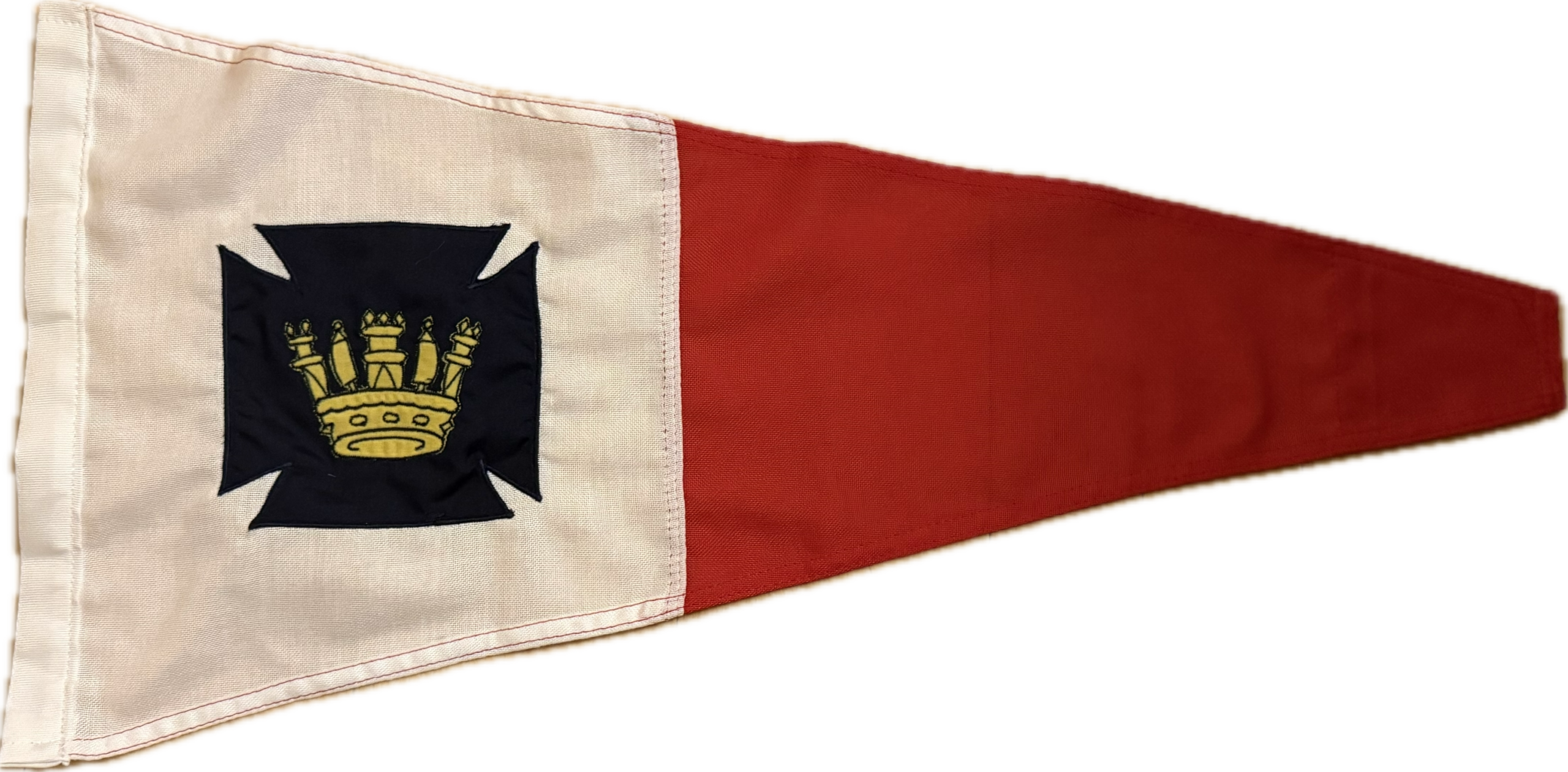
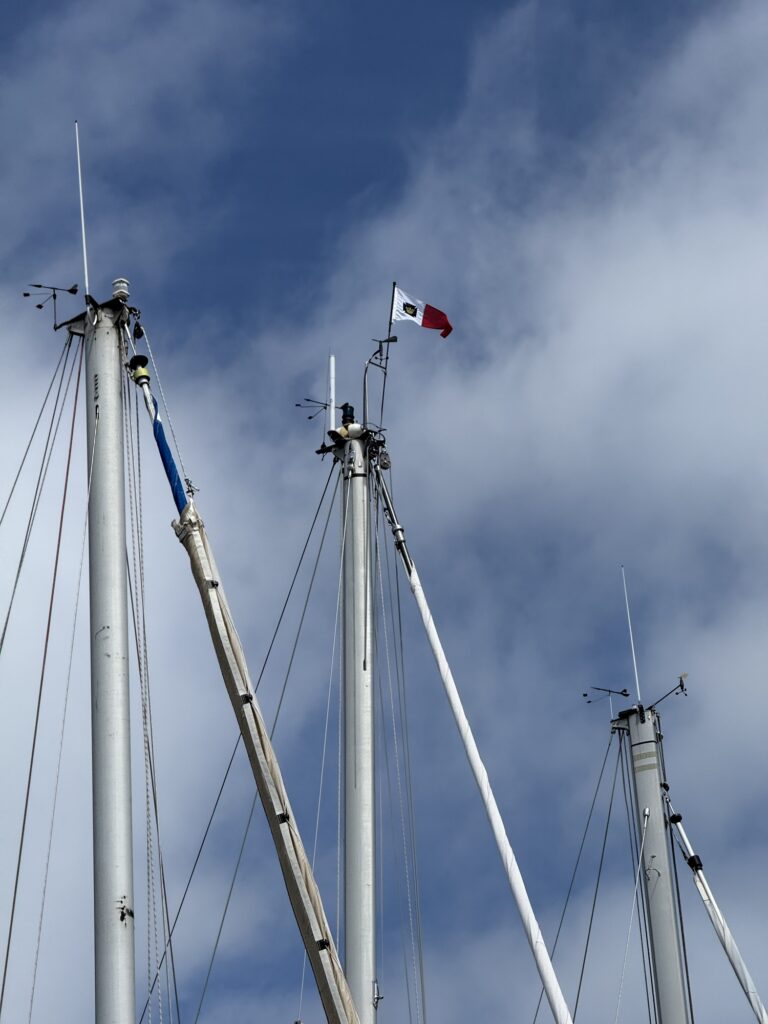
I became a member of the Royal Cruising Club (RCC) this year. The club has been very welcoming and has a thriving online community, as well as regular events and meet ups. It is of course the home of the RCC Pilotage Foundation, the publishers of most of the pilot books I’ve depended upon for years. I hope, in the future, to get involved in producing and maintaining these. The club is pretty relaxed, but does have a thing about flag etiquette. Members may choose to fly an undefaced blue ensign, which is a privilege rarely afforded to Sailing Clubs, but they insist that all members fly the club burgee from the truck (or masthead) at all times. The idea is it makes you easily identifiable and thus facilitates members saying hello to each other – which makes sense, especially for a club with no land base, where the whole point is to be away cruising.
Practically it’s a bit tricky: modern mast heads bristle with radio antennas, wind instruments, radar reflectors and the like. The solution is a small crane that extends a light halyard clear of the masthead. The problem with this is that the burgee can’t rotate freely and will ultimately tie itself around the crane – in my case some 20m above the deck. This is where a pig stick comes in: it’s a stick which can be hoisted with the crane halyard, but that will extend above the crane and around which the burgee can freely rotate. Traditional solutions involve garden canes and coat hangers.
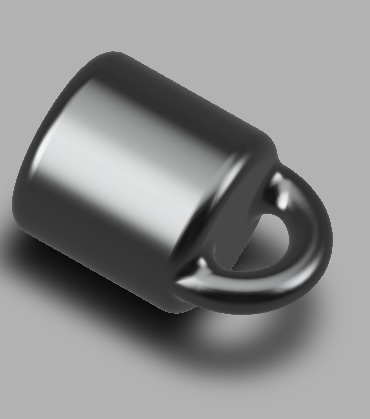
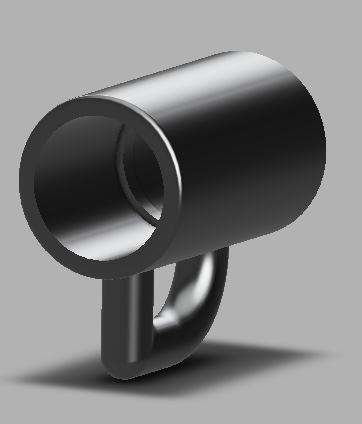
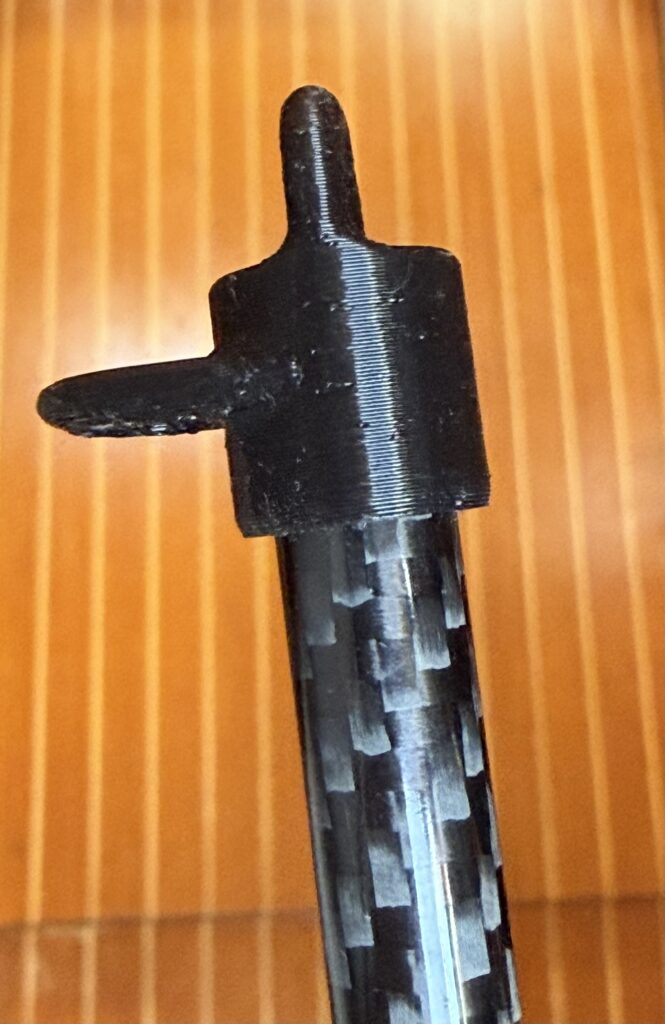
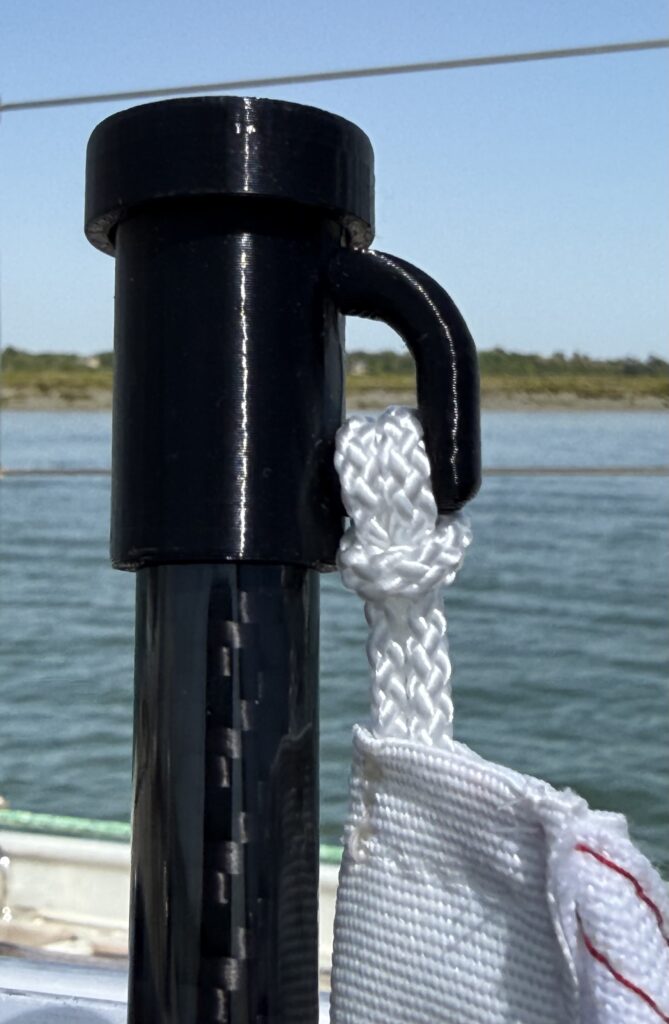
I felt the need to overengineer this a bit. Two lengths of carbon fibre tube, some epoxy, a few 3d printed parts and two sets of roller bearings later I’ve got a solution.
Its a 2m 10mm diameter carbon tube, with a second larger diameter tube mounted on roller bearings, long enough to support the burgee that sits on a bushing and it held on by a top cap.
Bottom fittingTop Fitting
I’m pleased to say it works rather well. It’s been up for five days now and seen gusts of over 30kts without a problem, and the burgee remains untangled.
One of the over winter projects was tackling the vibration we’d noticed from the propellor last summer. It had got bad enough that we’d had a diver check that it wasn’t fouled.
We have a Max Prop. It’s a clever feathering prop design, where the pitch can be adjusted – and even be different ahead and astern. It can also be easily adjusted between left and right handed rotation. When under sail the prop will automatically feather to a very low drag configuration, and the pitch is wound back on when the engine is put in gear.
Once we got Trouper out of the water it was obvious that the Max Prop was badly worn, The prop was original and dated from 1989, and had been serviced twice before, once by me. That had cost about £600 some ten years ago so I wasn’t looking forward to the bill. Worse still the advice at the time had been that it could be done a third time but that was likely to be a shorter lived repair.
Armed with this knowledge I got in touch with Max Prop, who’d been very helpful with new settings for the prop when we replaced the engine, a couple of years ago. They were really helpful and offered a part exchange replacement for their new model, that features simpler adjustment, for ‘only’ €1300 plus UK import duties. A new one retails for several times this.
So just before Christmas I got the old one off – which proved to be quite a job after I rounded a hex socket on one of the bolts and had to drill it out. It took both a bearing puller and a blow lamp to get the core of the prop that has a taper and keyway in it to match the taper and key on the shaft off. It was duly packaged off and couriered to Max Prop in Italy before we went to Canada for five weeks. It never got there, and it appears that it was lost in Italian customs. At this point I was a bit worried that without the old one I was in for the price of a new one – and of course the carrier insurance proved to be worthless as you had to show the purchase invoice for the lost item, not it’s replacement.
Max Prop however rose to the occasion and agreed to honour the deal – despite not receiving the 14kg of scrap bronze in exchange. They shipped a new prop with a taper and thread to the specification of the original drawings. Beyond a little adjustment of the key it fitted properly and was on in time for the boat to be launched.
Once afloat I recommissioned the engine (after sorting out some other stuff) and discovered on putting it in gear on the berth that we went astern when ahead was engaged and astern when ahead was engaged, We have a conventional right handed rotation, but I suspected that we’d been shipped a prop set for left handed rotation. A quick google established that on the max prop easy that we now had it was a simple adjustment to change from one to another. I got in touch with Max Prop and they agreed that this was the likely cause, so I booked a lift for the following Friday where the boat would be held out of the water whilst I adjusted the prop.
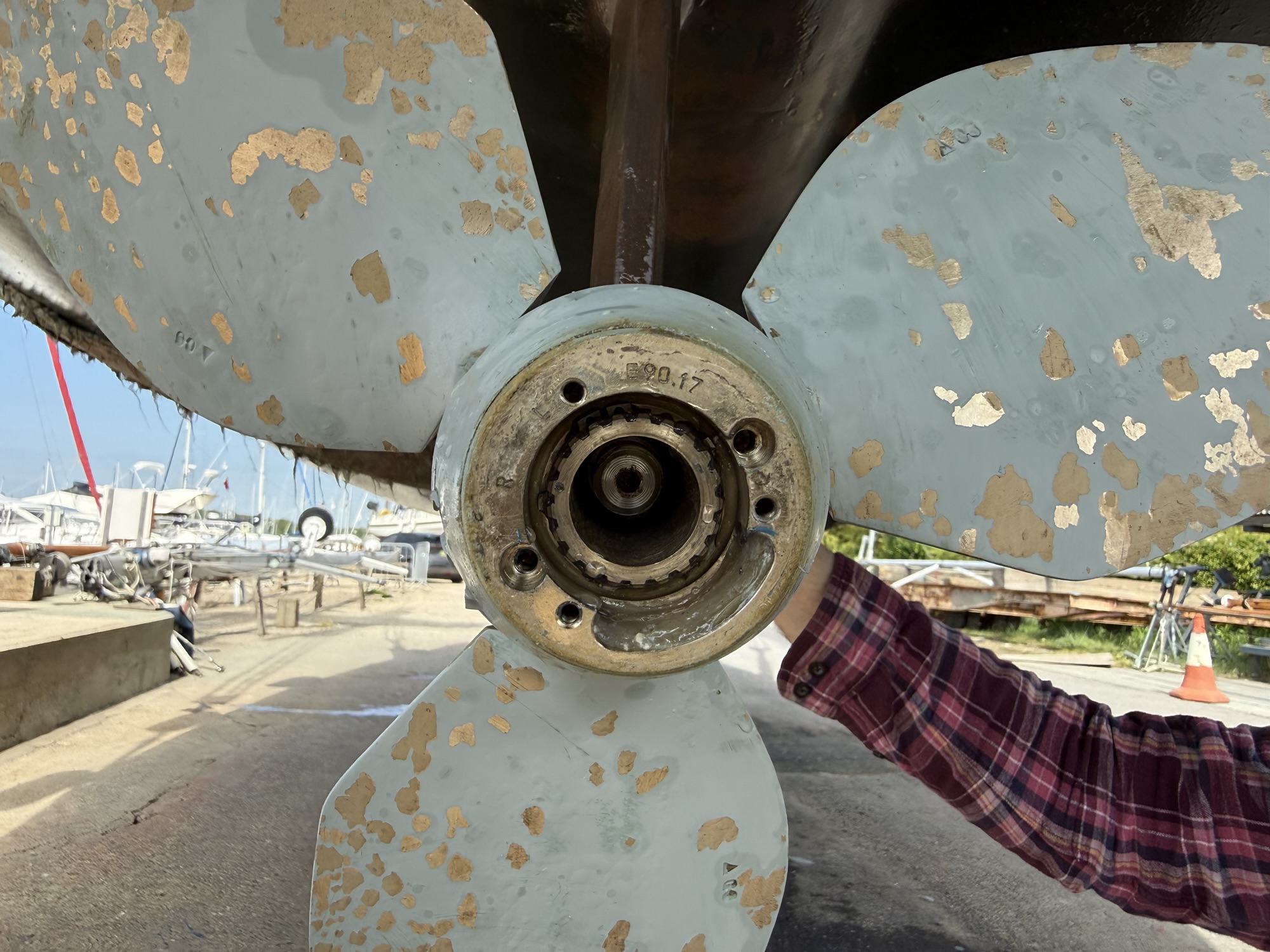
The video above shows what we found, and the general operation of the max prop, together with the evidence that I really need to try harder at antifouling the prop.
Unfortunately what this also shows all too clearly is that the prop is set for right handed rotation. The dot on the inner ring is clearly aligned with the R stamped into the outer ring. It was at this point that I realised that the Italian’s take their May day bank holiday on the Friday, not the Monday as we do. I coulnd’t get hold of them at all. So we put the boat into the yard ashore and I took the prop off and home, giving up on any idea of going out on the boat for the Bank holiday.
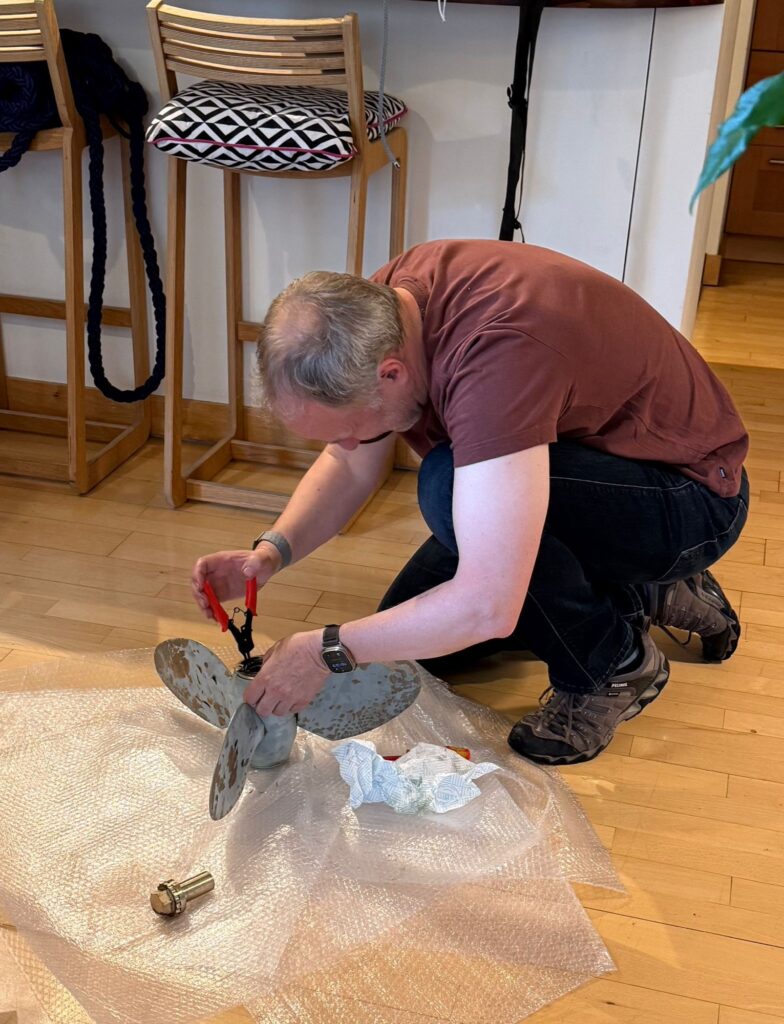
On the Monday Max Prop got in touch and we were reluctantly getting ready to ship it back to them in Italy – all very conscious of the lost prop last time and the likely 2 week delay at best. As a last measure we all got on a whatsApp video call and they examined the prop whilst asking me to move the blade positions. They spotted a problem – the inner sleeve appeared to be out by one notch. After a trip to screwfix for me to buy some circlip pliers (mine were all at the boat yard, I don’t commonly need them in London) it was a fairly quick and easy job fix it with them showing me what to do using another prop on their bench in Italy.
Adjustment underway
Then it was just the matter of another Friday off work, and another crane lift to put her back in the water and test that all was working as it should. Max prop had been so good around the lost parts at the start of the year that I decided that I’d not try to recover the cost of the lifts – it seemed as though one good deed deserved another.
Being lifted into the water – I never like this bit.
Thankfully I could drive her back onto her berth without a problem: it was fixed, and will hopefully now last another 35 years or more.
After I wrote the last post I spoke with a very helpful guy at B&G who explained a bit about the N2k/Fastnet bridge (H5000 Fastnet Interface). It would appear that it should be supplying more data to our N2K network than it is, which suggests our H2000 Performance processor isn’t correctly configured – which isn’t a huge surprise. He explained that the data transmission rates on Fastnet is much lower than N2K and they’d not bridged data to avoid swamping the Fastnet bus. I’m not sure that really makes sense – as a throttled feed of the data that they’ll already let you inject onto Fastnet from an old serial NMEA0183 source (such as a GPS set) would cause no more trouble than the current feed – and be rather simpler on a boat moving towards more modern tech, where a GPS upgrade to an N2K device has probably already happened. Anyway that’s how it is. It leaves me with a job to look at the config of our performance processor.
I did source a rather expensive but fairly pristine pilot remote on eBay, which worked perfectly. That gave me the confidence to take the old one apart. I found that one of the screws that hold the circuit board down had become loose and was lodged under the board. Once it was back in the right place all worked well again, so now I’ve got a spare. Whilst reassembling it I did replace the lanyard attachment point – it had always been broken and having a way of tethering it has always seemed a good idea. I was able to 3d print a replacement, which pleased me.
In order to provide the data feed to the Saillogger platform that provides the tracking I use here I’ve been running SignalK on the Cerbo GX display/processor that manages the Victron battery kit. It’s part of Victron’s supported configuration and the Cerbo is connected to the boat’s N2K network so has access to all the boat’s data. Signalk is really very neat – it’s an open source modern http based data sharing platform, which supports plugins to connect to all sorts of things, and when combined with Node Red workflows can be used to build all sorts of automation and monitoring.
My first step will be connecting the Cerbo to allow monitoring the the bilge pump and an high level bilge alarm. Because the Cerbo is always running and internet connected (ours uses the boat’s network or falls back to a cheap IoT mobile dongle) that means I can get flooding alerts whilst the boat is unattended.
Longer term I’m thinking that the sensible thing to do would be to create a Fastnet SignalK module. The SignalK platform can manage the translation to N2K – or wherever else – and it would allow all the Fastnet devices to be used for as long as they work. I also wonder about an Expedition/SignalK interface – that seems to be a match made in heaven with all the data Expedition makes available.
Trouper went into Nautor’s Hamble yard for a mini-refit in late October 2025. The main job was to remove the rig and renew the rather elderly rod rigging. There were a few jobs that it made sense otherwise do at the same time, such as replacing the radar, as it is only possible to re-run that cable with the rig out of the boat.
Rod – this was all renewed, with new bottle screws. Unfortunately the rigging subcontractor got their sums a bit wrong and has made the rods that run from the lower spreaders to the deck and the lower diagonals too short. Currently there is an interim solution using some extra toggles at deck level in place, and they’ll be swapping in new sections in the spring.
Compass – this has been a problem for some years. Id thought it just needed correcting. The Nautor guys arranged to swing the compass with a compass adjustor on board (much easier to arrange in Hamble, than Birdham). They identified that the problem was not the need for correction but rather that the bearing that the compass rose tuns on was sticking. Nautor managed to find a firm in Newcastle who appear to be the last people in the country able to rebuild compasses. I could have bought a new one, but ones as large as Trouper’s are no longer available, and critically the current one has the Swan logo on the compass rose. Happily the compass is now rebuilt – and for less than the cost of a new good quality one. Unfortunately the lamps were lost in the process, but Nautor are sorting out replacements for me.
The wire checkstays were changed for Dyneema. I wanted this to reduce chafe on both the mainsail and the boom as the checkstays are often rubbing against them when under sail. We decided to replace the babystay and backstay with dyneema too. The backstay went on whilst with Nautor but the babystay will be added in the spring when they sortout the shroud length issues.
After much deliberation I decided to replace the radar with the modern Furuno model. This had the great virtue of the same bolt fixing pattern as the old one, and they have a reputation for making stuff that works for ever. I’ll write a separate post on my experiences of using it. In the end I chose to use a computer software display solution for it rather than a dedicated display.
Nautor also commissioned an electrician to inspect our Victorn Lithium battery and charging system that I’d installed as our insurer had asked for something. They’d said an email was fine – what we got back was a rather grander pdf covered in logos but I was a bit smug to read that they thought it was a good installation, to a high standard.
I’ve subsequently tackled a few more jobs.
The Nautor guys pointed out that my halyards, especially the spinnaker ones, were really rather tatty. This was a big ticket item as I ended up replacing both spinaker halyards, one of the jib halyards, and one of the main halyards. I was able to buy a drum of 12mm dyneema cored rope and make up the halyards myself, which helped on the costs, though the rope itself was expensive.
The lazy jacks were also looking a bit tatty after 7 years uses so I bought 100m of the Lyros lazy jack line and remade those, which was a fairly quick job, and replaced all the fender lines whilst I was at it as they are made of the same stuff and were a bit tatty.
Last summer we’d added to the chafe damage on the mooring lines that had come with the boat. It was a good set of nice lines but they are probably 15 or more years old and with chafe damage usually in the middle we had fewer and fewer long ones and ever more short ones. I’d been eyeing up what to use for new ones and had settled on a lyros product that is designed to be especially stretchy which will help in windy or bumpy conditions. I used the halyard rope order as a chance to get a bit of a discount on 100m of that two, whcih I’ve cut down into 2x10m, 4x15m and 2x7m lines all with a decent sized eye splice at one end. I’ve used whippings on the unspliced end to indicate the length which should help finding the ones you want in the locker. We still have two 25m long shore lines in the locker too, so we’re very well proivded for now.
Replacing the worn Max Prop. This turned into a bit of a saga so gets its own post.
Patching the copper coat where some has come loose. That turned out to be a simpler job than I’d feared – as ever decent suface preparation and then following the instructions did the trick.
Our 12 year old liferaft failed it’s 3 yearly inspection, as it no longer maintained it’s pressure over 24 hours. Wouldn’t have stopped it working if we’d needed it but it marked the end of it’s useful life. Suffolk Marine safety sorted out a suitable replacement for a reasonable price. I want a robust well specified one (if you ever need it you’d regret penny pinching) capable of taking six people, and it has to fit inot the storage cage on Trouper’s coachroof.
This post has taken a while to be published so describes the autumn 2025 position, on our return from the Brittany trip.
This trip had a few purposes:
To give Kathryn and I a proper break and step away from the normal pressures of our lives.
To test out if living on Trouper for extended periods was comfortable and what we might want to do in future.
To test out Trouper’s systems and see if they needed any changes for future longer trips.
So how’ve we done? The first two I think we’ve achieved. We’re still talking to each other, and talking about future trips, indeed we’re both very clear that we’d like to spend more time on the Atlantic coast and explore further. There’s an awful lot to like about this coast, and whilst I would like to explore the Mediterranean in future I can see why this might make a better long term home for us. Neither of us feel a huge need to go crossing Oceans, though I did point out to Kathryn this afternoon that it’s only 155nm in nearly a straight line from Chichester to Roscoff, so we could leave one evening and be there the next afternoon, and that in the right weather that would be easy enough with just the two of us.
I think that for longer term trips I’ll need a sense of purpose and mission. Even just writing this blog helped, but simply wandering about exploring won’t quite do it for me – I need a bit more purpose. I think that getting involved in producing pilotage will be the answer – it will provide that sense of mission.
We bought Trouper 12 years ago and she was a very good fit to my tastes and needs, but we have made a few significant changes to her in our ownership. Before we launched her for the first time in our ownership we had the hull coated in ‘coppercoat’ which is a long life alternative to antifoul. It’s meant to be less polluting and doesn’t need annual reapplication. Ours has need some patches where it has come off but is otherwise working well. The pre purchase survey had spotted some issues with the heating system. Unlike most modern yachts that use a diesel fired blown air heating system ours heats a water circuit like a domestic radiator system. Rather than radiators we have two electrical thermostatically controlled blower units, one forward, one aft, which each deliver four hot air outputs. The surveyor had identified that the blower units were leaking, and we’d had them replaced. Trouper, like most boats, has a colorifier (hot water cylinder) that has a mains powered immersion heater element, and a heat exchanger coil from the engine’s cooling system, so engine heat is used to generate hot water at sea. The problem is that the calorifier is small at 25l, and if we at in an anchorage for a day or two we run out of hot water very quickly. During the first season of ownership I realised that we could use a two coil calorifier and connect the diesel heater circuit to the second coil. We had this done and it’s worked brilliantly – the 10kw heater heats the tank very quickly and showers at anchor are now much more comfortable. These diesel heaters have a very distinctive roar and we do get the odd strange look as we fire ours up on the middle of a hot summers day.
We’ve renewed the sails with the latest in high tech cruising sails (North 3di Nordac – a white seam free moulded sail more like flexible fibreglass in structure than traditional woven fabric), and in the process installed a new sail track on the mast to accept the batten cars needed for the fully battened mainsail. They still set beautifully and really do make a difference.
We also replaced the engine a couple of winters ago. That was an ambitious project on several fronts: finding an non turbocharged marine engine that would fit in the space available was tricky and then adapting that engine to fit with the boat’s systems and controls was quite fiddly. I must have been a nightmare client for the guys who supplied and fitted the engine (supplied by the lovely James French of French Marine, and fitted by the brilliant and lovely Dick Woodruff) But, aside from the last few teething problems the engine is working well and the integration with the boat and its systems is excellent. The old engine was becoming difficult to maintain and some parts were become unobtainable so whilst it ran well there was the real risk that it would pack up at some inconvenient moment never to work again.
The year before the engine work I’d also replaced the batteries and charging system moving away from the four big 6v golf cart batteries that were the original system design, to two Victron Lithium Iron Phosphate batteries, and associated charging, management and monitoring equipment. This was another big project, which was only really finished when the new engine went in with a new secondary alternator (another of those difficult client requests for James, that he rather overachieved on) capable of delivering the sort of charge that big LFP batteries demand. This has been transformational. We used to get anxious about power after a single night on the anchor, unable to plug in. Two was really the maximum possible. We’ve now doubled the available power and massively increased our charging capacity from the engine, added a small hoistable solar array and halved the weight of the system. We also have lots of lovely data telling use about how much power we use. Our usage has gone up as I’m much less abstemious than I used to be – for example the boat’s instruments have been on for nearly two months, and the starlink dish draws more than we could have supported.
Power consumption data from our Victron system.
So what would we change on Trouper?
We agree that a washing machine would be the biggest creature comfort. There appear to be more options opening up out of the motor home market, so for the future we might need to do some research on the possibilities, but we don’t have room for a traditional mini domestic machine – even if we had the power and water.
The Starlink mini dish has been really useful this trip and has made an always on internet connection just work, with very little effort (mounting bracket aside). I still baulk at spending money with a Musk company but there is nothing else like it. It’s allowed us unlimited access to large weather data files, to stream podcasts whilst on passage, and to even stream HD TV to our Samsung portable projector whilst at anchor in remote spots. We probably used the projector about 15-20 times over the 9 week trip.
Before we left I knew I fancied a larger tender, with a hull shape the would allow better seakeeping. Truthfully we’ve not really needed it, and our existing bombproof Avon has attracted admiring comments from people who are less impressed with the durability of modern PVC tenders, so that’s probably on hold until a proven need.
A water maker (most likely a Schenker Zen 30) is on the upgrade list. We didn’t struggle for water at all (and carry about 350l), but there were hose pipe restrictions in place for most places, and one might expect water supply issues to get worse rather than better due to climate change – so being able to turn seawater into drinking water, now that energy recovery water makers have pulled the power demands down seems sensible. Before these cleave energy recovery units were around it used to be said that all water makers did was turn diesel into water as you needed so much power to operate them! However they are maintenance intensive and need to be used regularly or ‘pickled’ as a consequence it’s probably something to leave until we’re spending longer periods on board.
Trouper’s rod rigging dates from 2017 and needs replacing – that’s going to get done overwinter, and the analogue Furuno radar will be replaced at the same time with a modern digital Doppler radar – though likely still a Furuno.
The minor issues with coolant leaks from the new engine need sorting out to ensure we’ve a robust and reliable set up. That should be easy. What’s a bit more tricky is the steam we get from the exhaust at higher power settings. The engine and exhaust don’t seem to be overheating. The steam isn’t coolant (the levels don’t drop, aside from the leaks) so it must be related to the raw water injection and cooling of the exhaust. But it’s got both engineers involved and me a bit puzzled.
Our anchor has served us well, but is a CQR design and original to the boat. CQRs were revolutionary high performance anchors in their time but they date from the 1950s have been overtaken in the last 20 years by higher performance designs. Ours is also showing some signs of wear and is starting to rust in a few places where the galvanising has worn off, so it might be time to consider a replacement. Trouper has a very nice clamp mechanism to hold the anchor secure in its roller, which will need adapting or replacing to cope with a different design so this won’t be a simple swap. I favour a Vulcan as the replacement – it has the same virtues as the Spade, but is reportedly less prone to corrosion (I think it’s a solid casting, where the spade is fabricated with a hollow shank, at can rust from the inside out) and it doesn’t have the significant failing of the roll bar anchors like the Rocna that are prone to clogging with mud and then not resetting if broken out by a wind or tide shift. Personally I’d trade a fair bit of optimum condition peak performance for reliably reseting after being broken out. Anchors and anchoring techniques are one of those things that people get very exercised about with very clear views on what is ‘right’ or ‘wrong’ – for me in this (and almost all things) there are many shades of grey. The first thing to do is make a template of the Vulcan and see if it will fit on Trouper’s bow roller. Our chain seems to be in good condition – so hopefully that’s good for a little while yet as 60m of 10mm chain isn’t cheap. I suspect I might ultimately change the chain at the same time as renewing the windlass (so hopefully far in the future) and maybe step down a chain size, whilst using higher strength steel chain, to enable me to stow more chain in the locker.
The last thing on the wish list is top down furling gennaker. A big asymmetric spinnaker optimised for sailing really deep (so close to dead downwind) with a small demountable bowsprit. The sail would let us make progress under sail in lighter airs – which is often my favourite sailing. The top down furler technology grew out of the Open60s where solo sailors needed to be able to safely handle large downwind sails. Essentially the sail is rolled up around a torsion rope from the top which has proved to provide much neater stows and to work much more effectively in stronger conditions than early simpler bottom up designs. The confidence of knowing that we could easily furl it would encourage us to use the sail much more. We have two big (one vast) symmetric spinnakers but they require quite a few crew to handle effectively – and are certainly not suited to just the two of us.
We left Poole on Monday afternoon and headed for Lymington, where we arrived in time for some excellent fish and chips. We stayed in the Yacht Haven, rather than the Berthon, as they had room. My father used to keep a boat here in the late 90s that I used to sail regularly. The marina has expanded somewhat since then and is now the home to a lot of charter power boats as well as the local sailing boats. The size of the boats, especially the powerboats is surprising, especially after the French coast where we were on the big side, and big powerboats were very scarce. Not so here…
After a day in the marina (avoiding the 25kts blowing in the western Solent), and some grocery shopping, we made our way across to Yarmouth for a night, and dinner at the Beach Hut.
The plan had been to anchor in Colwell Bay, which is opposite Hurst spit on at the western end of the Island, just before the Needles. the restaurant runs a tender service and will collect you from your boat and deliver you ashore to your table. We’d been texted the day before our booking announcing that in light of the weather forecast they’d not be running the tender service, but would collect us from Yarmouth using their minibus or landrover. This was no surprise – in the forecast weather there was no way I was going to anchor in Colwell Bay, let alone spend a night there after a nice dinner.
The Hut, Colwell Bay
The meal was lovely but twice the price of our Michelin starred meal in France, and whilst well prepared Kathryn thought that her fish was not as fresh as she’d become used to. It was, however, a lovely experience and a nice closing chapter to our trip.
We spent another day, Thursday, in Yarmouth to avoid more weather – a steady 38kts in the western Solent at one point, and made a very quick passage back to Birdham in 14-20kts on Friday. We arrived with just enough water to get to the lock and were on our berth by early afternoon. We did a quick tidy, grabbed the essentials and took the train back to our London flat, where we had a take away from our local, and excellent, Chinese, the River View.
Saturday saw us drive back down to the boat so we could load up with all the stuff to come off the boat and give her a proper clean before heading back to London on Sunday morning. We’d meant to have lunch at Itchenor sailing club with a friend from the club, but due to an ambiguous message exchange we thought he’d had to cancel and heade home. He’d meant that he couldn’t have lunch but would meet us for a drink… so we had a FaceTime chat once we were all back at our homes. He’s just had a hip replaced so I feel a bit guilty about having made him walk to the club and back. Nonetheless he’s invited me to apply to become a member of the Royal Cruising Club, which is a great honour. I may not make it through the selection process, but I’m rather pleased.
We left Treguier at about 0930 on Friday and, once clear of the river (and all its off-lying rocks), set a course for the Cap de la Hague, the South Western tip of the Cotenin peninsular. The straight line track takes you a bit close to some rocks half way to Guernsey and then straight through the Big Russel channel between Guernsey and Sark. On the way you get a good sight of pretty much all the other Channel Islands. We arrived in the Big Russell as the tide turned in our favour and started to push us towards the gap between Alderney and the mainland, known as the Alderney race.
Tides are effectively a collar of water drawn out from the planet by the gravitational pull of the sun. The collar goes round the world and the planet rotates once a day resulting in two tides a day where there is open water. Every two weeks there are larger tides (springs) when the moon is in line with the sun and its gravitational pull contributes, and in the intervening weeks the moon’s contribution drops to a minimum when the moon’s pull is at right angles to the sun’s (neaps) before increasing again until it is in line once more. The magnitude of tides is further effected by the earth’s elliptical orbit around the sun – when we are closer to the sun (the equinoxes) the gravitational effect is greater, and the tides bigger, resulting in higher high tides, and lower low tides.
We’d had to wait in Perros Guirac because the neap tide had not been high enough to reach the level of the water in the harbour held behind the sill. The following day when it did open there was only 30 minutes of open time predicted, and when the sill did open there was actually a 30mm or so difference in height of water, resulting in a huge inrush of water as boats were manoeuvring to hold position in the queue to leave. I’d seen what was happening and tucked out of the way with a couple of others, but there were a couple of collisions, one of which sounded quite substantial, from boats being swept around in ways their skippers clearly hadn’t expected.
As the collar of water, that creates the rising tide, approaches the French coast heading east, the opening for it to pass through to get to the east narrows progressively, and then it hits the Cotenin peninsular and has to all work north to get around the top and on towards Dover. This creates the Alderney race where currents of 10 knots have been recorded.
Tidal streams in the Channel Islands
I’d timed our passage so that we’d ride the tide north through the race and maximise the tidal contribution, but that meant that we’d not get to Cherbourg till about midnight. I was quite pleased that aside from some collision avoidance course changes we didn’t change course from the entrance to the Treguier river till the Cap de la Hague – some 70nm. Our ground track describes a curved track as our passage over the ground is affected by the tide sweeping us one way and then the other. The shortest distance for us is the straight line, through the water, so there’s some satisfaction to be had from getting your sums and judgements right and not to having adjust your course.
Our ground track to Cherbourg
In Treguier I’d been a but puzzled at the large number of near identical aluminium exploration yachts, all in the 45-55′ range. Looking a bit more closely they were all made by Boreal, which turn out to be made in Treguier. They look like really tough go anywhere boats of a sort I find really quite attractive – lifting keels, unpainted aluminium hull and big deck houses providing a lot of protection to the cockpit, and a great view out from inside. Very different to Trouper, but would enable a very different kind of exploration.
We got to Cherbourg and were tied up for about 1130, having made better time that we’d expected. We we both tired and had a quick shower on board and went to bed. On Saturday morning we got up, I filled Trouper up with water, and did some nav prep whilst Kathryn made a quick sortie to the boulangerie for bread and patisserie. We then settled up in the marina and joined the queue for having your passport stamped by the PAF. They turned up bang on time at 1030, and we were clear by 1035 and back to the boat which we then took to the fuelling berth and filled up with diesel (there was little wind in the forecast) and were away. It was about 1130 by the time we got out of the harbour, about an hour or two out of Cherbourg the wind filled in and we got 3 or 4 hours under sail before boat speeds started to drop and we needed to motor once more.
Our track from Cherbourg to Poole, showing the effect of the tide.
We made Poole harbour entrance with the rising tide as I’d planned and had enough water to safely get over the shallow patch off Brownsea Island and into South Deep, which is a favourite anchorage of mine. We met some good friends sailing another Swan who’d anchored there on their way from Salcombe back to the Solent. We anchored nearby and they came over by tender with a bottle of rum that they’d started earlier. A couple of very pleasant hours passed and the rum was dispatched and some of Trouper’s gin stocks were also depleted. They left Poole in the morning heading home and we took the rising tide round the corner into my favourite corner of South Deep. I blew up the SUPs and we spent another night there and left on Monday afternoon, following more SUPing, heading for the Solent.
South Deep looking to the South East.South Deep, looking to the North with Green, Furzey and Brownsea Islands.Trouper in South Deep.
Sadly my man in Lymington got back to be on the pilot remote control and said that whilst they’d have a look it wasn’t really their thing. They’ve given me the details of a guy in Croatia, so I’ll try him. But it’s got me thinking a bit about how to keep the boat’s instruments and pilot working long into the future without having to engage in a very expensive wholesale replacement.
The problem is one of history, and arguably corporate ownership. B&G are a venerable British marine electronics firms who produced the first electronic yacht instruments, starting in the 1950s. One of the best histories of marine electronics I’ve read is here, written by Nick White, the author of the truly awesome Expedition Navigation package (my only gripe with expedition is that it forces me to own a Windows PC – I’ve owned Macs since the ’80s).
B&G produced the first modern network style system and at some point in the 80s or early 90’s adopted a CAN bus technology that enables multiple devices to exchange data across a single network cable run around the boat, which they called Fastnet. It was a closed proprietary solution which allowed you to add whatever (B&G) elements you needed and have them all interoperate and display any of the data at any of the displays. In its day it was revolutionary. The modern NMEA2000 (N2K) Industry standard communications system is actually also a CAN implementation with a different messaging standard (which is irritatingly a closed standard owned by an industry body, rather than being open and public – though extensively reverse engineered these days). N2K achieves the same interoperability but across manufacturers allowing you to mix and match equipment, at least to some degree.
Trouper’s H2000 system uses this old B&G technology to connect its three processing units to 12 displays, and five fundamental measurement transducers. The fundamental measurements are depth, speed through the water, rudder angle, wind speed and direction, heading, trim, heel (and associated accelerations). The main processor combines wind and boat speed data to produce a calibrated and corrected set of both true and apparent wind values (the difference between the wind you’d feel stationary in the water, and the wind you feel as you move over the water), together with a calibrated depth (ours is set to report depth under the keel – some hold near religious views that this should be set to depth of water). The performance processor computes the boat’s performance data based upon an uploaded model of the boat’s performance (effectively the expected boat speed for different wind strengths and angles) known as the boat’s ‘polars’ to allow you to monitor your performance. It makes sail trim much easier to set as the system removes the effect of every gust and shift, so you can see if a trim change was effective. The performance processor also provides a serial comms interface to a computer (and Expedition in my case) that allows the computer to add data to the network as well as read its contents. The processor and also provides an NMEA0183 Industry standard serial interface for connecting a GPS. Finally the autopilot controller connects the heading, orientation, and ruder sensors to the network but also controls a motor unit that can move the rudder. It uses some quite clever algorithms keep the boat’s course straight – using acceleration data to create corrective inputs before the boat’s heading has changed, just as a good helmsman does. It will also sail to both true and apparent wind angles, using wind data from the network, which can be really helpful on longer passages under sail, or sailing upwind. The pilot was the first of the generation of systems to use this gyro data, and heavily used in the Open 60s of the late 90’s and early 2000s.
An H2000 FFD in Trouper’s Nav Station.
The remote control that has sort of died – given that it only works with the battery cover off, it’s not exactly useful on deck – was built by B&G at Ellen McArthur’s request, and she was often pictured clutching one when doing her single handed round the world record on her trimaran. It’s really handy – not only does it do pilot remote control functions but it allows you to set what data appears on the mast displays and alter system calibration and configuration settings.
The rather excellent B&G RemoteVision.
B&G ultimately ended up as part of Simrad, in turn part of Navico, which is part of Brunswick Corp, a US corporate behemoth. On the way it stepped away from the firm’s long history of incremental upgrade and backwards compatibility, and gave up on its UK manufacturing site. H3000 had replaced H2000 and everything interoperated happily using Fastnet and the displays fitted in the same holes in the boat’s deck. H5000 moved to the NMEA2000 (N2k) bus standard, supplemented by some ‘private’ proprietary messages for performance data, but dropped all interoperation with Fastnet devices and even eschewed direct connection of sensors to the processor. Even the visually similar displays required a new larger hole. If you wanted to move to H5000 you had to throw almost everything away and start again. Each of those dozen displays I mentioned is in the region of £1000.
B&G 2020’s on Trouper’s mast, below the boom, facing aft.
I didn’t go that route and instead have bought up spares from ebay and now have a small stock of spare parts. Indeed everything except the pilot remote control… Many of B&G’s service team, who were based in Romsey in Hampshire, ended up at a new firm called Tinley Electronics in Lymington (my nice man). Tinley have grown into A&T Instruments and initially targeted mainly the superyacht market, but essentially people with large legacy B&G installations. They continue to repair B&G displays and processors though now also make their own displays and processor that support the Fastnet protocol and fit in the holes. Their stuff is not cheap, but it will allow me to keep Trouper’s instruments working.
After a while B&G realised the error of their ways and released the H5000 Fastnet interface. This is an irritating device as it is so close to being what everyone needs, but not quite, presumably in the (erroneous) belief that it might cannibalise sales of new kit). It is essentially a one way converter from Fastnet to N2k. You can now connect N2K displays, including the nice H5000 colour graphic display at Trouper’s helm (guess how I know that the cut out is different – I ended up buying a 3d printer to fix that problem…). The problem is it doesn’t translate all the data – none of the performance or autopilot data, for example – and it is one way. Except that hardware is not really one way as it allows changes to display brightness in both directions. So it could pass much more data from N2k to Fastnet. This would be ever so handy as it would be a clean way to integrate my modern N2K GPS with the Fastnet instruments, and it could allow you to connect N2K autopilot controllers, complete with remote controls. But it doesn’t.
H5000 GFD at Trouper’s binnacle (with 3d printed enclosure).
A&T’s public literature is a little opaque about quite how much translation their processor does between N2K and Fastnet. It supports both but I’m guessing that given that they’ve reverse engineered and reimplemented B&G’s work there will be agreements in place, or at least a little caution, about what they say in public. As far as I’m aware it doesn’t translate pilot control messages, and at £7k ex VAT it would be a somewhat extreme fix to a broken remote even if it did.
Boats attract technologists and it should be no surprise that there is a large community of people building open source software solutions for sailing boats – from navigation applications through to autopilots and instrument systems. They have reimplemented N2k in software libraries that make it simple to use and implement on small hardware devices like Arduinos. There is a powerful Arduino with two CAN interfaces. There is some public documentation of the Fastnet protocol from a few people reverse engineering it. So I got to wondering: I’ve got all the bits to set up a test rig (all those spares), why not reimplement the Fastnet to N2k gateway with support for all the missing bits? It might be possible to get hold of some Fastnet documentation but if not reverse engineering it should be fairly doable, given what already exists. It won’t be a quick project, so I’ll get it touch with the guy in Croatia and see about sourcing a spare remote control. After I’d started drafting this a RemoteVision I’m trying to negotiate a sensible price for a spare on eBay. I’ll also have a conversation with B&G Support – if nothing else it will be worth checking that they aren’t willing to do a software update for the gateway…
We’d been planning to head towards St. Malo from Treguier with a stop in Saint-Quay-Portrieux, which I spent a night in some dozen years ago during Trouper’s first summer tour. That summer Kathryn and I had been beaten by the weather in our attempts to get to the Scillies but had had a glorious time exploring Falmouth harbour, and had gone out with my family from Fowey, and hove to off Gribbin Head to scatter my father’s ashes in a bit of water he loved sailing. He never saw Trouper – but I’m very confident he’d have approved. Anyway Kathryn and I had left Trouper in Falmouth and a week later I headed down with some work friends. Three of us took Trouper back up to Fowey where we had a day walking a bit of the Cornish coast (and my friends had a swim) before we were met by two more friends that evening. We left Fowey at about 9pm, having to pause on the way out for a firework display in the harbour to finish. We sailed straight to St-Quay-Portrieux before heading on to St Malo where one of the crew left us and another joined us, necessitating a day wandering around town and swimming off the beach, before we headed North to Guernsey, and then on to Portsmouth, and thence home.
Our plan had been to retrace some of those steps and have dinner at a lovely restaurant (a Michelin happy eater…) we found in a subsequent trip with other friends in St Malo, whilst getting our passports stamped there and heading home via the Channel Islands. However, looking at the weather forecasts over the last few days (and the Met Office’s excellent ‘Deep Dive’ YouTube videos that discuss the forecast and models in detail) we’ve had a bit of a rethink. Hurricane Erin rapidly grew into a category 5 storm over last weekend and as its remains track across the north Atlantic as a mid latitude low pressure system it is generating a fair bit if uncertainty about next week’s weather. If nothing else it is clear that it’s likely to deliver some significant swell into the western approaches an on into the channel next week.
Ventusky Display of Meteo France Significant Wave Height forecast for Tuesday evening.
We’ve decided to bank the current certainty and relatively calm sea state we have at the moment, so will stay here another night, but then leave for Cherbourg tomorrow (Friday), which will be a long day as we can’t leave very early if we are to catch the fair tide at Guernsey up to Cap del la Hague. We’ll probably get into Cherbourg marina by about 1 am French time. It would make much more navigational sense to go to Guernsey and head home from there, as I did that first year with Trouper, but now we need to visit a Port of Entry to get our passports stamped to leave the EU.
Last night the marina arranged for a local diver to pop round and have a look at Trouper’s propellor. We’d felt a little bit of unusual vibration, which following the weed on the prop the other day we wanted to check out. He was a lovely guy who put two huge (approx 80cm long) fins, mask, snorkel, and a weight belt on over his wetsuit and easily outpaced the quite substantial tide to have a good look. He was quite apologetic that he couldn’t see anything, though he could feel a little movement in the prop shaft. My guess is that the issue the other day has worn the cutlass bearing in the P bracket which supports the prop shaft at the prop. Renewing that is a job for the winter, but not a big deal. I’m pleased to know there’s nothing tangled down there before a long couple of day’s where we’re likely to be motor sailing.
Once in Cherbourg we can easily get the paperwork done, as the French border police visit the marina office a couple of times a day. We might head straight across on Saturday, once the passports are stamped, but that depends on the forecast. At the moment Sunday looks a fair bit less attractive with a headwind, and rougher sea state, though Saturday will be more motor-sailing with little breeze. But we’ll review that plans in Cherbourg, the forecasts are moving about a fair bit at the moment, and whilst we can have good certainty for 36h or so much further out is shifting about a bit.
We’ll probably head back to Poole, which we’ve not been to for some years, and offers an easy all states entrance. Studland bay might be an option on the way in but we’ll have to see how it looks. The current forecast has it looking very welcoming until the small hours of Sunday when 0.8m waves will start rolling in from the South East, leaving the beach as a lee shore, which would make it anything but a restful night.
Inevitably there is paperwork to complete for our UK entry, though the Borders agency introduced quite a good online system a couple of years ago. It has the odd niggle (why will it remember the passport details of anyone I’ve ever entered, but require me to input my contact details as skipper by hand each time?) but it’s actually quite simple to use. Once in Poole we can have an easy week heading back to Chichester. Perhaps a night or two in South Deep in Poole (a favourite of mine), if there’s room on an August Bank Holiday.
We spent a single night back in Roscoff, having arrived via the passage inshore of Ile de Batz. This was a recommendation from my friend Andy who had enjoyed my account of getting caught out on the outboarnd journey, having done exactly the same himself. With a decent rise of tide the passage is simple, but you don’t want to be plugging a foul tide, as it fair whistles through the gap. Once we’d got in I found a nice description of the passage in the pilot book. I’m pleased to report that that is exactly what we’d done, figuring it out from the charts.
Ile de Batz, and the inside passage
We headed on on Thursday morning for Perros-Guirac which we’d not been to before. It’s a lovely little town with a marina tucked behind a headland and with a newly installed automatically folding sill, to replace the old lock, that lets you into the inner harbour. The approach dries entirely. In the chart extract below the underlined numbers in the green patches are the height above the lowest tide that the land is, in meters with 10’s of centimetres in the subscript.
Perros-Giurec, and its approach
Friday was spent exploring ashore where we found an excellent butchers, supermarket and patisseries. I love that even the kerbstones are made from the local pink granite.
A place in which I could get comfortable (and fat)
Friday evening saw us eat a steak supper on board, and as I was wrestling with getting the VPN working (so we could stream Bookish to our little Samsung projector on board) Kathryn discovered that there was a free concert going on just across the street. We rather liked what we could hear so went to have a listen, and bough a couple of petite beers. The band were modern Breton folk, with a pair of pipers, as well as guitar and a couple of traditional percussion. I’m not sure that I ever thought I needed amplified bag pipes in my life, but they were rather good and there was a distinctly north African feel to aspects of their music. We didn’t enjoy the main act so much so returned to the now working VPN and Bookish (which was a Marina Hyde/Richard Osmand recommendation of their podcast).
Saturday, saw the wind blowing fairly firmly from the east. It’s hardly a gale but it would be hard work to go upwind in, and our next stop is around a headland with a lot of off-lying rocks that would need to be given a respectful distance in an brisk onshore breeze with a little bit of a sea running. Sunday looks no better, but Monday did. I went to the Capitanerie to pay for an extra couple of nights to discover that it will be three nights: there is not enough water at high tide on Monday to open the sill, so we’re stuck here. It’s very much a gilded cage though (see Patisserie above).
We do now have a bit of a timeline – we need to be back for the Saturday afternoon tide at Birdham in two weeks. Plenty of time, as we keep reminding ourselves: a whole summer holiday, but nonetheless we are now starting to plan to a timeline. The other constraint is needing to get to a French Port of Entry: there are a few options but the favourite option at the moment is Carteret on the Cotenin peninsular, and on to Alderney before crossing to Poole/Studland.
Sunday was lost to books (see bibiliography) and boat cleaning. On Monday we caught a bus to Lannion, and then another on to Citie de Telecom, and the museum set around one of the first satellite ground stations, built in 1961/2 for the original Telstar. It revieved the first TV satelite broadcast from the US. Telstar 1 (and 2) was a very small low powered microwave relay satellite that took in a revieved signal and rebroadcast it on a different frequency. It was on an elliptical orbit which meant it was only in sight for 25 minutes every 2.5 hours and was spinning to stabilise itself, meaning that it could not have directional antennas. The result was the very weak signal from a fast moving source, which necessitated a very large antenna to focus the signal of a receiver, and that antenna had to track the satellite with great precision, from horizon to horizon in 20 odd minutes.
Kathryn’s picture of the dome.
The resulting machinery was in use for 20 years or so, before it was retired and declared a national monument in the late 1980s. I’d love to know if the machinery still works – our French isn’t good enough to have established it on the tour. It does look as though it might. France Telecom have a number of other ground stations near there, many retired, but still maintain a large R&D facility. The dome is clearly visible from the sea, and we’d known about it as we’d spotted it on the outbound trip and looked it up. The dome is huge enclosing a large horn shaped receiver and tracking gear. In order not to have any physical dome support structure, that might interfere with the signal, they had built the dome out of a plasticised fabric, which is held in place by air pressure. Effectively a big balloon. During the tour they were at pains to demonstrate the airflow, and you could only leave or enter via air lock type arrangements – one neatly integrated into a rotating door. Until the pressure is equalised you physically cannot open the inward opening exit door.
Inside the dome, with the huge horn shaped antenna, and machinery.
It’s a rainy Tuesday at the moment, and our current plan is a head out at 1530, when the sill opens (only for 30mins today, due to the small tidal range) and head round to Treguier, where we’ll likely spend two nights.