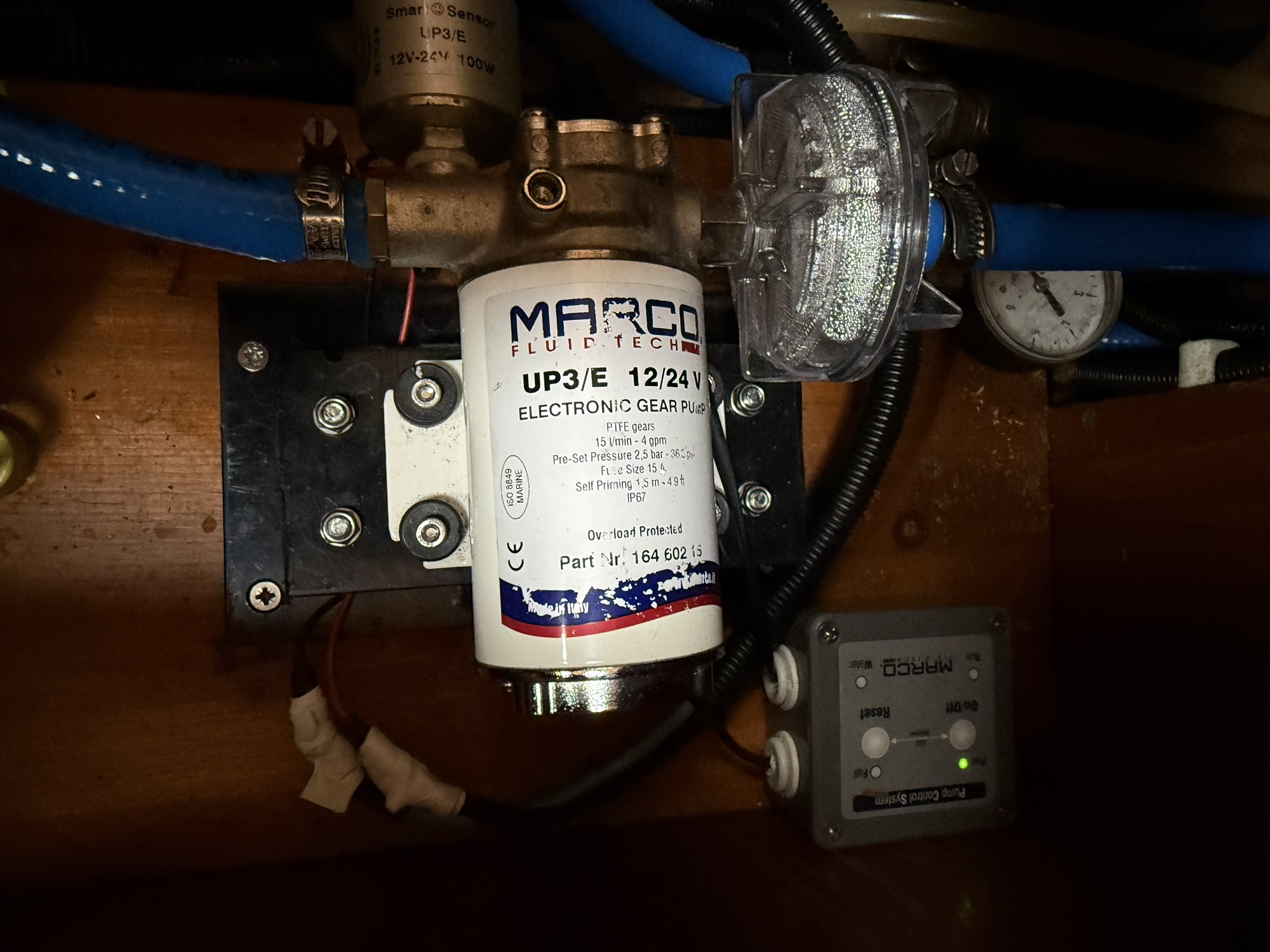
One of the spring jobs that I’d not written up but what has made a huge difference is some work on our freshwater pump. We have a Marco UP3/e gear based pump. It’s excellent and varies it’s speed to match the flow demand. I’d hoped it would self prime, but in our installation it doesn’t and needs a knurled bleed screw opening for a moment when we change tanks.
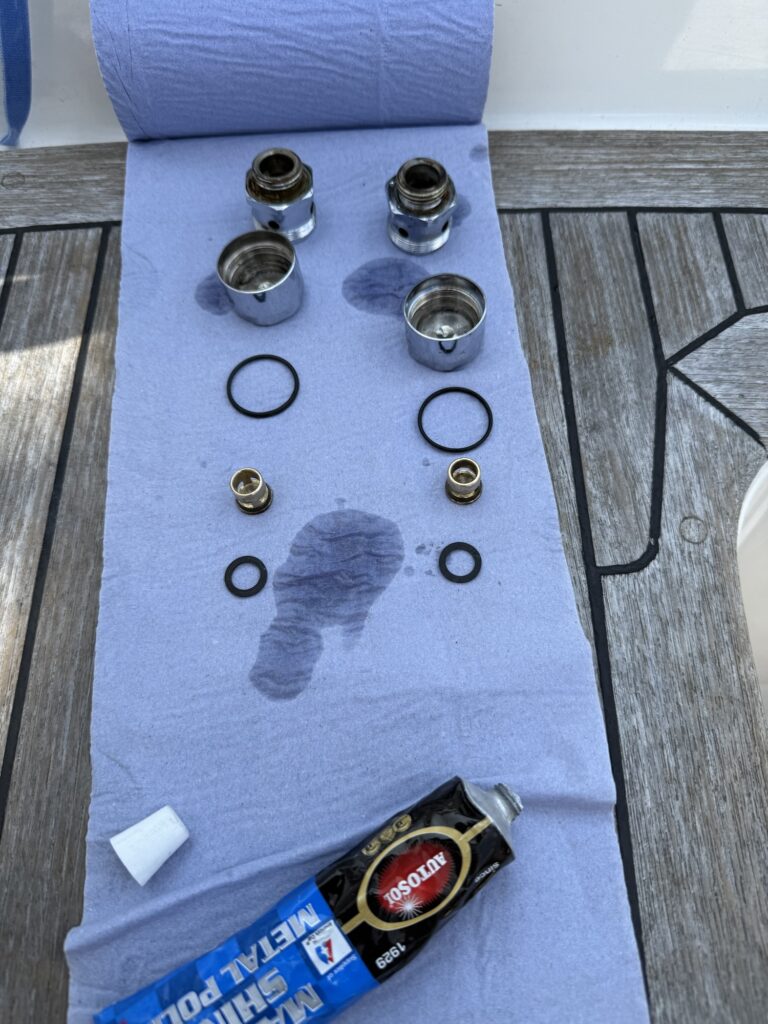
After six or more years use the need to prime it had increased and it might struggle to empty the tanks. That was partly due to some deposits on the valves on the breather lines, but stripping and polishing those in May 2025 didn’t entirely resolve the issue.
Cleaning and polishing the breather valves
This spring I bought a service kit for the pump – essentially two new helical gears, an O ring and new face plate. It was pretty trivial to install – though the gotcha is not to tighten the faceplate too hard, as over compressing the seal presses on the end face of the gears and prevents them from turning.
The pump had always been rather noisy with a high pitched whine. It was it’s Achille’s heel for us: I love the robust, durable pump, and variable flow but the noise was an irritant. It didn’t help that the pump was mounted to a shelf inside a locker under the saloon sofa that acted as a sounding board amplifying the noise.
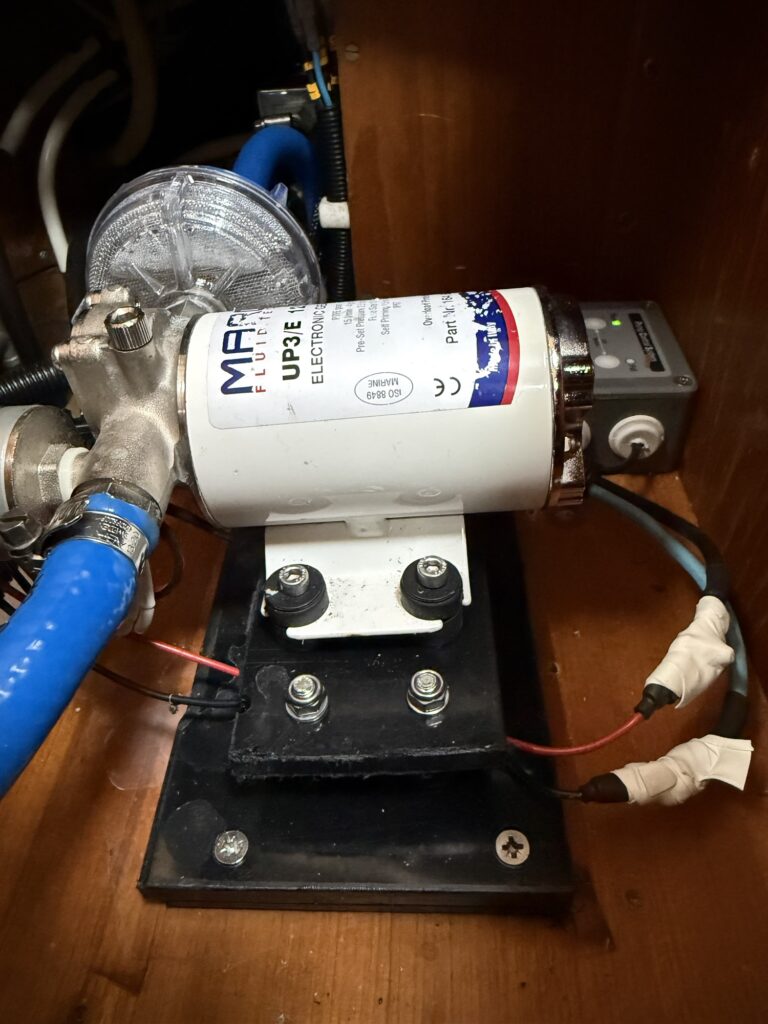
This spring I pointed my AI agent of choice, Perplexity, at the problem and it came back with a pile of sensible suggestions about installing the pump on a noise isolating raft. £10, including postage, got me four rubber mounting bushes, each with an M4 thread protruding on both sides. I used them to fix an 8mm offcut of HDPE sheet floating above another that with some spacers under it could be fixed to the original shelf, whilst the pump was mounted to the floating raft, plumbed in with flexible hose.
The noise isolated raft and pump.
It was a huge success. The noise levels dropped dramatically. Still audible but there was no longer a need to raise your voice or wait till it stopped.
I was very pleased with the pigstick. It did the job beautifully. But as we left Cherbourg it seemed not to be turning so freely. Once out of the harbour, on the way home, I lowered it to see that was going on. It turned out that the lovely roller bearings that I’d thought were stainless only had stainless shells, and that the lower one, that can sit in water, had rusted up solid.
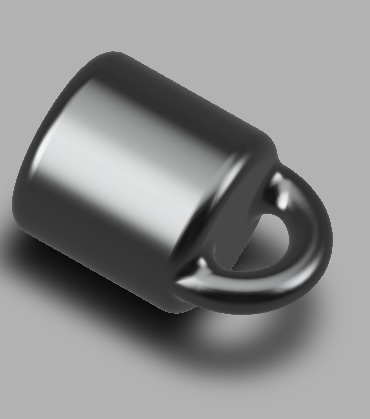
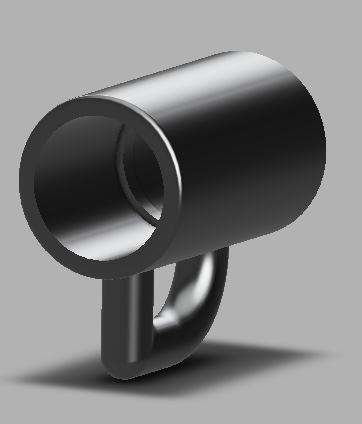
Mark 2 was clearly required. Shopping around I couldn’t find any suitable stainless needle roller bearings but could get some standard all stainless bearings – trouble is they were a fair bit larger in diameter, so I had to redesign the fittings a bit. I printed redesigned end caps for the outer carbon tube, that acts as the carrier for the burgee, with a larger cavity for the conventional bearings. It’s not as slick looking, but works perfectly and has now coped with a couple of weeks of use.
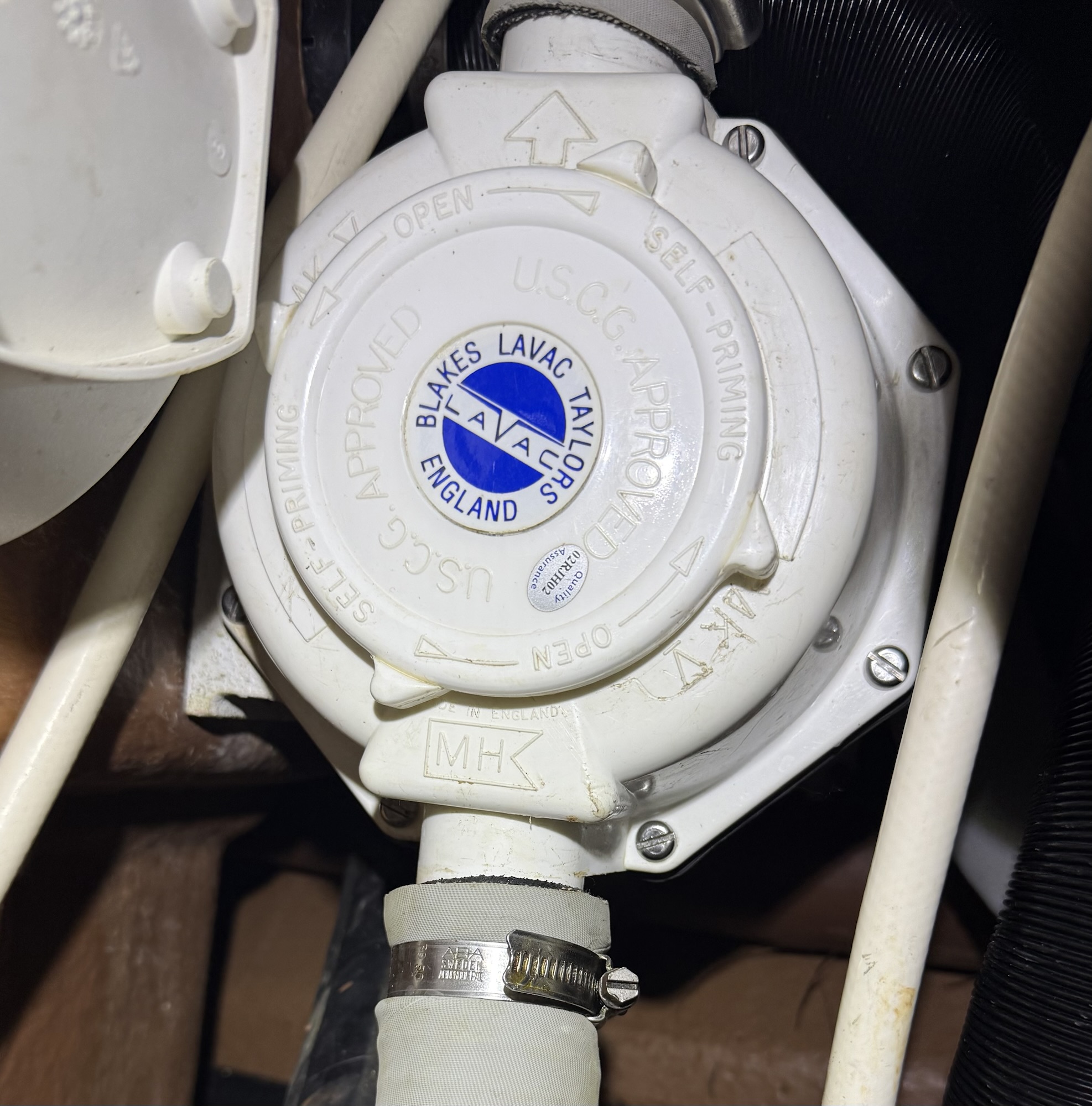
Trouper has rather clever Blakes Lavac toilets. Unlike the more common Jabsco marine toilets there is no change over valve between flush and rinse. The Lavac design simply has a large diaphragm pump on the discharge side, a high loop with a small vent on the inlet side and seals under the list and seat. When the pump runs it creates a vacuum in the bowl and draws seawater in to flush it. When the pump stops the vent breaks the seal after a little while and the lid can be raised. The beauty is in the simplicity – and is best appreciated by those who’ve tried to strip and rebuild the Jabsco ones at sea: they are not only full of small parts, including springs, but the pump itself is notorious for cracking at its base and they are prone to clogging, due to some small openings.
Trouper not only has two of these Lavacs, adding a little redundancy, as well as ensuring that at sea one is always on the downhill side at sea, but they are also electrically operated.
I rebuilt the aft one about 8 years ago, and the forward one’s motor failed in 2022. When the forward one failed I also rebuilt it with new valves and diaphragm together with repainting the aluminium body. It was looking as though I was going to have to replace the pump with the newer design they now supply as the parts are no longer available. This was going to be quite expensive and would need some new brackets and reorganised plumbing to accommodate it as they weren’t the same shape as the old ones. In desperation I looked hard at the old motor unit and spotted what turned out to be a Bosch part code stamped into its body. The previous owner had told me that he’d installed that motor and it had never seemed quite right to him as it operated very slowly – he’d even wondered if it was a mislabelled 24v version. Armed with Bosch part code I went internet shopping: it turned out to be the windscreen wiper motor and gearbox from a 1990 vintage Mercedes Sprinter van. I ordered a new one for about £40 (the replacement pump, that wouldn’t fit, was well over £250) and it fitted perfectly. When I came to wire it up I discovered that there are 3 positive terminals and one negative. They are for intermittent, slow and fast wipe settings. It turns out the old one had been connected to the slow wipe setting!
When we were in France at the start of the month Kathryn had spotted a dribble on the aft head hose that turned out to be from the pump diaphragm leaking. So last weekend, in sweltering heat, of course, I stripped and rebuilt the pump. When I first bought the boat I’d tried doing this in situ under the after heads sink working through a tiny cupboard door. It took all day and didn’t last long as I’d not got it all together straight, which resulted in the rebuild about 8 years ago. I’d been driven to this as I was worried about reinstalling the pump, but when I rebuilt it I did take it out and discovered how to reinstall it easily. Trouper’s heads have a shower head and hose that is stowed in a hole in the counter top of the sink. If you pass a loop of sting through that you can use that to support the bit of the pump you can’t reach in place chest you put the fixing bolts in place. After that it’s two hoses and an electrical plug.
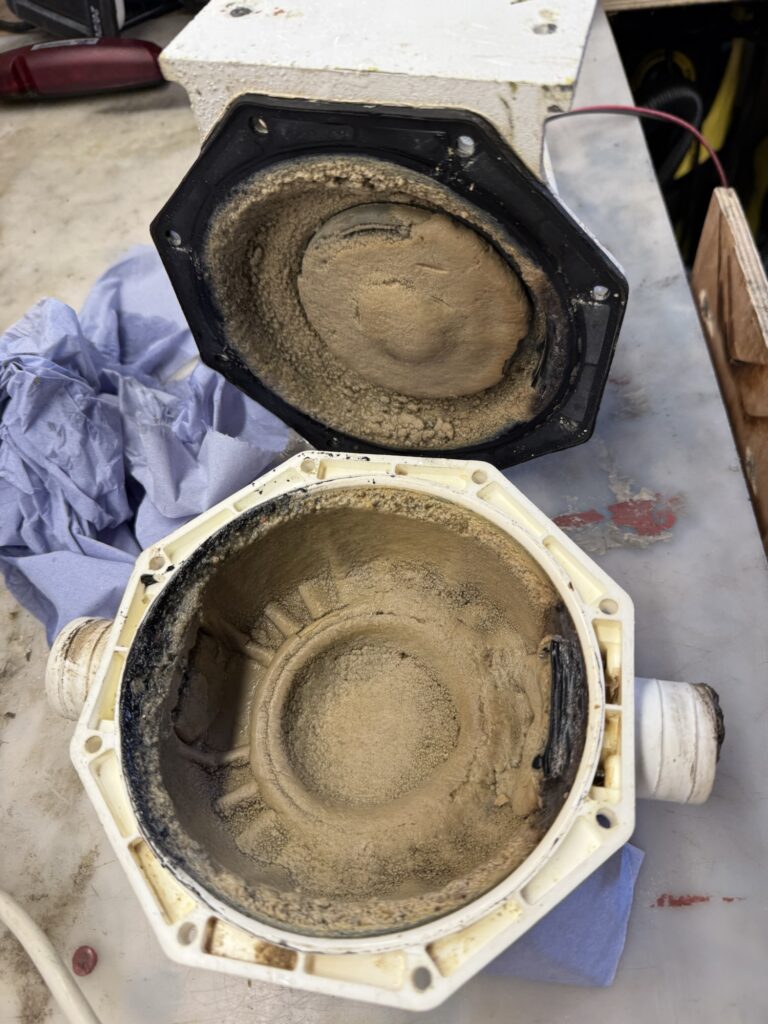
So this time I took the pump out with some confidence (having flushed it with a lot of seawater first) and took it off to the bench in my workshop. Once apart it needed quite a clean – there’s an unfortunate reaction between salt water and urine that forms a crystalline deposit, and 8 years use had created a fair bit of that.
Inside of the pump body before cleaning.
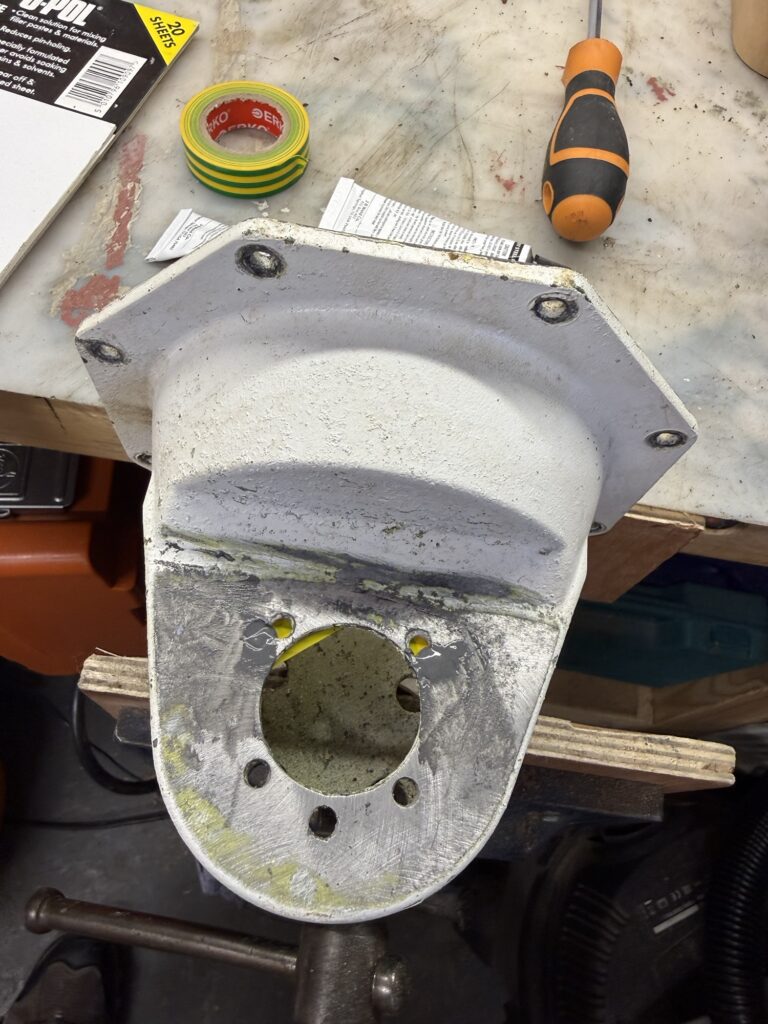
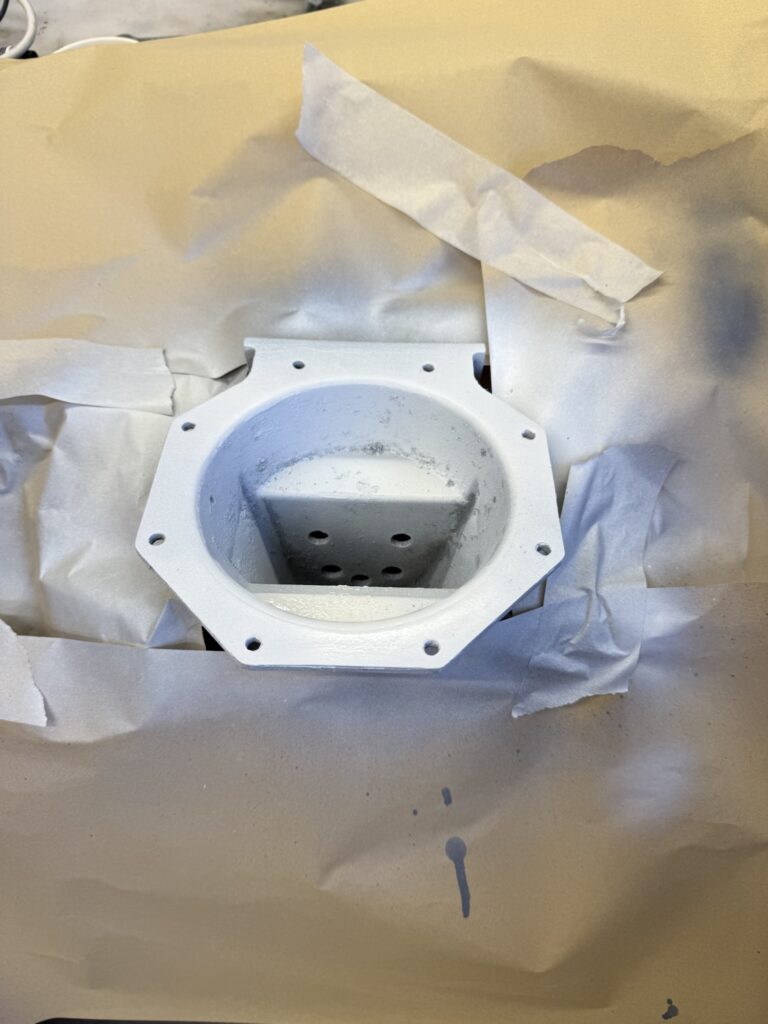
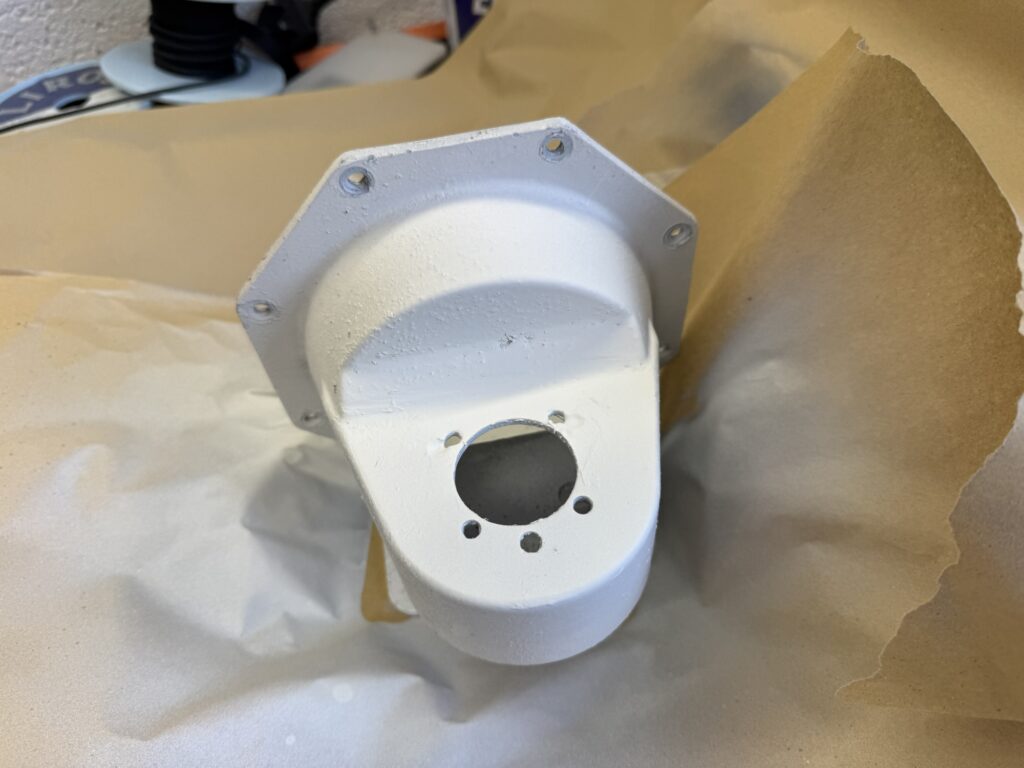
The paint from 8 years ago was in quite good condition (the metal painted bit should be on the dry side of the diaphragm and hold the motor assembly in place) so I just repainted a couple of patches that were most in need, and filled some corrosion damage with JB Weld.
Ground back awaiting primingTop coat going on Finished job, before remounting the motor.
I primed it with two coats of an acid etch primer, and then gave it three coats of top coat – with the last two either side of a much needed early evening shower.
On Sunday morning I reassembled it with a new diaphragm and valves and reinstalled it. The reinstallation was a bit fiddlier than I hoped as I needed to tidy up the end of the inlet hose which was a bit battered. I trimmed about 20mm off it, and then removed the spiral steel reinforcement for about 30 mm to make it soft enough to mate on the pump and clamp tight.
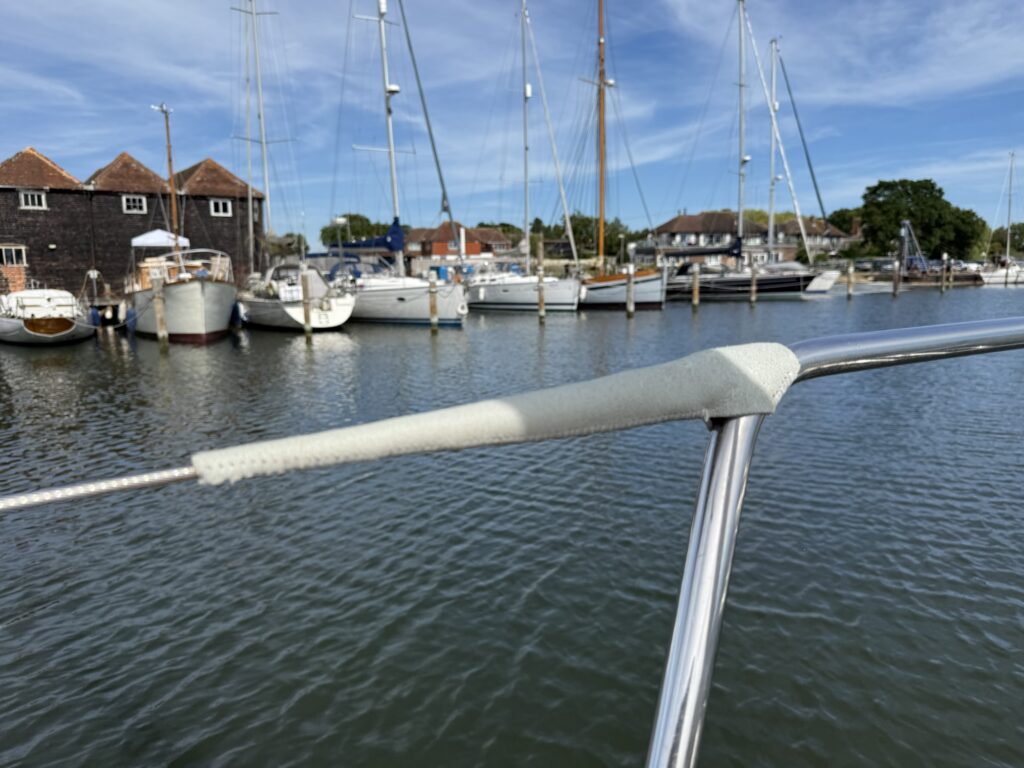
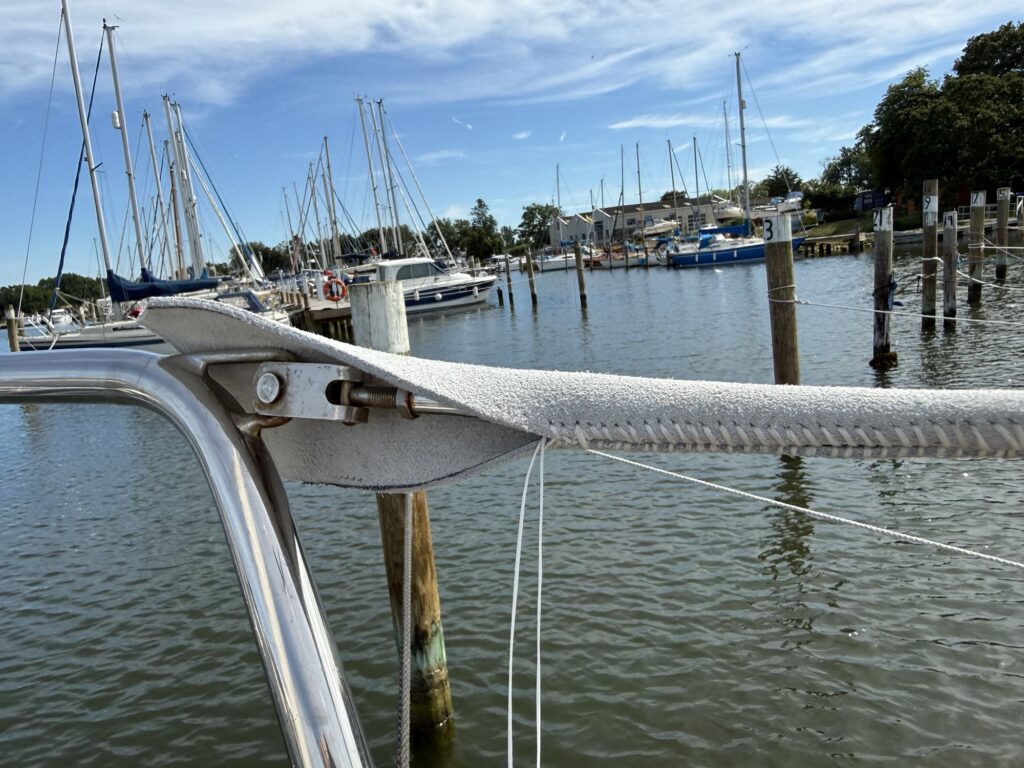
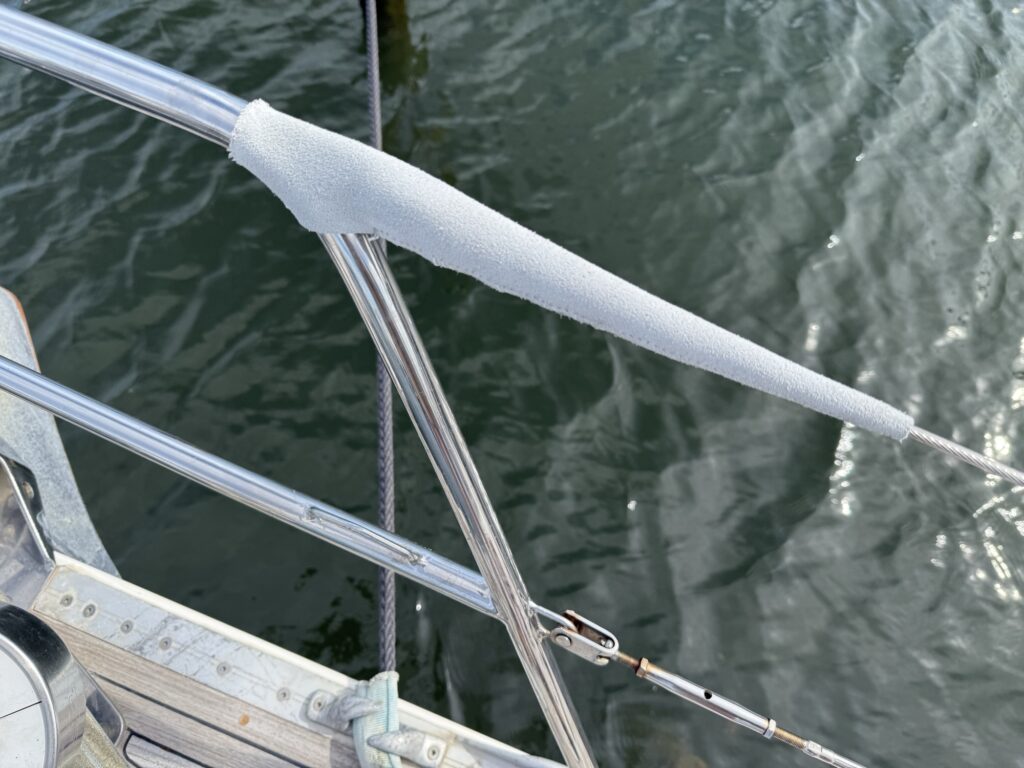
I also finished fitting the new leather boot to the lifeline to protect the headsail, that I’d started in Cherbourg.
The one I did in cherbourgWork in progress stitching it in placeFinished job.
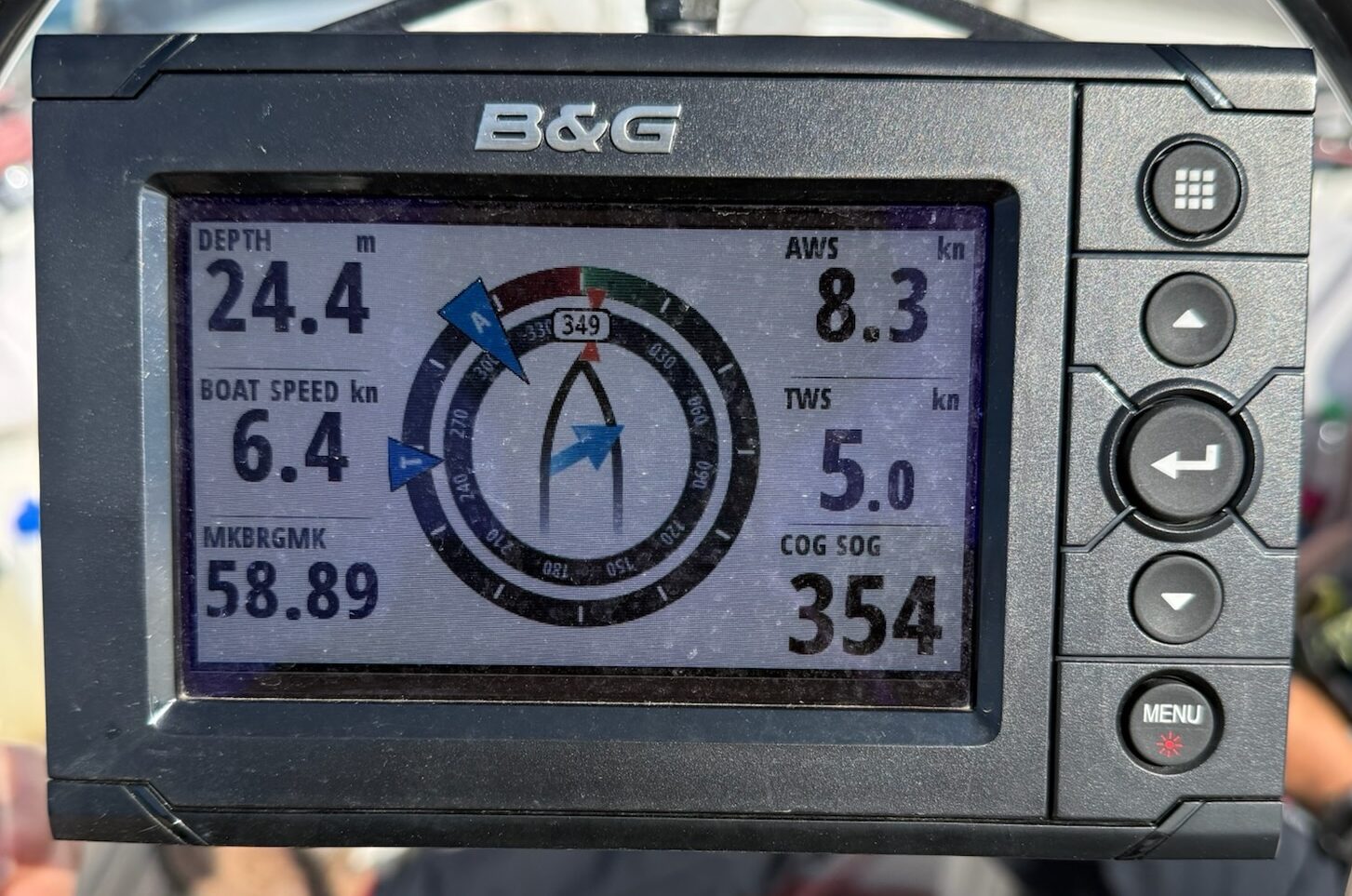
I did a little, very much needed, workshop tidying too, and assembled and tested Mk2 of the Pig Stick and fitted a new brighter B&G 2020 HV Mast display. All in all it felt like a very productive 36 hours at the boat.
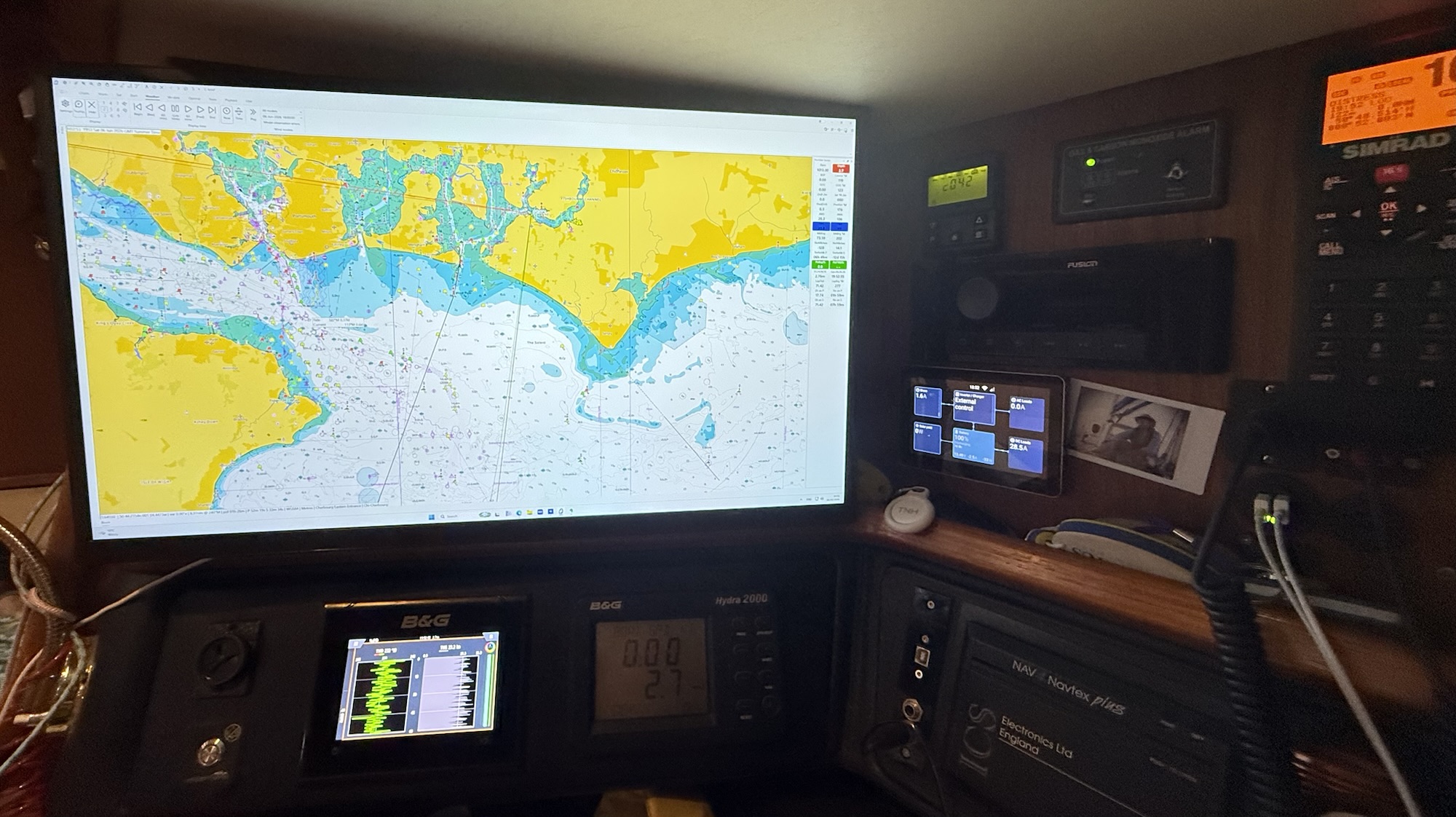
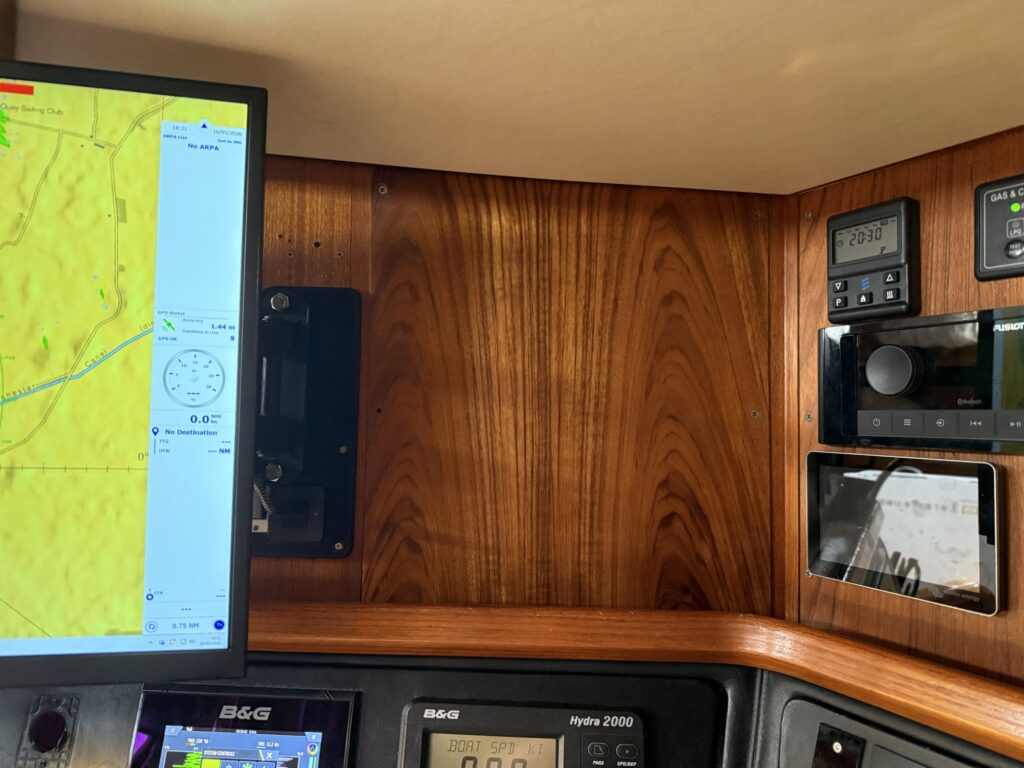
I fitted a new larger computer display to support the new radar and because the new C-Map Reveal X charting in Expedition (which is excellent) now supports 4K monitors. Removing the old radar display had left a hole in the nav station bulkhead that I had to make and veneer a new panel to fill. I was quite pleased with the results, although I had to move the radio handset to make room for the monitor.
New panel, where the radar was.
I’ve also acquired a Victron 4LTE device on ebay. It’s now installed but not working correctly yet but it will establish a always on network connection through the mobile network allowing the Victron monitoring data to be available even when the boat is shut down. It’s handy for monitoring the batteries, but I plan to add an interface to let it monitor the bilge pump and bilge alarm so it will be able to alert me if something goes wrong whilst we’re away.
The Victron Cerbo GX is proving to be a very powerful and flexible system – I simply bought it as part of the lithium battery install a few years ago (mainly for it’s lovely display, if I’m honest) but it’s capable of doing far more than I realised. It is now also our SignalK Server and will run NodeRed allowing low code automation.
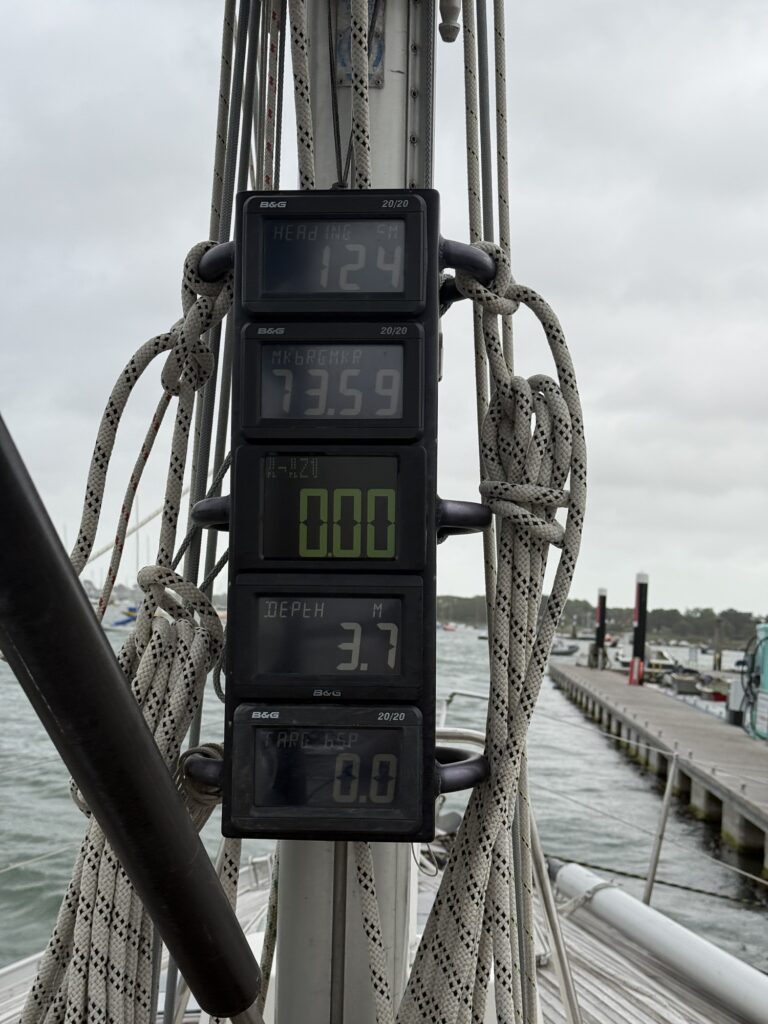
The final prep job was to fit a new display to the instrument pod on the back of the mast that has 5 B&G 2020 displays. I’ve slowly been acquiring used newer models (that are still Fastnet and not N2K) to replace the ones that are there on eBay. The later models are a bit brighter and have better waterproofing – every couple of years I have to dismantle the current ones and put new desiccant bags in them. Though the new ones aren’t in yet (I’ve got two to fit) because they need a slightly bigger hole and different fixing holes, so I need to modify the pod. My standing ebay search had spotted an A&T 2030 display, which I’d snapped up for a couple of hundred quid. These are great quality after market displays made in Lymington by a fantastic little firm: A&T Instruments. The display name comes from the fact that it fits on a 2020 cut out (and will support either fixing pattern that B&G have used) but the characters on the display are the size of those the larger B&G 3030. It works brilliantly and is so much clearer than the other displays that I went to see how much four more new ones would be: at just under £2000 each I’ll stick with the eBay search. I do hope that a few people will have bought these, and A&T’s cockpit displays, to keep old B&G instrument systems going that are now being replaced and that the A&T displays might turn up on eBay.
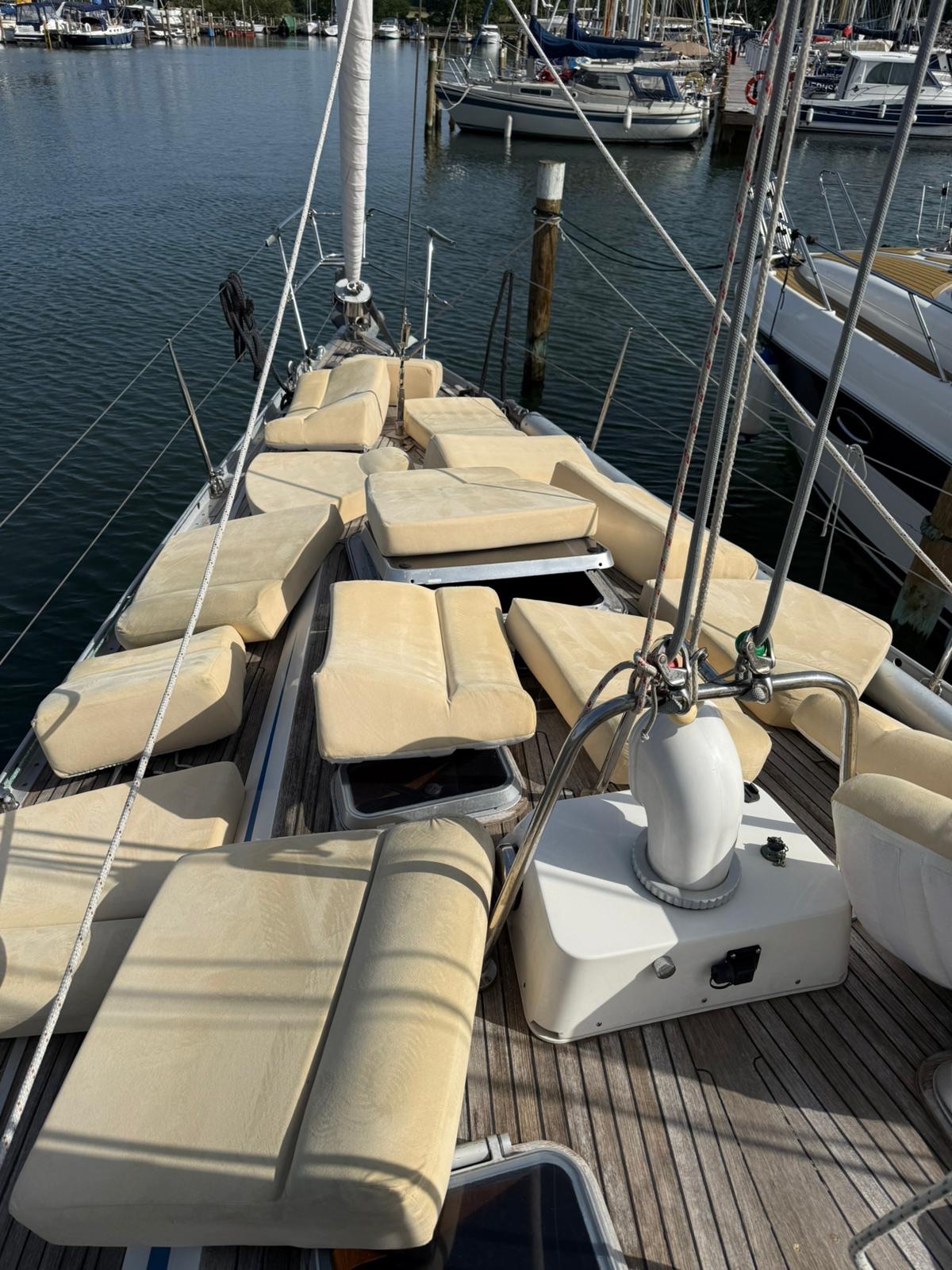
Before we could get away for the late may Bank holiday there was a pile of work to be done: the usual spring clean below and cleaning all the upholstery.
I was also able to finally fix the forward bunk hinges. One had failed on each side and Nautor had supplied some replacements over the winter. Sadly they were close but not quite the same with two of the screw holes slghtly smaller and with a different spacing. These screwed into a tapped 5mm thick stainless plate that is in turn bolted to the bunk frame and acts as a spacer. I’d spoken to Rob, the local marine fabricator, about making up some new plates but he had a better and cheaper plan: he’d simply weld up the existing holes and then redrill and tap the plate. He promised me I’d not be able to tell where the old holes were. Suffice it to say he was right and they allowed me to put it all back together.
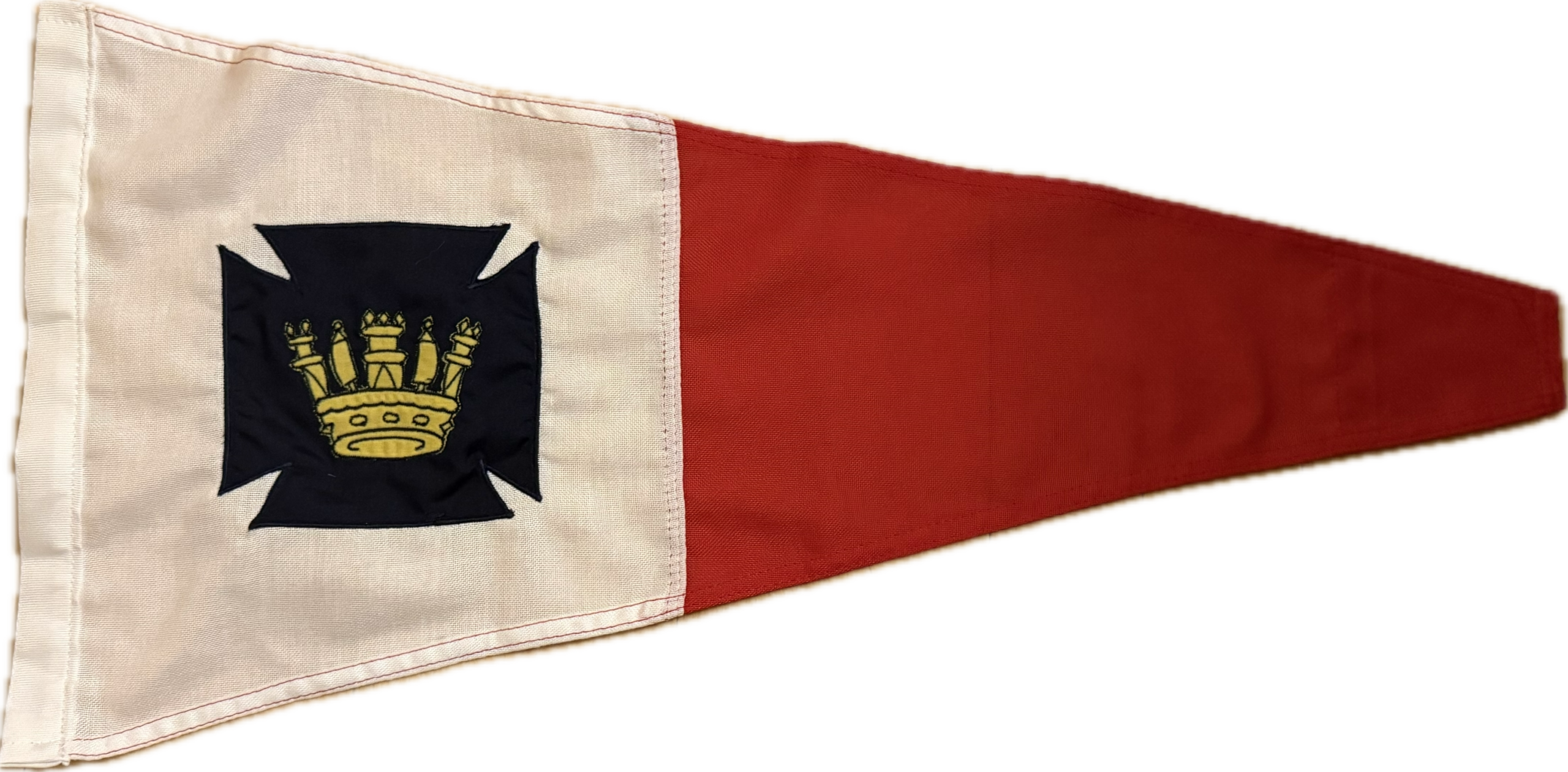
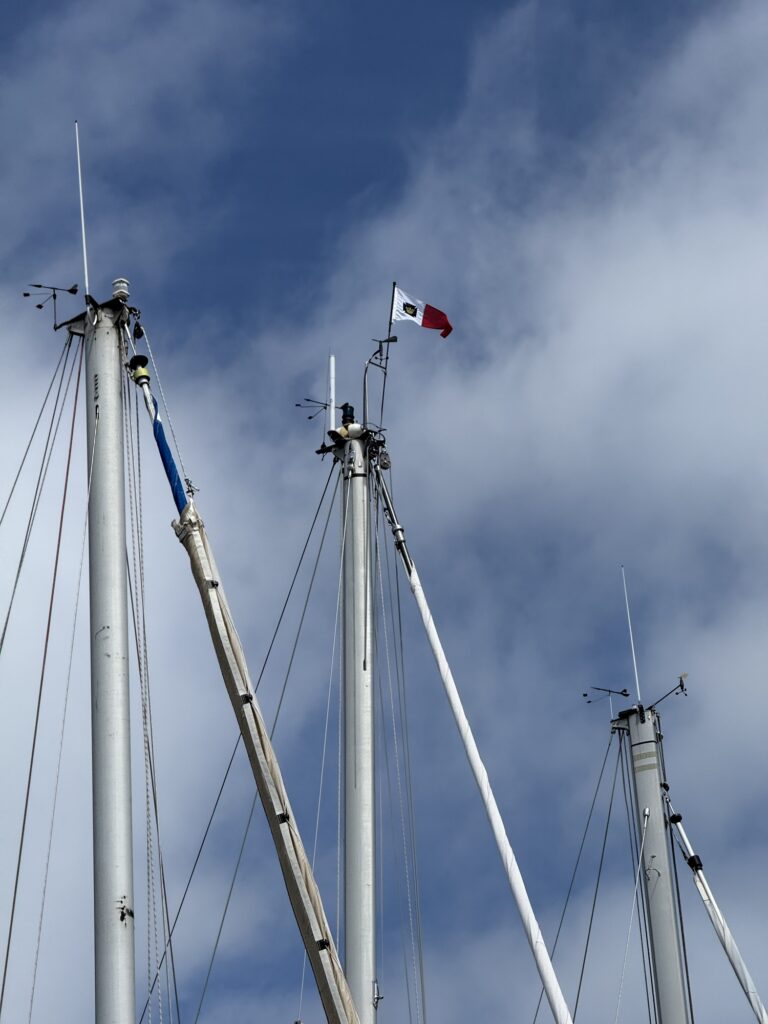
I became a member of the Royal Cruising Club (RCC) this year. The club has been very welcoming and has a thriving online community, as well as regular events and meet ups. It is of course the home of the RCC Pilotage Foundation, the publishers of most of the pilot books I’ve depended upon for years. I hope, in the future, to get involved in producing and maintaining these. The club is pretty relaxed, but does have a thing about flag etiquette. Members may choose to fly an undefaced blue ensign, which is a privilege rarely afforded to Sailing Clubs, but they insist that all members fly the club burgee from the truck (or masthead) at all times. The idea is it makes you easily identifiable and thus facilitates members saying hello to each other – which makes sense, especially for a club with no land base, where the whole point is to be away cruising.
Practically it’s a bit tricky: modern mast heads bristle with radio antennas, wind instruments, radar reflectors and the like. The solution is a small crane that extends a light halyard clear of the masthead. The problem with this is that the burgee can’t rotate freely and will ultimately tie itself around the crane – in my case some 20m above the deck. This is where a pig stick comes in: it’s a stick which can be hoisted with the crane halyard, but that will extend above the crane and around which the burgee can freely rotate. Traditional solutions involve garden canes and coat hangers.
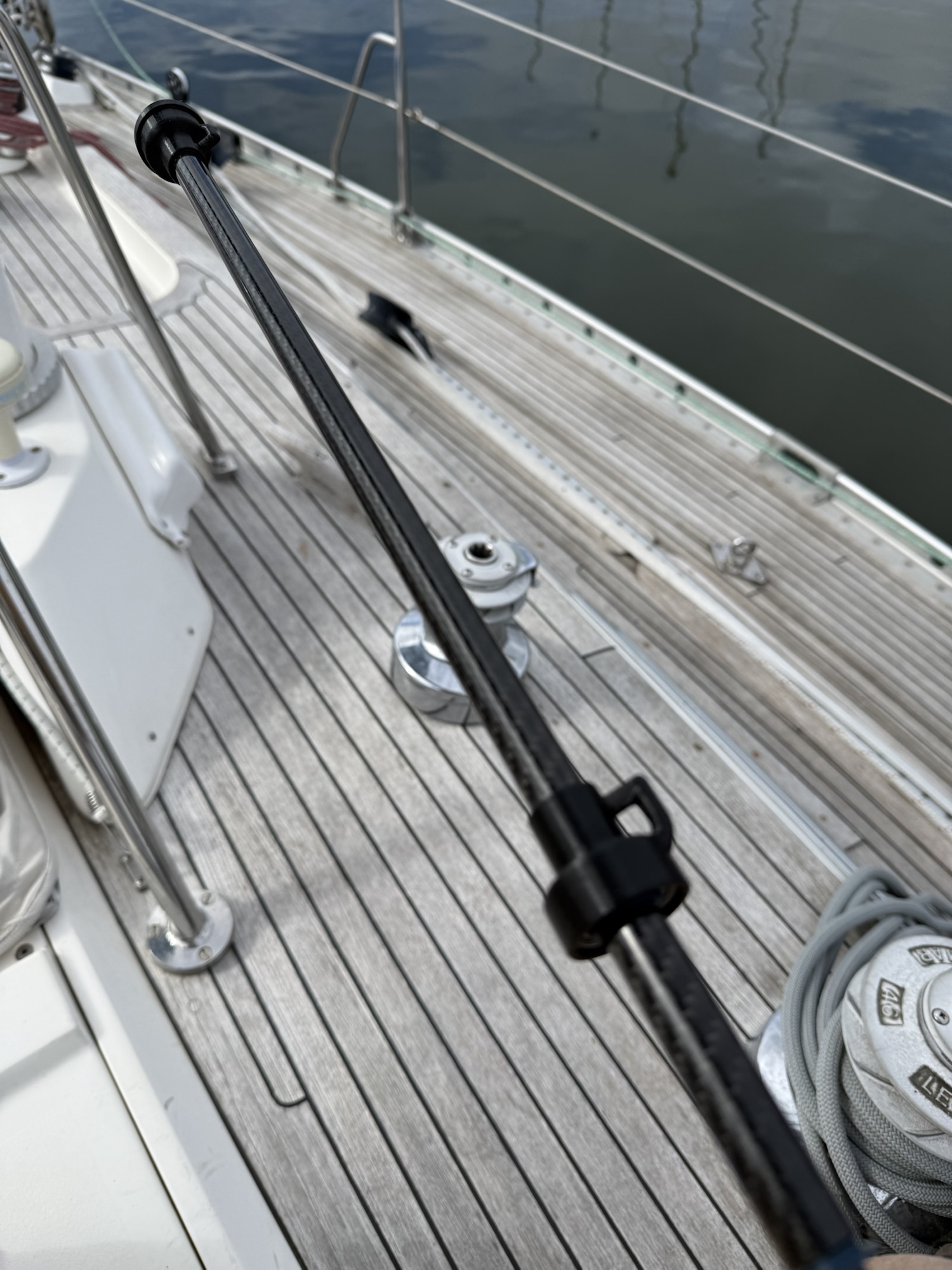
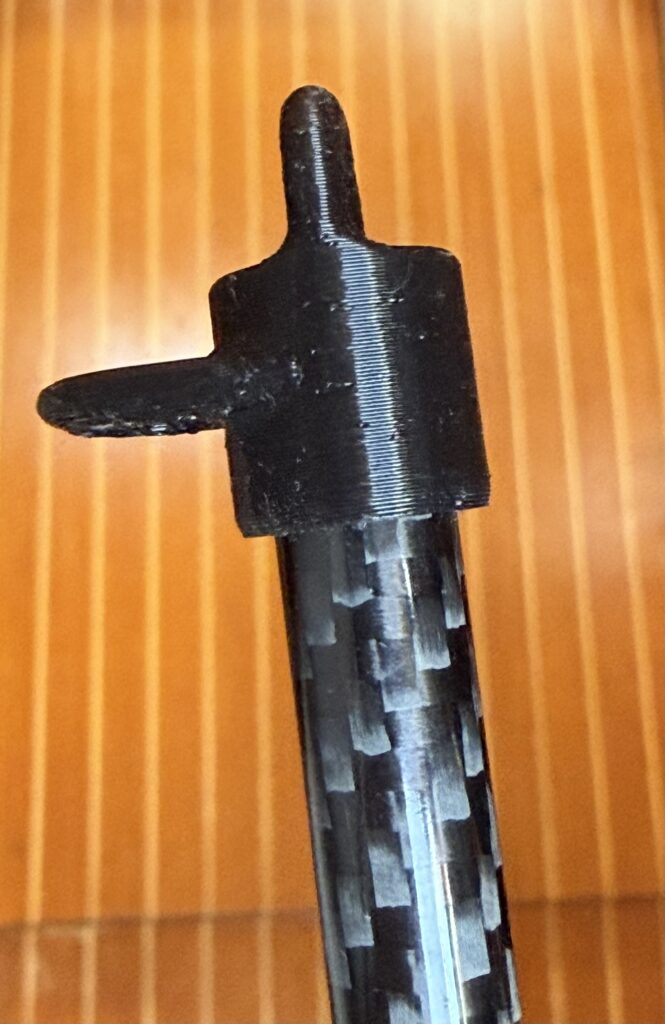
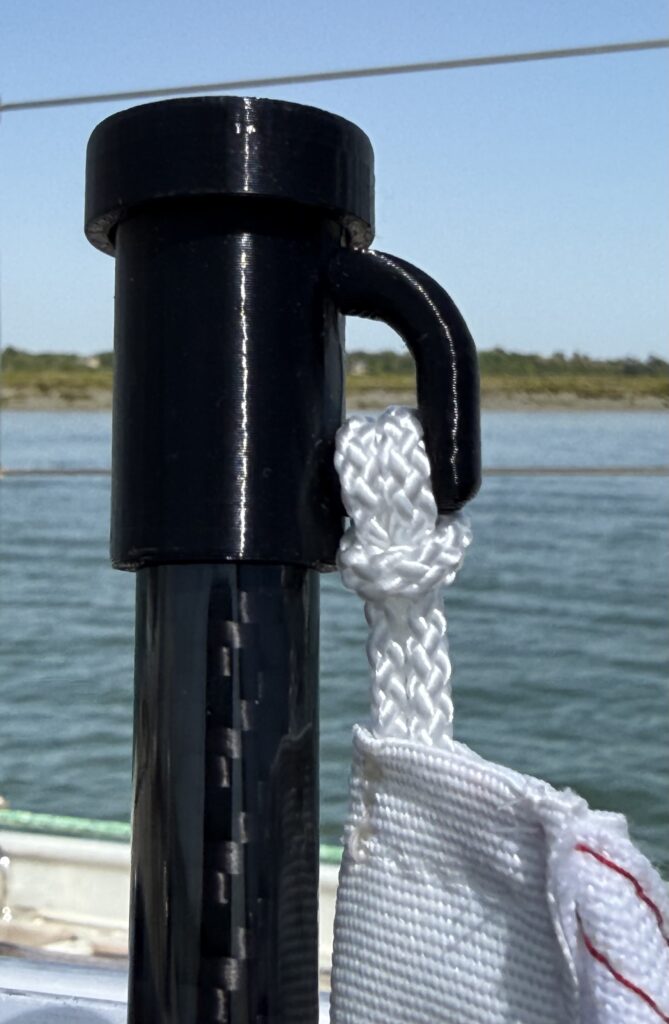
I felt the need to overengineer this a bit. Two lengths of carbon fibre tube, some epoxy, a few 3d printed parts and two sets of roller bearings later I’ve got a solution.
Its a 2m 10mm diameter carbon tube, with a second larger diameter tube mounted on roller bearings, long enough to support the burgee that sits on a bushing and it held on by a top cap.
Bottom fittingTop Fitting
I’m pleased to say it works rather well. It’s been up for five days now and seen gusts of over 30kts without a problem, and the burgee remains untangled.
One of the over winter projects was tackling the vibration we’d noticed from the propellor last summer. It had got bad enough that we’d had a diver check that it wasn’t fouled.
We have a Max Prop. It’s a clever feathering prop design, where the pitch can be adjusted – and even be different ahead and astern. It can also be easily adjusted between left and right handed rotation. When under sail the prop will automatically feather to a very low drag configuration, and the pitch is wound back on when the engine is put in gear.
Once we got Trouper out of the water it was obvious that the Max Prop was badly worn, The prop was original and dated from 1989, and had been serviced twice before, once by me. That had cost about £600 some ten years ago so I wasn’t looking forward to the bill. Worse still the advice at the time had been that it could be done a third time but that was likely to be a shorter lived repair.
Armed with this knowledge I got in touch with Max Prop, who’d been very helpful with new settings for the prop when we replaced the engine, a couple of years ago. They were really helpful and offered a part exchange replacement for their new model, that features simpler adjustment, for ‘only’ €1300 plus UK import duties. A new one retails for several times this.
So just before Christmas I got the old one off – which proved to be quite a job after I rounded a hex socket on one of the bolts and had to drill it out. It took both a bearing puller and a blow lamp to get the core of the prop that has a taper and keyway in it to match the taper and key on the shaft off. It was duly packaged off and couriered to Max Prop in Italy before we went to Canada for five weeks. It never got there, and it appears that it was lost in Italian customs. At this point I was a bit worried that without the old one I was in for the price of a new one – and of course the carrier insurance proved to be worthless as you had to show the purchase invoice for the lost item, not it’s replacement.
Max Prop however rose to the occasion and agreed to honour the deal – despite not receiving the 14kg of scrap bronze in exchange. They shipped a new prop with a taper and thread to the specification of the original drawings. Beyond a little adjustment of the key it fitted properly and was on in time for the boat to be launched.
Once afloat I recommissioned the engine (after sorting out some other stuff) and discovered on putting it in gear on the berth that we went astern when ahead was engaged and astern when ahead was engaged, We have a conventional right handed rotation, but I suspected that we’d been shipped a prop set for left handed rotation. A quick google established that on the max prop easy that we now had it was a simple adjustment to change from one to another. I got in touch with Max Prop and they agreed that this was the likely cause, so I booked a lift for the following Friday where the boat would be held out of the water whilst I adjusted the prop.
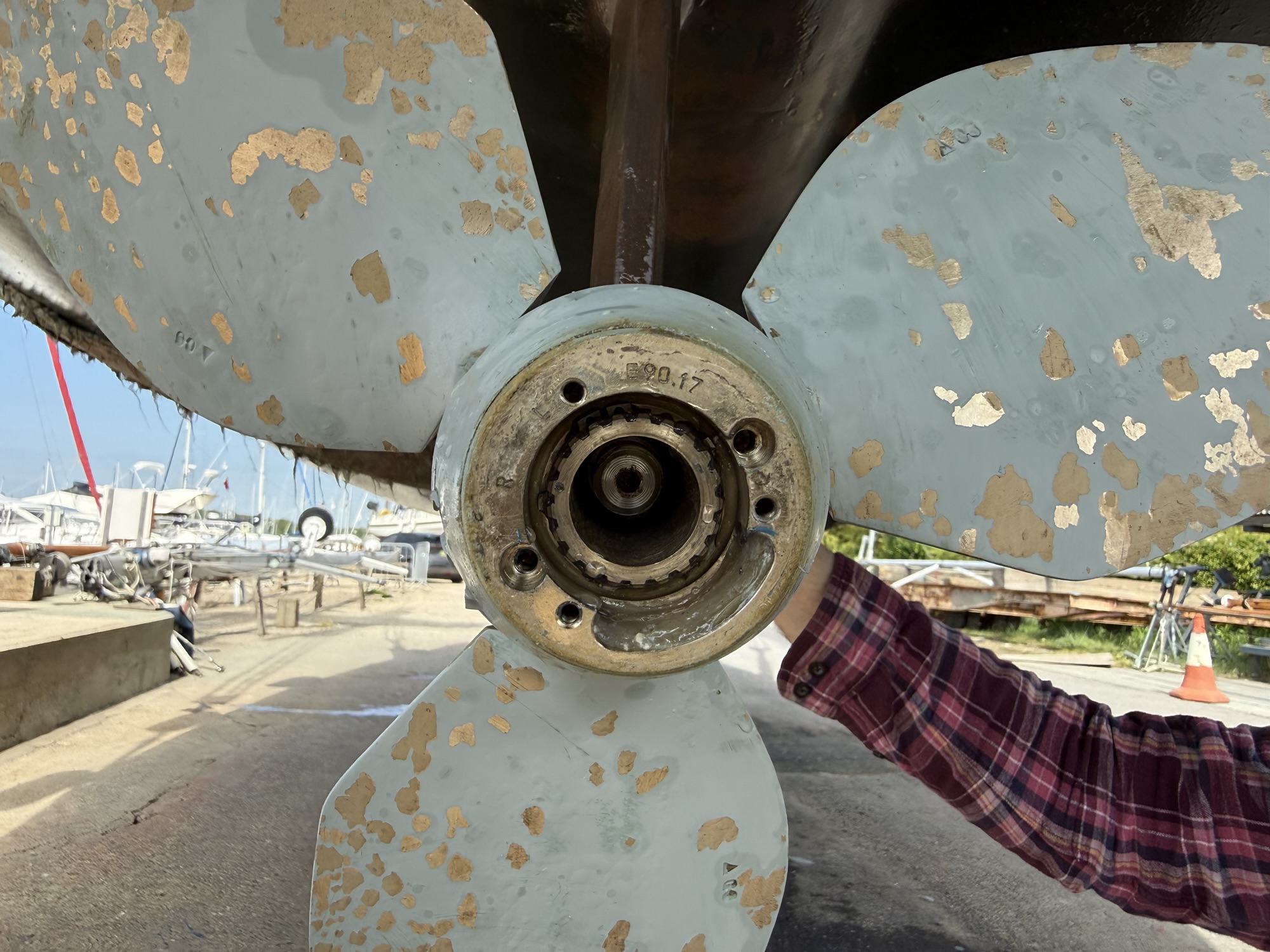
The video above shows what we found, and the general operation of the max prop, together with the evidence that I really need to try harder at antifouling the prop.
Unfortunately what this also shows all too clearly is that the prop is set for right handed rotation. The dot on the inner ring is clearly aligned with the R stamped into the outer ring. It was at this point that I realised that the Italian’s take their May day bank holiday on the Friday, not the Monday as we do. I coulnd’t get hold of them at all. So we put the boat into the yard ashore and I took the prop off and home, giving up on any idea of going out on the boat for the Bank holiday.
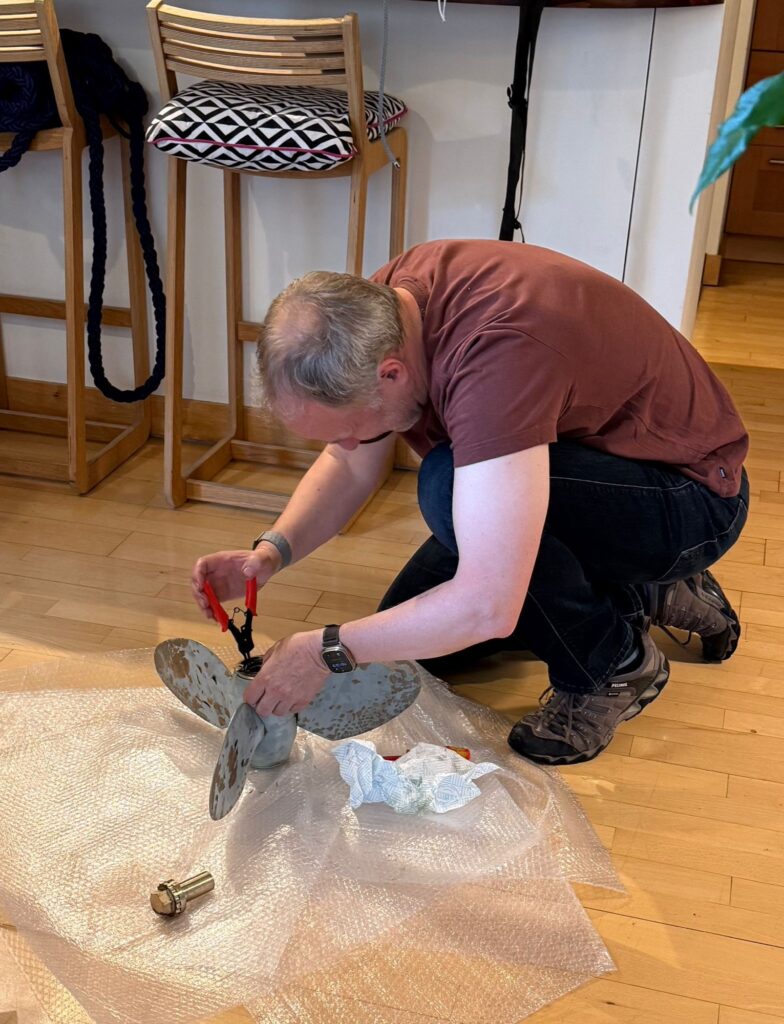
On the Monday Max Prop got in touch and we were reluctantly getting ready to ship it back to them in Italy – all very conscious of the lost prop last time and the likely 2 week delay at best. As a last measure we all got on a whatsApp video call and they examined the prop whilst asking me to move the blade positions. They spotted a problem – the inner sleeve appeared to be out by one notch. After a trip to screwfix for me to buy some circlip pliers (mine were all at the boat yard, I don’t commonly need them in London) it was a fairly quick and easy job fix it with them showing me what to do using another prop on their bench in Italy.
Adjustment underway
Then it was just the matter of another Friday off work, and another crane lift to put her back in the water and test that all was working as it should. Max prop had been so good around the lost parts at the start of the year that I decided that I’d not try to recover the cost of the lifts – it seemed as though one good deed deserved another.
Being lifted into the water – I never like this bit.
Thankfully I could drive her back onto her berth without a problem: it was fixed, and will hopefully now last another 35 years or more.
After I wrote the last post I spoke with a very helpful guy at B&G who explained a bit about the N2k/Fastnet bridge (H5000 Fastnet Interface). It would appear that it should be supplying more data to our N2K network than it is, which suggests our H2000 Performance processor isn’t correctly configured – which isn’t a huge surprise. He explained that the data transmission rates on Fastnet is much lower than N2K and they’d not bridged data to avoid swamping the Fastnet bus. I’m not sure that really makes sense – as a throttled feed of the data that they’ll already let you inject onto Fastnet from an old serial NMEA0183 source (such as a GPS set) would cause no more trouble than the current feed – and be rather simpler on a boat moving towards more modern tech, where a GPS upgrade to an N2K device has probably already happened. Anyway that’s how it is. It leaves me with a job to look at the config of our performance processor.
I did source a rather expensive but fairly pristine pilot remote on eBay, which worked perfectly. That gave me the confidence to take the old one apart. I found that one of the screws that hold the circuit board down had become loose and was lodged under the board. Once it was back in the right place all worked well again, so now I’ve got a spare. Whilst reassembling it I did replace the lanyard attachment point – it had always been broken and having a way of tethering it has always seemed a good idea. I was able to 3d print a replacement, which pleased me.
In order to provide the data feed to the Saillogger platform that provides the tracking I use here I’ve been running SignalK on the Cerbo GX display/processor that manages the Victron battery kit. It’s part of Victron’s supported configuration and the Cerbo is connected to the boat’s N2K network so has access to all the boat’s data. Signalk is really very neat – it’s an open source modern http based data sharing platform, which supports plugins to connect to all sorts of things, and when combined with Node Red workflows can be used to build all sorts of automation and monitoring.
My first step will be connecting the Cerbo to allow monitoring the the bilge pump and an high level bilge alarm. Because the Cerbo is always running and internet connected (ours uses the boat’s network or falls back to a cheap IoT mobile dongle) that means I can get flooding alerts whilst the boat is unattended.
Longer term I’m thinking that the sensible thing to do would be to create a Fastnet SignalK module. The SignalK platform can manage the translation to N2K – or wherever else – and it would allow all the Fastnet devices to be used for as long as they work. I also wonder about an Expedition/SignalK interface – that seems to be a match made in heaven with all the data Expedition makes available.
Trouper went into Nautor’s Hamble yard for a mini-refit in late October 2025. The main job was to remove the rig and renew the rather elderly rod rigging. There were a few jobs that it made sense otherwise do at the same time, such as replacing the radar, as it is only possible to re-run that cable with the rig out of the boat.
Rod – this was all renewed, with new bottle screws. Unfortunately the rigging subcontractor got their sums a bit wrong and has made the rods that run from the lower spreaders to the deck and the lower diagonals too short. Currently there is an interim solution using some extra toggles at deck level in place, and they’ll be swapping in new sections in the spring.
Compass – this has been a problem for some years. Id thought it just needed correcting. The Nautor guys arranged to swing the compass with a compass adjustor on board (much easier to arrange in Hamble, than Birdham). They identified that the problem was not the need for correction but rather that the bearing that the compass rose tuns on was sticking. Nautor managed to find a firm in Newcastle who appear to be the last people in the country able to rebuild compasses. I could have bought a new one, but ones as large as Trouper’s are no longer available, and critically the current one has the Swan logo on the compass rose. Happily the compass is now rebuilt – and for less than the cost of a new good quality one. Unfortunately the lamps were lost in the process, but Nautor are sorting out replacements for me.
The wire checkstays were changed for Dyneema. I wanted this to reduce chafe on both the mainsail and the boom as the checkstays are often rubbing against them when under sail. We decided to replace the babystay and backstay with dyneema too. The backstay went on whilst with Nautor but the babystay will be added in the spring when they sortout the shroud length issues.
After much deliberation I decided to replace the radar with the modern Furuno model. This had the great virtue of the same bolt fixing pattern as the old one, and they have a reputation for making stuff that works for ever. I’ll write a separate post on my experiences of using it. In the end I chose to use a computer software display solution for it rather than a dedicated display.
Nautor also commissioned an electrician to inspect our Victorn Lithium battery and charging system that I’d installed as our insurer had asked for something. They’d said an email was fine – what we got back was a rather grander pdf covered in logos but I was a bit smug to read that they thought it was a good installation, to a high standard.
I’ve subsequently tackled a few more jobs.
The Nautor guys pointed out that my halyards, especially the spinnaker ones, were really rather tatty. This was a big ticket item as I ended up replacing both spinaker halyards, one of the jib halyards, and one of the main halyards. I was able to buy a drum of 12mm dyneema cored rope and make up the halyards myself, which helped on the costs, though the rope itself was expensive.
The lazy jacks were also looking a bit tatty after 7 years uses so I bought 100m of the Lyros lazy jack line and remade those, which was a fairly quick job, and replaced all the fender lines whilst I was at it as they are made of the same stuff and were a bit tatty.
Last summer we’d added to the chafe damage on the mooring lines that had come with the boat. It was a good set of nice lines but they are probably 15 or more years old and with chafe damage usually in the middle we had fewer and fewer long ones and ever more short ones. I’d been eyeing up what to use for new ones and had settled on a lyros product that is designed to be especially stretchy which will help in windy or bumpy conditions. I used the halyard rope order as a chance to get a bit of a discount on 100m of that two, whcih I’ve cut down into 2x10m, 4x15m and 2x7m lines all with a decent sized eye splice at one end. I’ve used whippings on the unspliced end to indicate the length which should help finding the ones you want in the locker. We still have two 25m long shore lines in the locker too, so we’re very well proivded for now.
Replacing the worn Max Prop. This turned into a bit of a saga so gets its own post.
Patching the copper coat where some has come loose. That turned out to be a simpler job than I’d feared – as ever decent suface preparation and then following the instructions did the trick.
Our 12 year old liferaft failed it’s 3 yearly inspection, as it no longer maintained it’s pressure over 24 hours. Wouldn’t have stopped it working if we’d needed it but it marked the end of it’s useful life. Suffolk Marine safety sorted out a suitable replacement for a reasonable price. I want a robust well specified one (if you ever need it you’d regret penny pinching) capable of taking six people, and it has to fit inot the storage cage on Trouper’s coachroof.
This post has taken a while to be published so describes the autumn 2025 position, on our return from the Brittany trip.
This trip had a few purposes:
To give Kathryn and I a proper break and step away from the normal pressures of our lives.
To test out if living on Trouper for extended periods was comfortable and what we might want to do in future.
To test out Trouper’s systems and see if they needed any changes for future longer trips.
So how’ve we done? The first two I think we’ve achieved. We’re still talking to each other, and talking about future trips, indeed we’re both very clear that we’d like to spend more time on the Atlantic coast and explore further. There’s an awful lot to like about this coast, and whilst I would like to explore the Mediterranean in future I can see why this might make a better long term home for us. Neither of us feel a huge need to go crossing Oceans, though I did point out to Kathryn this afternoon that it’s only 155nm in nearly a straight line from Chichester to Roscoff, so we could leave one evening and be there the next afternoon, and that in the right weather that would be easy enough with just the two of us.
I think that for longer term trips I’ll need a sense of purpose and mission. Even just writing this blog helped, but simply wandering about exploring won’t quite do it for me – I need a bit more purpose. I think that getting involved in producing pilotage will be the answer – it will provide that sense of mission.
We bought Trouper 12 years ago and she was a very good fit to my tastes and needs, but we have made a few significant changes to her in our ownership. Before we launched her for the first time in our ownership we had the hull coated in ‘coppercoat’ which is a long life alternative to antifoul. It’s meant to be less polluting and doesn’t need annual reapplication. Ours has need some patches where it has come off but is otherwise working well. The pre purchase survey had spotted some issues with the heating system. Unlike most modern yachts that use a diesel fired blown air heating system ours heats a water circuit like a domestic radiator system. Rather than radiators we have two electrical thermostatically controlled blower units, one forward, one aft, which each deliver four hot air outputs. The surveyor had identified that the blower units were leaking, and we’d had them replaced. Trouper, like most boats, has a colorifier (hot water cylinder) that has a mains powered immersion heater element, and a heat exchanger coil from the engine’s cooling system, so engine heat is used to generate hot water at sea. The problem is that the calorifier is small at 25l, and if we at in an anchorage for a day or two we run out of hot water very quickly. During the first season of ownership I realised that we could use a two coil calorifier and connect the diesel heater circuit to the second coil. We had this done and it’s worked brilliantly – the 10kw heater heats the tank very quickly and showers at anchor are now much more comfortable. These diesel heaters have a very distinctive roar and we do get the odd strange look as we fire ours up on the middle of a hot summers day.
We’ve renewed the sails with the latest in high tech cruising sails (North 3di Nordac – a white seam free moulded sail more like flexible fibreglass in structure than traditional woven fabric), and in the process installed a new sail track on the mast to accept the batten cars needed for the fully battened mainsail. They still set beautifully and really do make a difference.
We also replaced the engine a couple of winters ago. That was an ambitious project on several fronts: finding an non turbocharged marine engine that would fit in the space available was tricky and then adapting that engine to fit with the boat’s systems and controls was quite fiddly. I must have been a nightmare client for the guys who supplied and fitted the engine (supplied by the lovely James French of French Marine, and fitted by the brilliant and lovely Dick Woodruff) But, aside from the last few teething problems the engine is working well and the integration with the boat and its systems is excellent. The old engine was becoming difficult to maintain and some parts were become unobtainable so whilst it ran well there was the real risk that it would pack up at some inconvenient moment never to work again.
The year before the engine work I’d also replaced the batteries and charging system moving away from the four big 6v golf cart batteries that were the original system design, to two Victron Lithium Iron Phosphate batteries, and associated charging, management and monitoring equipment. This was another big project, which was only really finished when the new engine went in with a new secondary alternator (another of those difficult client requests for James, that he rather overachieved on) capable of delivering the sort of charge that big LFP batteries demand. This has been transformational. We used to get anxious about power after a single night on the anchor, unable to plug in. Two was really the maximum possible. We’ve now doubled the available power and massively increased our charging capacity from the engine, added a small hoistable solar array and halved the weight of the system. We also have lots of lovely data telling use about how much power we use. Our usage has gone up as I’m much less abstemious than I used to be – for example the boat’s instruments have been on for nearly two months, and the starlink dish draws more than we could have supported.
Power consumption data from our Victron system.
So what would we change on Trouper?
We agree that a washing machine would be the biggest creature comfort. There appear to be more options opening up out of the motor home market, so for the future we might need to do some research on the possibilities, but we don’t have room for a traditional mini domestic machine – even if we had the power and water.
The Starlink mini dish has been really useful this trip and has made an always on internet connection just work, with very little effort (mounting bracket aside). I still baulk at spending money with a Musk company but there is nothing else like it. It’s allowed us unlimited access to large weather data files, to stream podcasts whilst on passage, and to even stream HD TV to our Samsung portable projector whilst at anchor in remote spots. We probably used the projector about 15-20 times over the 9 week trip.
Before we left I knew I fancied a larger tender, with a hull shape the would allow better seakeeping. Truthfully we’ve not really needed it, and our existing bombproof Avon has attracted admiring comments from people who are less impressed with the durability of modern PVC tenders, so that’s probably on hold until a proven need.
A water maker (most likely a Schenker Zen 30) is on the upgrade list. We didn’t struggle for water at all (and carry about 350l), but there were hose pipe restrictions in place for most places, and one might expect water supply issues to get worse rather than better due to climate change – so being able to turn seawater into drinking water, now that energy recovery water makers have pulled the power demands down seems sensible. Before these cleave energy recovery units were around it used to be said that all water makers did was turn diesel into water as you needed so much power to operate them! However they are maintenance intensive and need to be used regularly or ‘pickled’ as a consequence it’s probably something to leave until we’re spending longer periods on board.
Trouper’s rod rigging dates from 2017 and needs replacing – that’s going to get done overwinter, and the analogue Furuno radar will be replaced at the same time with a modern digital Doppler radar – though likely still a Furuno.
The minor issues with coolant leaks from the new engine need sorting out to ensure we’ve a robust and reliable set up. That should be easy. What’s a bit more tricky is the steam we get from the exhaust at higher power settings. The engine and exhaust don’t seem to be overheating. The steam isn’t coolant (the levels don’t drop, aside from the leaks) so it must be related to the raw water injection and cooling of the exhaust. But it’s got both engineers involved and me a bit puzzled.
Our anchor has served us well, but is a CQR design and original to the boat. CQRs were revolutionary high performance anchors in their time but they date from the 1950s have been overtaken in the last 20 years by higher performance designs. Ours is also showing some signs of wear and is starting to rust in a few places where the galvanising has worn off, so it might be time to consider a replacement. Trouper has a very nice clamp mechanism to hold the anchor secure in its roller, which will need adapting or replacing to cope with a different design so this won’t be a simple swap. I favour a Vulcan as the replacement – it has the same virtues as the Spade, but is reportedly less prone to corrosion (I think it’s a solid casting, where the spade is fabricated with a hollow shank, at can rust from the inside out) and it doesn’t have the significant failing of the roll bar anchors like the Rocna that are prone to clogging with mud and then not resetting if broken out by a wind or tide shift. Personally I’d trade a fair bit of optimum condition peak performance for reliably reseting after being broken out. Anchors and anchoring techniques are one of those things that people get very exercised about with very clear views on what is ‘right’ or ‘wrong’ – for me in this (and almost all things) there are many shades of grey. The first thing to do is make a template of the Vulcan and see if it will fit on Trouper’s bow roller. Our chain seems to be in good condition – so hopefully that’s good for a little while yet as 60m of 10mm chain isn’t cheap. I suspect I might ultimately change the chain at the same time as renewing the windlass (so hopefully far in the future) and maybe step down a chain size, whilst using higher strength steel chain, to enable me to stow more chain in the locker.
The last thing on the wish list is top down furling gennaker. A big asymmetric spinnaker optimised for sailing really deep (so close to dead downwind) with a small demountable bowsprit. The sail would let us make progress under sail in lighter airs – which is often my favourite sailing. The top down furler technology grew out of the Open60s where solo sailors needed to be able to safely handle large downwind sails. Essentially the sail is rolled up around a torsion rope from the top which has proved to provide much neater stows and to work much more effectively in stronger conditions than early simpler bottom up designs. The confidence of knowing that we could easily furl it would encourage us to use the sail much more. We have two big (one vast) symmetric spinnakers but they require quite a few crew to handle effectively – and are certainly not suited to just the two of us.