Category: Maintenance

  • Glenan and the Raz with company

    Glenan and the Raz with company

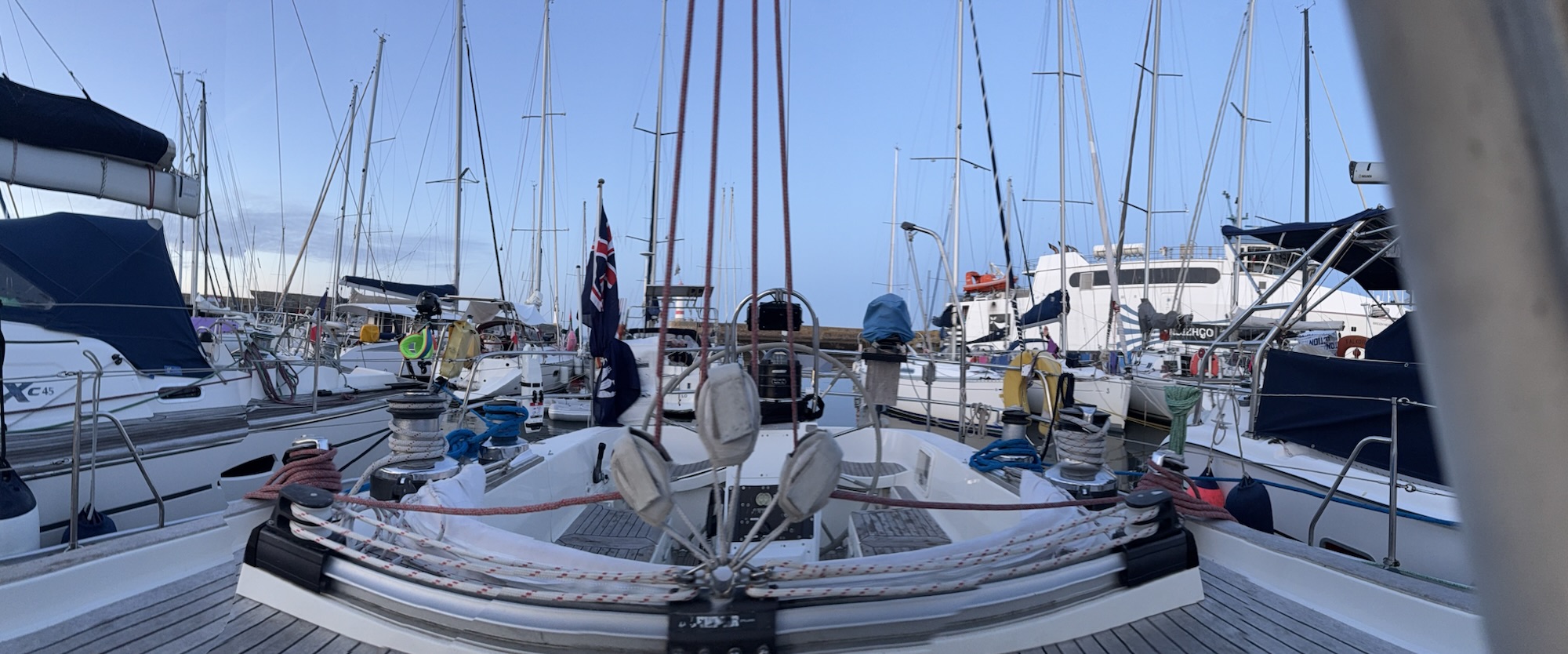
    Port Tudy drove home what I’d been noticing for some time: whilst Trouper is perhaps a little larger than average around the Solent but at 43′, she’s hardly large, and 50’+ boats are common; here we are definitely heading for outsize. When we had dinner with our friend’s brother in law, a lifelong sailor, the other week he’d suggested that there was no need for a boat larger than 10m (33’ish) south of Brest. Most ‘big’ cruising boats here are 30′-35′ and moorings are much more limited for boats over 12m (40′). Boats in the 20-30′ range are still common. This feels much more like my childhood sailing in the Solent in the 70s and 80s. At some point in the 90s boats started to get really big.

    The last of my families ‘big’ cruising boats was bought in 1980, and sold in 1987 when I went to University and my father lost his crew, and was 26′. A family of four on board was snug. We had a single hand pump for a fresh water tap and no hot water beyond that the that kettle would supply. In those days a 32′ boat was a big boat and 40’ers were scarce. Given that Trouper was built in 1989 it’s clear that there were bigger boats around, but at 43′ Trouper was then far from the smallest boat in Swan’s range, and Swan were then, and still are, pretty much the definition the premium end of sailing boat construction. Swan have in the last couple of years introduced a new small boat into their cruising range at 48′ after years of not making anything much smaller than 54′.

    The prevalence of smaller boats brings the costs down considerably and makes access to boating much more affordable. It is very noticeable that in my childhood boat ownership was affordable for people of reasonable means – at least two of my secondary school teachers had boats – but I can’t imagine a modern teacher being able to afford a boat in the UK these days. I suspect a combination of the early skill development and exposure to sailing, a national obsession with fishing, and more affordable boats makes mucking about in boats much less of a privileged elite’s hobby in France.

    We left Port Tudy a little after 9 – when we had to go in order to let someone on the inside of the raft out. The timing suited us as I was very keen to have time in the middle of the day to have a good look at the Glenan. These islands are famous because of the sailing school set up there post war. It’s original aim was to rehabilitate former resistance fighters but it has grown and become the centre of a huge sail training operation. The Glenan’s teaching philosophy is set out in its sailing manual, that was available in the 80s and 90s in English translation, which is where I was first exposed to it by my father, who I think got his copy in the now sadly defunct nautical bookshop at Bursledon on the Hamble river. The approach is what I’d now know to describe as experiential: starting in dinghies and slowly supplying equipment such as masts, sails, centre boards, boom and ultimately rudder so that students developed a deep seated understanding of the forces that acted on a boat and the controls available. The RYA’s ‘five essentials’ in the dinghy scheme tries to deliver the equivalent knowledge. I suspect the Glenan’s approach could be resource and time intensive, but I’m sure it pays dividends – and I’ve seen plenty of sailing school groups using elements of it whilst we’ve been here.

    Image 1
    The Glenan

    We arrived in the Glenan late morning and initially anchored in about 3m of water to the west of Penfret. We had lunch and I fitted the outboard on the tender. I almost never tow the tender with an engine on, and take the engine off every night after a memorable childhood experience of waking on mid river piles at Bucklers Hard (now sadly pontoons joined to the main marina) to discover that the rear half of the Avon dinghy had deflated lowering the 2hp Yamaha 2 stroke outboard (a great little machine) into the water overnight. A fresh water flush and drying out and it was actually fine.

    I took the tender up to Saint Nicholas, dodging fleet after fleet of sailing school dinghies – which felt odd given that we were are 10 miles offshore. It was a bit bumpy upwind against a small chop and with the boat on the plane at about 12-15 kts I had to sit on the floor, and play the throttle to stay secure and keep everything balanced. I was quite enjoying myself. Once in ‘La Chambre’ the moorings on the south side of the island the little chop, that was a little uncomfortable where we were anchored, eased up and, to my surprise for a Friday in August, there were many free moorings. So I motored the mile and a half back to Trouper and we lifted the hook and towed the dinghy (the first time ever with the engine on, I think!) up to the moorings. Once secure we took the tender ashore onto Saint Nicholas for a look around.

    Once we’d clambered up from the side of the rough concrete jetty where we’d tied up with some other dinghies the first shock was the crowds. We got ashore as the queues started to form for the last couple of tourist boats back to the mainland, and there were hundreds of people queuing clearly keen not to miss the last ride home. Under foot it was deep soft sand which turned into wooden walkways to protect the delicate fauna once we got clear of the few buildings on the island. There were still lots of people around. After a lap of the island we retreated to the boat, had dinner and watched some of the Netflix documentary about the Tour de France – it seemed fitting.

    The following morning (Saturday) we picked up the anchor and headed to the east and then north of St Nicholas to regain the deep water. As we did it one of the big verdettes steamed past us heading straight for a row of rocks, only to confidently motor through a 30m wide gap at a steady 10kts. We stuck to a bigger gap.

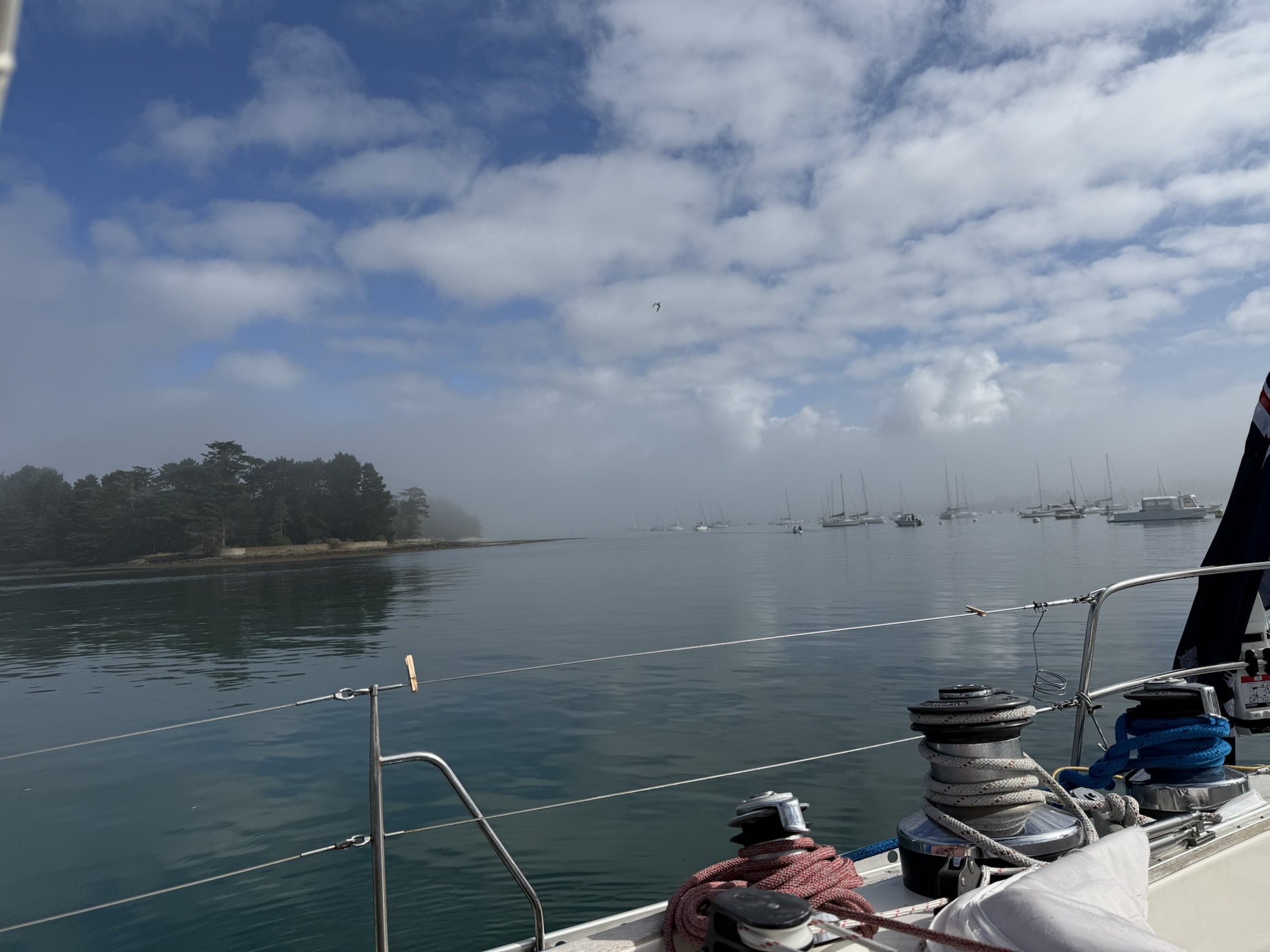
    Once clear we made our way across Benodet bay to arrive at Benodet with the start of the rise of the tide to explore the Odet river, which all the pilot books call out as very pretty indeed. Once we’d got under the 30m air draft bridge (our rig is a bit over 20m with the instruments and antennas on the top), we headed on up the river. There’d been no wind at all so we’d motored all the way, and in the process our nice big alternator has taken the battery from 65%, to over 85% at the entrance to the river. By the end of the afternoon the batteries were at 100% once more. We worked up the river on the tide and the wooded banks steepened and the river narrowed. We stopped for a late lunch on some visitors moorings but we were too big to stay there overnight and we carried on upriver to explore a little side creek, which the pilots reported as lovely spot for the night. It was gorgeous but with two other boats in there and not a lot of depth there just wasn’t room for us, so we headed back out to the main river.

    Image 2
    Anse de St Cadou – our possible anchorage

    We tried to anchor in the river nearby a couple of times but the bottom was bare rock scoured clean by the tide – there is a huge flow in the river – and we couldn’t get the anchor to bite. The muddier spots were either too shallow or occupied. So we headed down river as the tide started to ease and found a spot to anchor for the night just before the bridge. I deflated the tender and stowed it back in the forepeak, which is rather full of kit and toys. As an aside when I came to use the tender in Etel I checked the pressure of the tubes and floor with the new electric pump, having inflated them by foot pump and it very quickly got them up to the proper pressure. I’ve high hopes for the new pump.

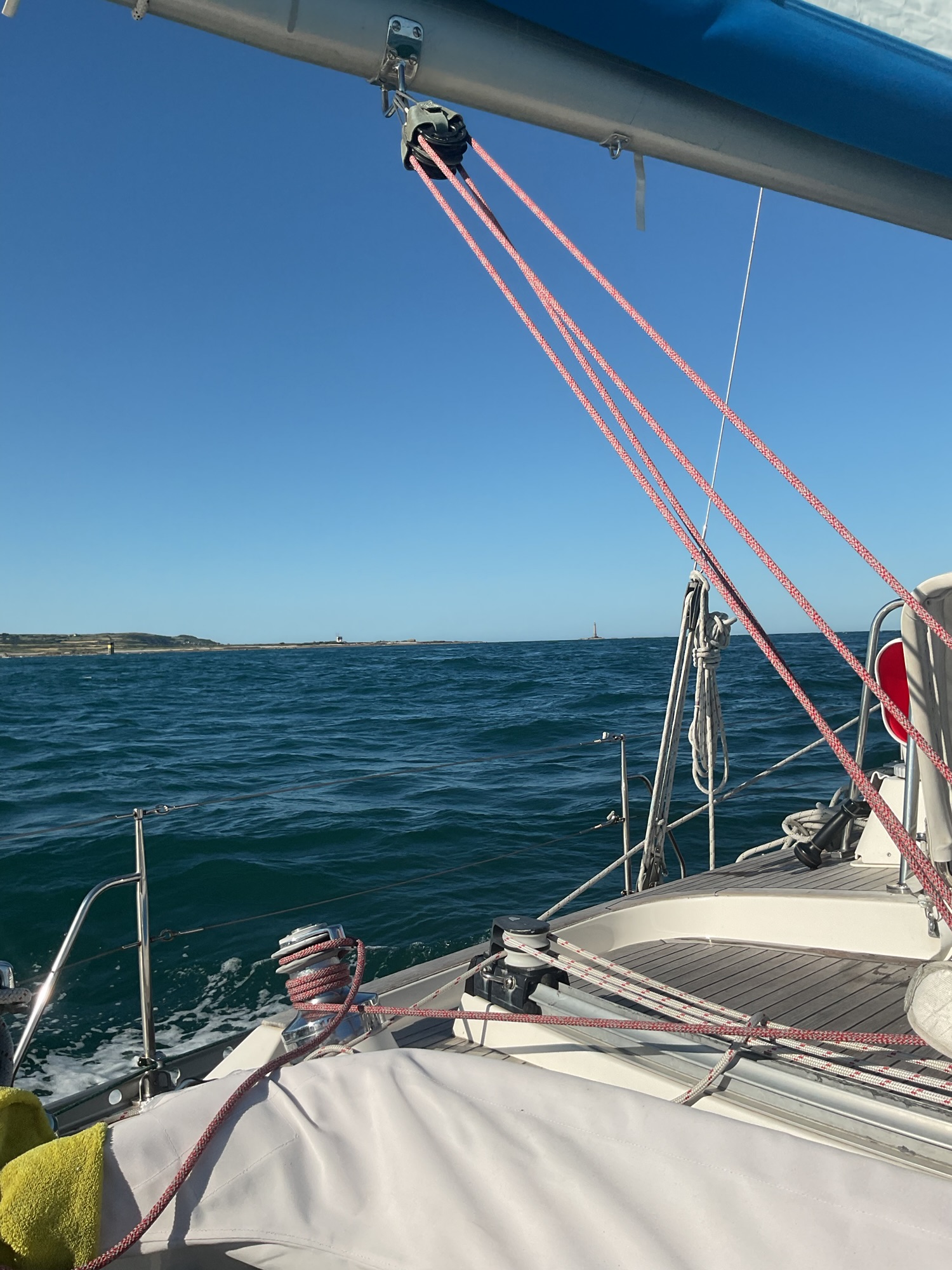
    We left at about 0715 on Sunday morning to head out of Benodet bay, past Pointe de Penmarc’h and out towards the Raz du Seine. We were motor sailing in very little breeze and what little there was was on our nose once we turned north at Pointe de Penmarc’h.

    Image 3
    Our passage plan for Sunday

    Most of the way to the Raz we saw evidence of pod of dolphins hunting: lots of dorsal fins breaking the water and turning rapidly with frenzied fish jumping to the delight of packs of gulls. We also had them come and join us repeatedly, and I finally got some photos and a video – we’ve seen them at some point most days this trip.

    We arrived, as planned at the Raz as the tide turned in our favour, but even then it was quite bumpy for a couple of miles as the tide whistles between the island and the headland, with a ridge of rocks extending out underwater.

    Img 0776
    Trouper doing her thing when faced by an unruly wave in the Raz.
    Img 0773
    The Pointe du Raz

    After that it was a relatively simple 12 nm or so north and round a headland into Cameret, just before the entrance to the Rade de Brest. We’d picked up a small vibration that you could feel through the boat and was very noticeable on the wheel. We tried going astern a couple of times and the vibration intensified. Clearly there was something on the prop. I was bracing myself to get a diver or a boat lift when we got in, and trying to justify it to myself as at least we’d get the hull cleaned too (reducing drag). Approaching the marina once the sails were down I tried going astern one more time, mainly to check that I’d got manoeuvring control and after a moment of more acute vibration the vibration stopped and Kathryn reported seeing some seaweed appearing in our wash. After that all seemed well, so hopefully that problem is resolved.

    Sadly the remote control for the autopilot also stopped working during the afternoon: it turns on works when the battery cover is off, but not when it is on and the device is thus waterproof. Hardly ideal. I’ll have to see if I can get it repaired as it’s 20 years old and not readily replaceable – modern stuff works to a different set of standards and replacing the autopilot could lead you into replacing the whole instrument system as the current pilot is tightly integrated into the B&G H2000 Hercules processor. And the current displays won’t work with new processors so you could quite easily end up with a £20k bill to replace all of our, admittedly old, very high end instruments. However there is a firm in Lymington who I’m pretty sure will be able to help.

  • Morbihan

    We’d chosen the anchorage on the Auray as it was the spot favoured by George Millar in his book Oyster River about a summer cruising the Morbihan. It’s a lovely read (though out of print) describing a summer on his 50′ wooden yawl sometime in the late 50s. Both he, and his wife Isabel, are extraordinary characters. He had been captured in North Africa during the war, escaped during a prisoner transfer during the collapse of Italy, and made his way on foot across France and Spain to escape back to the UK from Portugal. Once back in the UK he joined the SOE and was dropped back into occupied France to support the resistance. He’s spending the summer recuperating following a riding accident that left him with serious internal injuries when his horse fell landing on him… so they sailed from Plymouth to the Morbihan to take it easy.

    Sunday saw us gently sail back down the river under headsail alone and across the entrance to pick up a mooring that was across the headland from Port Du Crouesty on the inside of the gulf. We’d agreed to meet our friend there in the morning, and to spend the day with her on the Morbihan.

    Monday morning saw me in the tender picking her up from the slipway, before we spent the day doing a lap of Ile Aux Moines, following a lunch stop at the head of Ile Ilur. One of the innovations of Sunday afternoon had been discovering the SHOM Tidal Stream Atlas that covers the gulf could be purchased as a PDF online. Having navigated the checkout and download process in French we now had the tidal information that made Monday’s tour possible. The tidal flows are huge and being only a few minutes late or early for a turn of tide can stop you in your tracks – and it did on Sunday when we were a little early at the entrance and motoring at 7kts saw us stand still until we could slide sideways into slower moving water.

    Image
    SHOM tidal stream atlas of the gulf – 1 hour before high water

    We spent another night on the mooring buoy before heading up to Vannes up a river off the North of the Morbihan. It proved to be a lovely town and we spent a couple of nights there, we did some laundry, and had a great meal at another happy Michelin. On Thursday we headed down the river, across the gulf and out to Port de Croesty once more. Our local friend had picked up a new electric dinghy pump for us, as our current one had died when inflating the tender up the Auray at the weekend. The old one was ten years old and a bit of research identified had been rather overtaken by technology. The new pump of choice was stocked nearby and she’d offered to collect it for us. We met up on Thursday afternoon and she announced that we’d been invited to her brother-in-laws for dinner. He is a sailor and keeps a boat in the marina. We had a lovely evening in a French home, and drank a little too much.

    On Friday we headed to Trinite sur Mer, which is only a few miles away and a yachting mecca. Our favoured pilot book (written by the late Peter Cumberlidge) raves about the marina, which is an oddity as the author clearly prefers a night at anchor whenever possible. We got a snug berth tucked behind the wavescreen which has pontoons for race boats on the seaward side. There are two Ultimes, an Ocean 50 trimaran, a 50′ Offshore racer of a modern scow design, an IMOCA and half a dozen Class 40s all tied up there. I’d been struggling with a cold for a couple of days and rather crashed for a few days. We have had a little wander around the place and it is lovely – there’s the gallery of the famed French sailing/sea photographer Philip Plisson and some great gear shops, as well as sailmakers and all the usual fantastic food shops of a French town.

    The local lifeboat has been busy. They are just down the pontoon from us and were out at 0130 on Sunday for a search, then again for most of the day on an exercise (seems like Sundays are lifeboat training days the world over), and then again on Sunday evening for what looked like a Medivac from Houat, one of the offlying islands. Today (Monday) they were out again in the evening to tow a boat back into the harbour.

    Sadly I also got the news this week that after about a year doing battle with cancer one of my team back at work had died. He was a lovely man whose sense of fun belied his age: he was the antithesis of the grumpy old man. Murray Stephen: you will be greatly missed.

  • Weather

    Weather

    The weather has dominated the most of the last week. Douarnenez was lovely but the swell into the visitors’ pontoon for the second and third nights resulted in lot of groaning warps, if no actual discomfort (Kathryn might disagree as the groaning warps kept her awake). On Wednesday we left reasonably early and headed out for a passage through the Raz du Sein. It was a long motor sail to windward to get to the headland and drop south through the Raz. The Raz du Sein is a notorious tidal race, but other than a bit of slightly confused seas on the approach we passed through smoothly – though we did test out our newly recanvassed cockpit spray hood – which provided a very warm an snug spot in the cockpit. It only saved us from one wave’s worth of spray – but that’s quite enough for it to have earned it’s keep.

    We ended the day in Loctudy, a marina in a small town south (and east) of Pointe de Penmarc’h. The pilot books and almanac all observe that the Pointe de Penmarc’h is the gateway to better weather as you move into South Biscay. It was glorious in Loctudy though the first morning we were there is was very foggy ’till about midday.The marina had nice facilities and an excellent chandlers that had stock of all sorts of specialist parts: needless to say they had the belts that I’d been looking for, and had several interesting looking brackets for clamping onto stainless tube, and lengths of tubing. I was hopeful I’d be able to cobble some sort of temporary starlink mount, so I took the bits of the broken one in, and with a fair bit of gesticulation explained the issue. This is when things took a turn for the better: the bits were whisked off into a back office, there was a bit of a discussion, a man in overalls appeared and joined in. I was led into a workshop behind the chandlers where they clearly fixed outboards and the like and went someway to explain the stock: these were people who made things… 20 minutes later my new friend in overalls had drilled a hole though the fitting and installed a nice big bolt to hold it together. With the addition of a little glue to stop it rotating around the new bolt the job was done and our Starlink is back in its spot on the aft rail.

    Img 0649
    Starlink back in it’s spot

    On Friday we hopped across the bay to Concarneau. There was little sailing to be had, as it was very still, and there was a little bit of a deadline to get there before the market shut down at 1300. This is also a TransEurope marina (a federation of independent marinas that offer a 50% discount for up to 5 nights to berth holders from another member), which was sort of planned as it looked like we’d be staying a few nights, to wait out some weather. It’s been moderately windy, but has rained hard on and off for the past few days (I write this on Monday afternoon) and there has been some serious (over 5m) swell offshore. We’ve explored the town, it’s fishing museum in the island citadel in the centre of the harbour, and taken the bus to Pont Aven on a sightseeing trip whilst dodging the worst of the weather. Assuming the weather forecast delivers then tomorrow should be fine, a bit on the still side, but will let us move on to Lorient and towards the Baie de Quiberon. This bay looks like a truly lovely spot with lots anchorages and the Gulf de Morbihan, an inland sea full of islands accessed through a narrow entrance which has been on my list of places to visit ever since we started researching the trip.

  • Grey in Roscoff

    Grey in Roscoff

    We left Cherbourg on Wednesday, filling up with diesel before we left at the self service pumps. The 300Euro maximum for a card transaction filled one tank and took the other to 92% so we left it at that and headed off. We took a fair tide to Cap de la Hauge and saw a fair bit of water over the deck, though never in the cockpit, in the overfalls as we motor sailed into the Alderney race.

    Our straight line course to Treguier took us down the Big Russel channel between Sark and Herm passing lots of fond memories – more than one involving food on a beach – before a fairly dull 40 mile stretch towards the French coast with the engine thumping away all the time. It was uneventful except for some dolphins joining us mid afternoon just after I’d gone for a nap – Kathryn had no hesitation in banging on the cockpit sole to summon me back on deck, and I was glad of it. As ever the dilemma was whether to just soak up the moment or to go and find a camera to get a record. This time we both settled on just enjoying the moment, which was over all too soon.

    Tregieur entrance is a bit wiggly and needed some attention at the end of a long day – we were easily 12 hours in by then, though had both had naps.

    Image

    But once in, and up the river a bit, it is very snug and sheltered. We elected to anchor as we planned to be off the following day. We picked a lovely spot a little downriver from the town and across the river from a Chateau. A quick shower followed by a long sleep was in order.

    I am very pleased to report that the coolant leak seems to have been a loose hose clip on the shut off valve for the hot water calorifier (domestic hot water is heated using the engine cooling circuit, when the engine is running, or, on Trouper, by an immersion heater when plugged into the shore, or from our diesel heating). We’ll probably now carry the remaining 4.5l of coolant around as a talisman against leaks for the foreseeable future.

    On Thursday morning we had a leisurely start to the day and I got our newish solar panel array out for it’s first real test in bright conditions.

    The FlinKite solar array is very neat – it hoists out of it’s storage bag on a spinnaker halyard and plugs in on the back of the forward dorade box. It has a notional 200W capacity, and can be orientated to point at the sun and operate as efficiently as possible. Without any real care in pointing it, it was generating 180-200W, as you can see from the display. For us that’s great news as it means it will outpace our electricity consumption at anchor and remove any need to run the engine for battery charging. At sea there is a big 225 Amp alternator managed by the battery management system that can very quickly put charge back into the 660 Amp hour LFP battery bank. The great thing about LFP battery chemistries is their very high charge acceptance: it will accept pretty much as much as we can generate.

    The holding was excellent in the river and despite all the pilot books’ warnings about the strength of the tide, albeit at neaps, we barely troubled the anchor all night. I put 40m of chain out and even when the tide turned I don’t think we pulled it straight in the mud. It certainly took some cleaning.

    Img 0114 1
    Anchor Watch Display

    We left on Thursday lunchtime for a smaller hop down the coast to Roscoff where we plan to spend a few days, partly to do chores such as laundry, and partly to let some weather blow through. Finally on this leg we were able to actually sail for at least half the passage and were making a nice 6.4kts in 10kts of breeze on a beam reach for a period. It was so lovely to be at sea without the thrum of the engine. Kathryn made a lovely dinner of trout fillets, new potatoes and veg which I’m sure tasted all the better for the noise of the water gurgling past Trouper’s transom.

  • Lifeboating won’t let me go

    Lifeboating won’t let me go

    I stood down form the RNLI lifeboat crew at Tower after over 20 years on the crew last month. As we left for Cherbourg we found a young man at about 0615 in the morning swimming well over 2 miles offshore. He was struggling a bit and was glad of a ride back into Chichester… so we turned round and went back the way we came.

    I phoned the coastguard to report what we’d found and try to arrange some sort of reception for him when we got ashore – he’d set off from West Wittering beach at 0430, and all his clothes and possessions were still on the beach. We could only land him at Hayling, and it’s a good two hours by car from one to the other, around the harbour, and all he had were a pair of swimming shorts. As I was speaking to the coastguard watch leader he wasn’t initially sure what to do as the guy seemed fine and was just in need of a taxi (and some clothes), but as we spoke he got a report in that a suicide note had been found by the police that related to the guy. That urge had clearly passed, as whilst a bit cold and glad of a cuppa, he’d been swimming for shore, was glad of the assistance (and very apologetic) and borrowed my phone to try and call his dad (though he didn’t get through). We headed into Sparkes marina and waited for the cavalry to arrive. They had trouble raising me by phone as it was so early my phone was still in sleep mode…. Sussex police turned up first, followed by HMCG’s rescue team (well one of them in a truck). The lovely woman police office from Sussex was torn between trying to make sure she did the right thing, ie keeping the guy safe, and the logistical problem she had that whilst he’d set off from Sussex we were all now standing in Hampshire, which has a different constabulary. She put the young guy in the back of her Sussex Police car with one of the coastguard’s blankets, and we left them to it. Only to find that the tide had now dropped too far for us to get out of Sparke’s marina… well we got out and then ran gently aground in the channel 20 minutes before low water, about 10 feet from a channel mark where we waited… The deep water turned out to be about another boat length ahead of us.

    After an otherwise uneventful passage motor-sailing we tied up in Cherbourg at about 2130 local time – several hours later than we’d aimed for with our 0500 start. We spent a day recuperating and taking it easy (we’re both fighting off colds, and had been cooked in the sun on Monday) and I discovered that the engine coolant levels had dropped a fair bit on the trip. The engine had run hard for over 10 hours, but it’s meant to be a closed system. None of the local chandlers had the right coolant (and I’d not quite got round to buying any spare before we left) but on Wednesday I found a motor factors round the back of Carrefour with the right stuff (G12, if anyone cares). I think that the leak was from one of the hose joints on the engine, and that with such a slow dribble (we’d only lost about 300ml) it had all evaporated in the hot engine compartment. The hose clips are all a bit tighter now.

    Tuesday wasn’t a great day: we were both feeling a bit grotty, and slightly grumpy; I had found the coolant problem; and then when taping up the split pins on the backstay to stop them cutting anyone using the boarding ladder I knocked the starlink dish only to have the nice 3d printed mounting bracket I’d made it fail. In hindsight, its good that it happened then, as it was clearly going to fail, and at least I was able to recover all the parts and not drop anything in the harbour. It didn’t feel like it at the time. To round things off I dropped a nice Wera stainless allen key in the harbour whilst unbolting the bracket. Amazon will have a nice new one waiting for me in London, but I had to buy a ‘cheap’ set in the chandlery to finish the job… I made the bracket as I just couldn’t find a commercial solution that did what I needed so there isn’t an easy replacement which leaves us only able to use the Starlink when at rest and able to perch the dish safely in the cockpit. The cables, that I’d so carefully run on Sunday morning, are now fixed and rather limit our options.

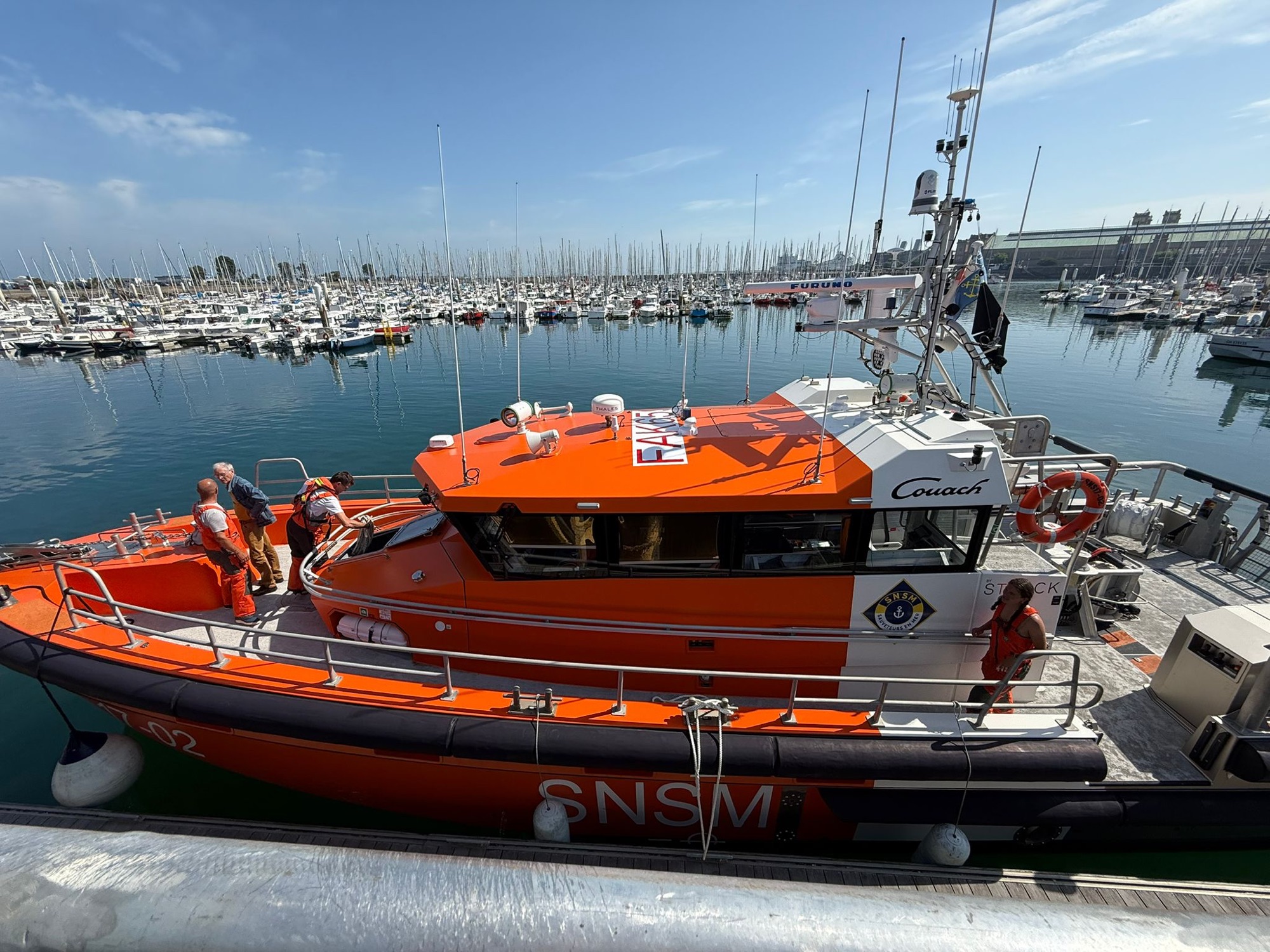
    I did get to have a look around one of the French SNSM lifeboats though. It was Goury’s boat and on Tuesday they’d launched at 0400 to a British sailing boat that had been in collision with a small freighter, presumably somewhere off Cap de la Hague. They’d towed the boat into Cherbourg and put it straight into the slings of the travel hoist, as there was a decent sized hole on the starboard quarter right on the waterline. There were two decent sized pumps on board – one the lifeboat’s (looked like the same big diesel pump that the RNLI use) and I think the other from a helicopter (it had a big lifting lug on it) who I suspect had also recovered the crew, as they weren’t about. One of the helicopter crew turned up in a flightsuit, presumably to recover the pump. The lifeboat moored up astern of us as the crew headed off for a well earned brunch (it was mid morning by then) but on their return one of them was asking about Trouper and we got into a conversation, and then I got the tour. It was a very nice bit of kit, only a year old, aluminium, slipway launched, and 17m long. It carries a tender under the aft deck and has a big hydraulic towing reel as well as powered bollards that would be the envy of many an RNLI crew. The deck provides a decent sized well protected working area – it seemed really well thought out, though I’d swap its props for water jets. The cabin was air-conditioned too which was very welcome on Tuesday.

    Aa9e074e C70a 489d Ba6f 8d784033f382 1

    So a mixed start to the trip, but a life saved (and Kathryn’s first) and a nice meal tonight make it seem rather better, and a lovely text message from the parents of the guy we fished out rather reframes things.

  • Trouper’s Atlantic France Trip Preparations

    Trouper’s Atlantic France Trip Preparations

    Over the last few years I’ve invested a lot of time, effort, and a fair bit of money into getting Trouper set up for extended cruising. We’ve installed a new engine, a large Lithium Iron Phosphate battery bank with a large alternator to charge it, and a hostable array of solar panels. Our plan has been to spend a couple of months away this summer, partly as an end in itself and also to test out how we might like spending months at a time on the boat at some point in the future.

    The last few weeks have seen a slightly frenzied sprint to the line. Inevitably I finished some parts of this this morning as we got ready to leave the marina. Last week saw the very just in time delivery of the new bed linen, the renewal of the sprayhood canvas and some fitted cockpit cushions. The previous few weeks have seen some repainting of the coachroof’s blue stripe and the fabrication of a bracket to hold a starlink mini dish on the stern of the boat. Completing the starlink install, and reassembling the outboard motor’s mounting bracket (with some new bits) were the last jobs this morning.

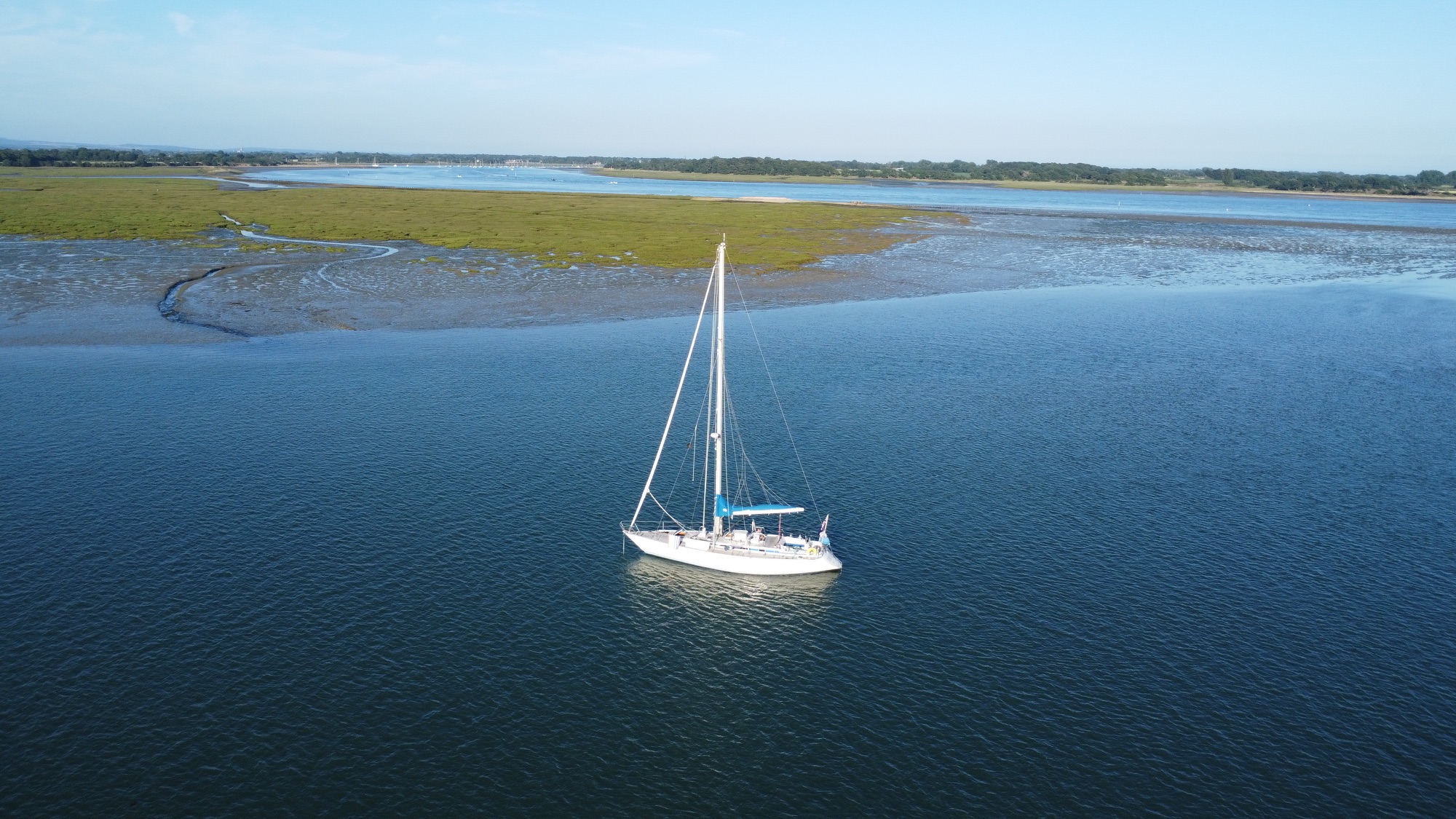
    We slipped our berth at 1515 today (29 June) and left through Birdham’s lock at free flow (the top of the tide where both inner and outer gates are open at once). We motored a whole mile to anchor in the harbour in the Thorney channel. We aim to leave at about 0530 tomorrow for Cherbourg – I’ve send the French PAF their entry form and completed the UK online departure notification – so hopefully all the admin will go smoothly.