Category: Safety

  • Risk perception and back in the English Channel

    As someone who has spent a lot of time teaching people to use powerboats safely it is interesting to see the French approach to risk management and safety. The UK has a sad history of accidents resulting in deaths and serious injury from using powerboats, especially RIBs. That’s resulted in an approach to managing them and ‘good practice’ standards that are far removed from what I see here. To be clear I see no evidence of the French approach being dangerous, and indeed I suspect that they don’t have our history of accidents, suggesting a higher standard of safety. But what I see would have many of my UK colleagues tutting: no kill cords in use, sponson riding, indeed driving the boats from the sponson and driving whilst standing, even with tiller steered boats. And yet the standard of boat handling is consistently very high with a casual and unconsciously competent displays of excellent boat control.

    More generally I can’t help but notice that the French approach tends towards less physical infrastructure and more towards people being encouraged to be sensible. Walking on the wave screen wall at Trinite there was no railing either side – just an obvious edge. Walking around an old castle there was no fence to the drop into the dry moat, just a band of about a meter of larger pebbles to delineate where the safe footpath finished. I must confess I do like the approach of expecting a bit more from people, although I’d still favour the use of kill cords – once you’re used to them they really aren’t much of a pain and are a simple mitigation to a low probability, very high impact event (ie falling out and being mown down by your own boat and propellor).

    When, in a former life, I did my professional training in Occupational Health and Safety we were taught a clear hierarchy of desirability of risk mitigations: safe place was far preferable to safe person. the thinking was that in a workplace you should not need specialist knowledge or equipment to stay safe. In a controlled environment that still seems to me to be the preferred solution: you provide effective dust or fume extraction, not respirators to anyone who enters the space. But I wonder if that culture has bled out from making factories and laboratories safer workplaces into the wider public assuming that their safety will be managed for them and that they don’t need to worry about it. That might be one of the reasons why the construction industry has long struggled with its safety record – construction sites are usually difficult to control fast changing environments.

    There’s been a lot of research showing that risk perception can have an outsize impact on risky behaviours: across London railings have been taken down around pedestrian crossings, and pedestrian injuries have been reduced. Car drivers are slower and more cautious around exposed pedestrians, yet the old railings afforded little real protection to the pedestrians. I wonder if the French approach to boat handling and education is more effective. But then every town we’ve visited has had huge sailing schools taking all the local children out, so familiarity with the environment is deeply ingrained knowledge.

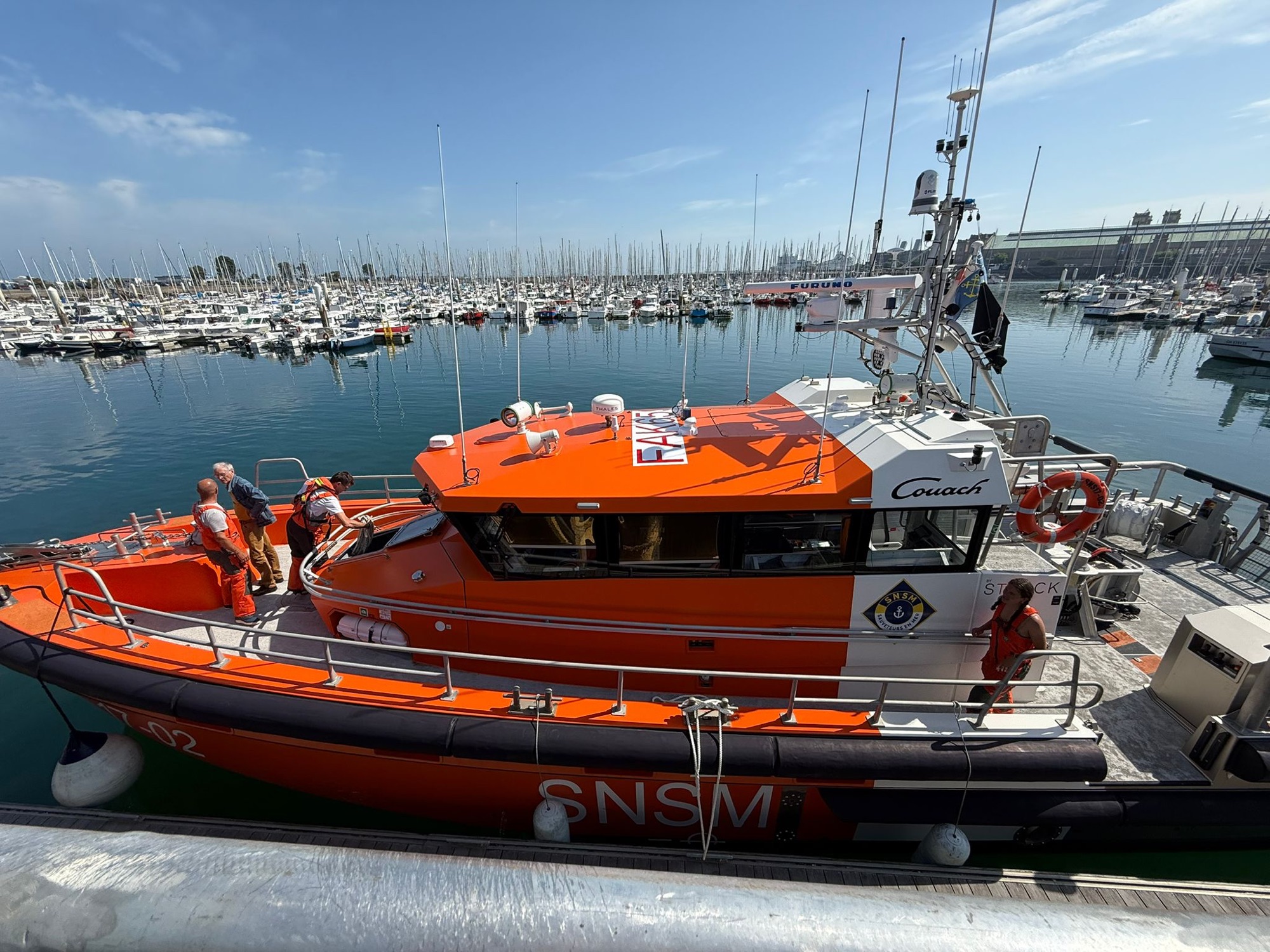
    Cameret proved to be a nice little seaside holiday town that was having a Fete for the local lifeboat, complete with helicopter winching exercises off the quay a little after we arrived. The visitors berths a quite a walk out along the breakwater (no railings…) and the sanitary facilities are a bit basic. We elected to shower on board for the two nights we were there.

    Whilst in the Morbihan we’d used the boat’s black water holding tank to capture toilet waste and then pumped out in Port Du Crouesty. The boat was built with a holding tank for the aft head, and you can choose to flush to toilet into the tank or over the side. When built the only way to discharge the tank was to pump it out (by hand) back through the toilet’s normal discharge over the side. For our trip to Holland some ten years ago I’d also fitted a deck pump out fitting allowing the tank’s contents to be pumped ashore. That turned into a bit of a mission. I couldn’t find a pump out deck fitting that visually matched the existing deck fittings for water and fuel. Finally I contacted Nautor, the makers of Swans, in Finland and they explained that the fittings on our boat were custom made to their specification. They offered to have a pump out fitting made to match. It cost about 500Euros in the end, but I felt it was worth it to keep the boat (and Swans of this vintage are sort of iconic) looking right. Anyway in the end it all seemed a little excessive as we never found anywhere on the Dutch canals with a working pump out station, despite all the warnings before we got there that it was mandatory to pump out ashore. I’ve never regretted having the option but had never actually used it before. We connected it up and pushed the button and could see liquid being extracted through the window in the hose. It took a good ten minutes to suck the 120l tank dry. Carteret saw the tank put back into service, though I pumped it out by hand once suitably offshore.

    Img 2650 Edited
    Bespoke Pump out Fitting from Nautor – it weighs about 4kg!

    We had two nice dinners ashore in Carteret, and a much needed trip to their excellent SuperU to stock up before we left this morning to head North and up through the Chenal Du Four. After filling up with fuel (215l, the first since Brest) we sailed for a bit to start with before the wind died away. It was grey all day, though not at all cold.

    Img 0789
    Pte de Saint-Mathieu at the Southern entrance to the Chenal du Four.

    By later afternoon we were working out way into Aber Benoit where we picked up a visitor mooring, put the kettle on and tidied up. The harbour master popped by, took 18Euros for the night and offered to take any rubbish ashore if we needed, which was welcome, though not needed.

    Tomorrow sees us head east to Roscoff.

  • Starting to Head Home

    We left Trinité-Sur-Mer on Tuesday heading for Etel. Etel is to the North of the Quiberon peninsular and this marks the start of our progress back towards home and the end of our trip. But that’s not till the start of September so there’s no time pressure and we plan to meander our way back.

    Etel is interesting as the entrance to the river has a shifting bar and there is a huge tidal flow that can create difficult conditions. The deep water passage moves around too much to be marked in the conventional way, with buoys, so they have a novel system with a semaphore tower. The tower is manned when there is enough water in the channel and talks you in by radio, though they retain the old pointer system for boats without radios.

    Img 0725
    Semaphore Tower at Etel, note the big red pointer on the rear tower.

    The guy was very friendly and helpful, apologising that his English wasn’t great. It was better than my French – using a radio in a foreign language adds a whole new set of specialist vocabulary, and is a bit intimidating.

    We had a lovely couple of days in Etel, with a nice meal out, where Kathryn had her first ‘fruits der mer’ of the trip. We took the tender across the harbour to the beach on the other side of the entrance on the second afternoon (whilst the morning’s laundry dried), and Kathryn had a swim in the rather chilly water.

    Etel is a holiday town, with a long fishing history, and still has a fleet of tuna boats that head out into the Atlantic. It’s not a big racing centre, but a measure of the French obsession with offshore racing is that even here, in the fishmongers, there was a framed set of foul weather gear from a Vendee round the world race, in much the same way that you might see a football shirt in the UK.

    Img 0721
    Waterproofs from PRB’s 2020 Vendee Globe

    Entertainingly I use the same foulies (probably OTT for my use) and picked up the matching jacket in Trinite-Sur-Mer where there was a North Sails store I could try them on in. North’s run a mainly mail order model and it’s hard to get the sizing right and pick over the features. I was a bit concerned that the jacket didn’t have fleece lined handwarmer pockets, which are much loved on my existing Mustos as they weren’t listed on the features, and the pared down racing ethic might have gone too far for my tastes. Happily I was able to establish that there were hand warmers, and that I needed a large (normally a medium) so a purchase was made. The colour is not to everyone’s tastes but it’s chosen to be visible in the water.

    North’s are primarily a sailmaker (and made our funky high tech moulded seam free sails) but have an apparel line which in the last few years has started to include foul weather gear. Until then, in my view the best kit was made by Musto, who used to be a sailmaker (Musto and Hyde) in the 70s and 80s before the sail and clothing businesses split. My first generation HPX (their top of the line, and the first Gore-Tex sailing gear – normal Gore-Tex can’t cope with salt water) from 2000 has arguably lasted better and is more robust than my later stuff (which is a bit lighter weight, which has its virtues) and I still use it in London on the Thames. Keith Musto, the son of the founder, who I think had been an Olympic sailor, ran the clothing business which had been an awesome firm to deal with – their service team in Southend put new cuffs on my first HPX jacket in the mid 00s when I wore through them for about £30. Famously HPX came with a lifetime warranty – which has replaced both trousers and jacket of my second set when they delaminated. Manufacturing later moved abroad and in my experience the quality dropped a bit, ultimately Helly Hansen bought up Mustos in the late 2010s at some point. Last time I looked both were actually onwed by a Canadian teacher’s pension fund. Keith Musto has however reappeared, presumably after some non-compete clause had expired, as the designer of the North’s range, complete with his trademark collar system that keeps water out and your ears warm. The Norths stuff feels like the next evolution – it’s very comfortable and pared down to keep it light without sacrificing the features you actually need (like the handwarmers!). A ludicrous purchase on a sunny day when it was heading for 30Deg C, but should last me a decade or more.

    Whilst in La Trinite, on 1 August (the half way point), we finished the first gas bottle on board. This has been the source of some thought when coming away. Trouper carries two 6Kg Calor Propane bottles. You effectively buy the bottle and then pay an fee to exchange it for a full one when empty. Camping Gaz operates in a similar way across Europe using a mix of propane and butane, but does not have any bottles as large as 6Kg. We have a ‘universal’ gas regulator that will accept propane, butane or a mix – essentially it’s a compromise that does all of them equally badly. We have adaptors for different bottles on board, and could switch over to Camping Gaz. But I’m not sure there is room in the locker for both and I’m loath to throw away a Calor cylinder – they are expensive and it’s hardly very green. Gas is very dangerous stuff on boats and has led to a number of nasty explosions, including one in the 90s in Poole harbour that cost someone I used to know a little their lower leg. The problem is that the gas is heavier than air and if it leaks accumulated in the boat forming an explosive mix with air. Then it just needs a spark to ignite it. We keep the gas in a sealed locker (together with the outboard fuel) that has a low level drain over the side. There is a solid copper pipe from the regulator to the cooker, and an electrically operated isolating valve at the regulator that means that the gas pipe is only pressurised when the stove is in use. There is a gas detector mounted low by the stove and it is connected to an alarm that also cuts the gas at the isolating valve. Ideally I want to have one cylinder in use and to swap the empty for a full spare as soon as possible. But Calor isn’t available here, so I was relieved that the bottle that was in use for a few weekends before we left made it to the half way point. It should mean that we can get back to the UK without needing any more – though if it starts to feel too light I might pick up a Camping Gaz as a backup – I think I can stow it safely and the prospect of not being able to make tea (or cook) is unappealing.

    We left Etel on the late afternoon tide, you’re advised to leave just before high water, after two nights there and headed 10 miles (all distances are in Nautical miles – the distance described by 1 minute of arc of latitude, so a bit longer than a stature mile and about 1.8km) or so down the coast to a bay just past Lorient that had looked like a good place to spend the night before heading on a further 20 miles to the Isle Glenan the following day. Sadly the sheltered bit of the bay was now full of mooring buoys, which all looked too small for us, and outside the shelter it was a bit rolly and wouldn’t have been a pleasant night. We had backup plans, either heading into Lorient or over to Isle De Groix. we chose Port Tudy in Isle De Groix, which was about 40 minutes away, and arrived early evening. The harbour master met us in little rib (tiller steered sitting on the sponson, or standing, as is the custom here) and led us into the outer basin where boats moor rafted secured fore and aft to mooring buoys. He said once we were alongside he’d run the lines for us, though we were towing the tender so we could have been self sufficient. However the gap he led us into proved to be such a snug fit that we ended up secured alongside on both sides connecting two rafts. There was no need for lines to the buoys, which was as well as with breast ropes and springs on both sides and one longer line tied up towing the tender I was running out of mooring lines. Those who have sailed with me will know that this is a bit of an extreme event – I do like to make sure I’ve enough rope for any circumstance, as indeed did the previous owner of Trouper. Whilst I’ve retired one of his lines due to chafe damage, I’ve only added two long lines in our ownership. Following this trip and a bit of chafe in places I think one of this winter’s jobs will be making up a new set of mooring warps.

    Img 0730
    Port Tudy, before another couple of people arrived behind us.