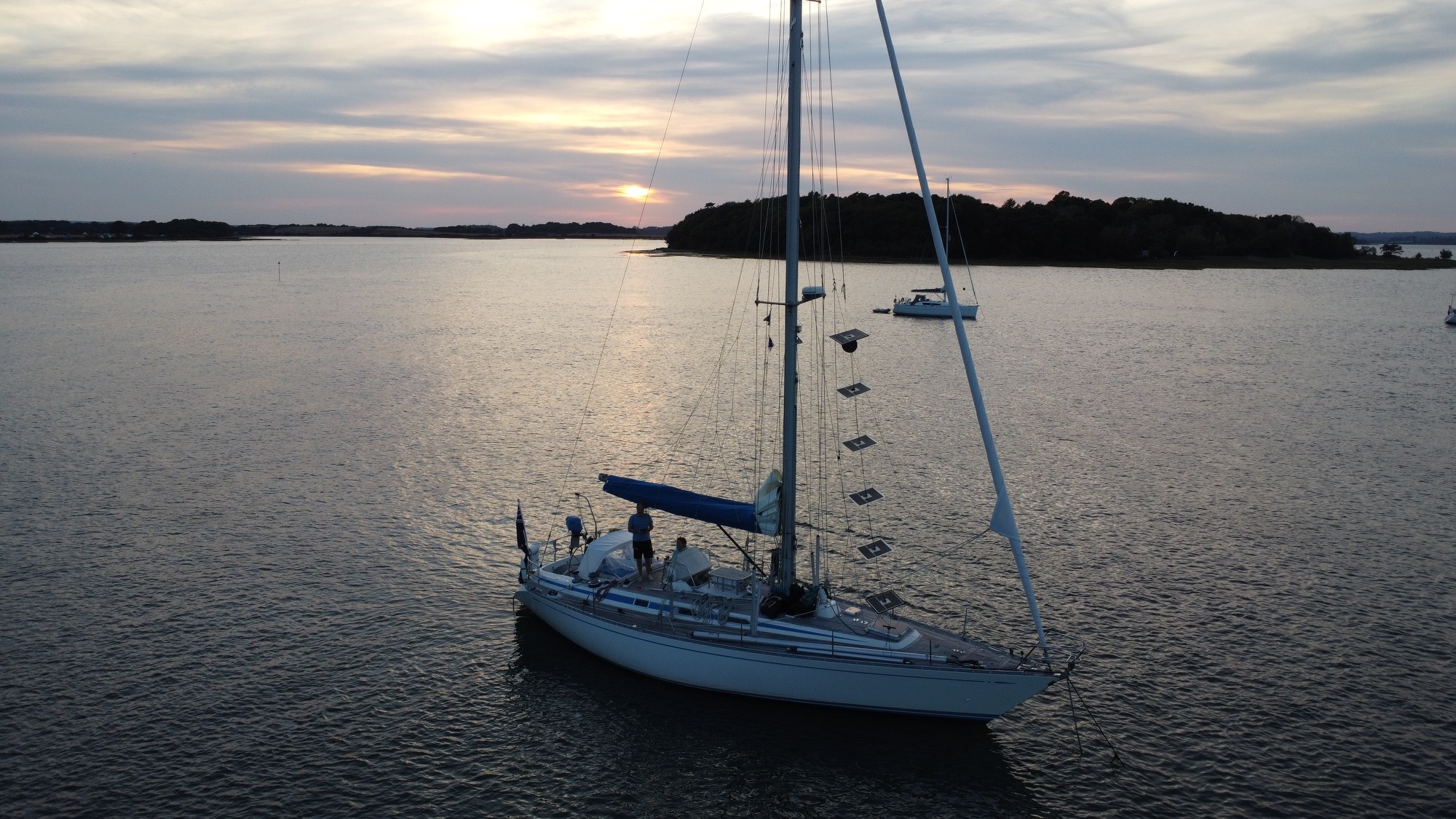
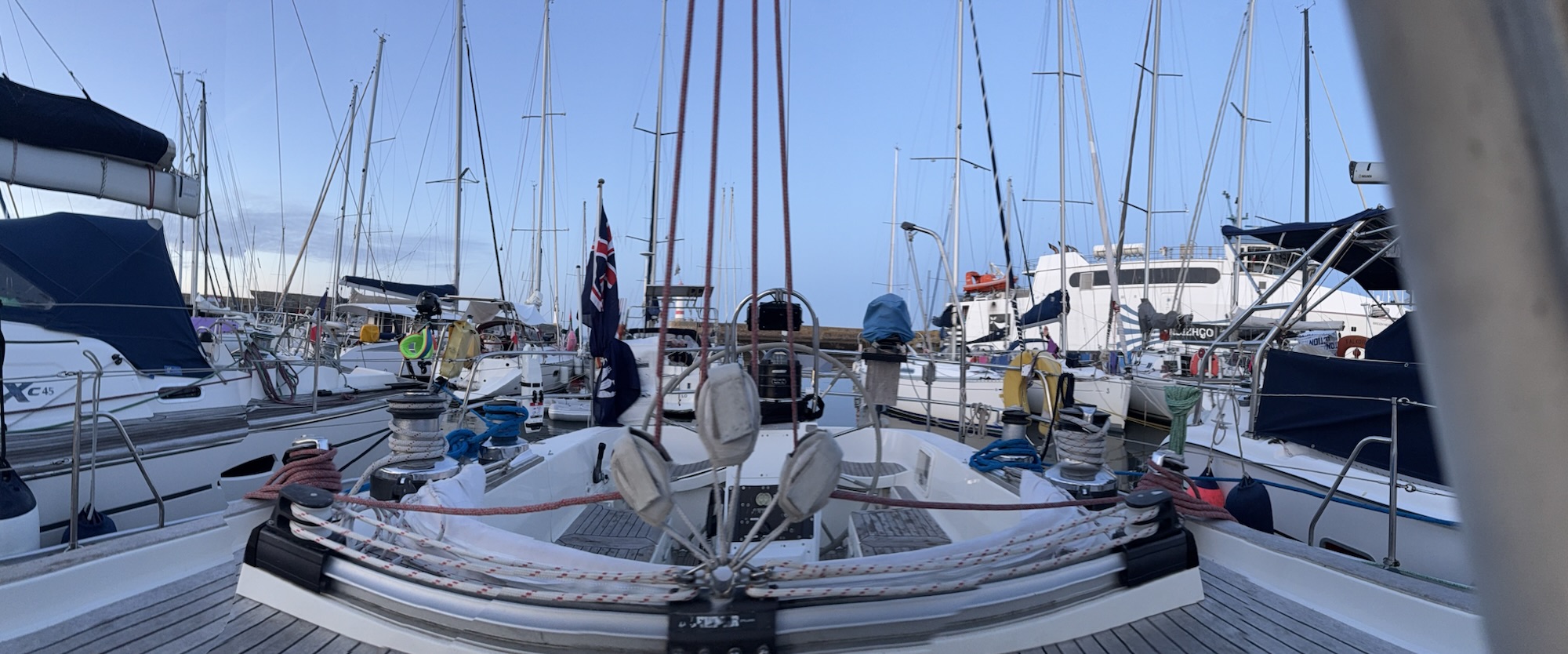
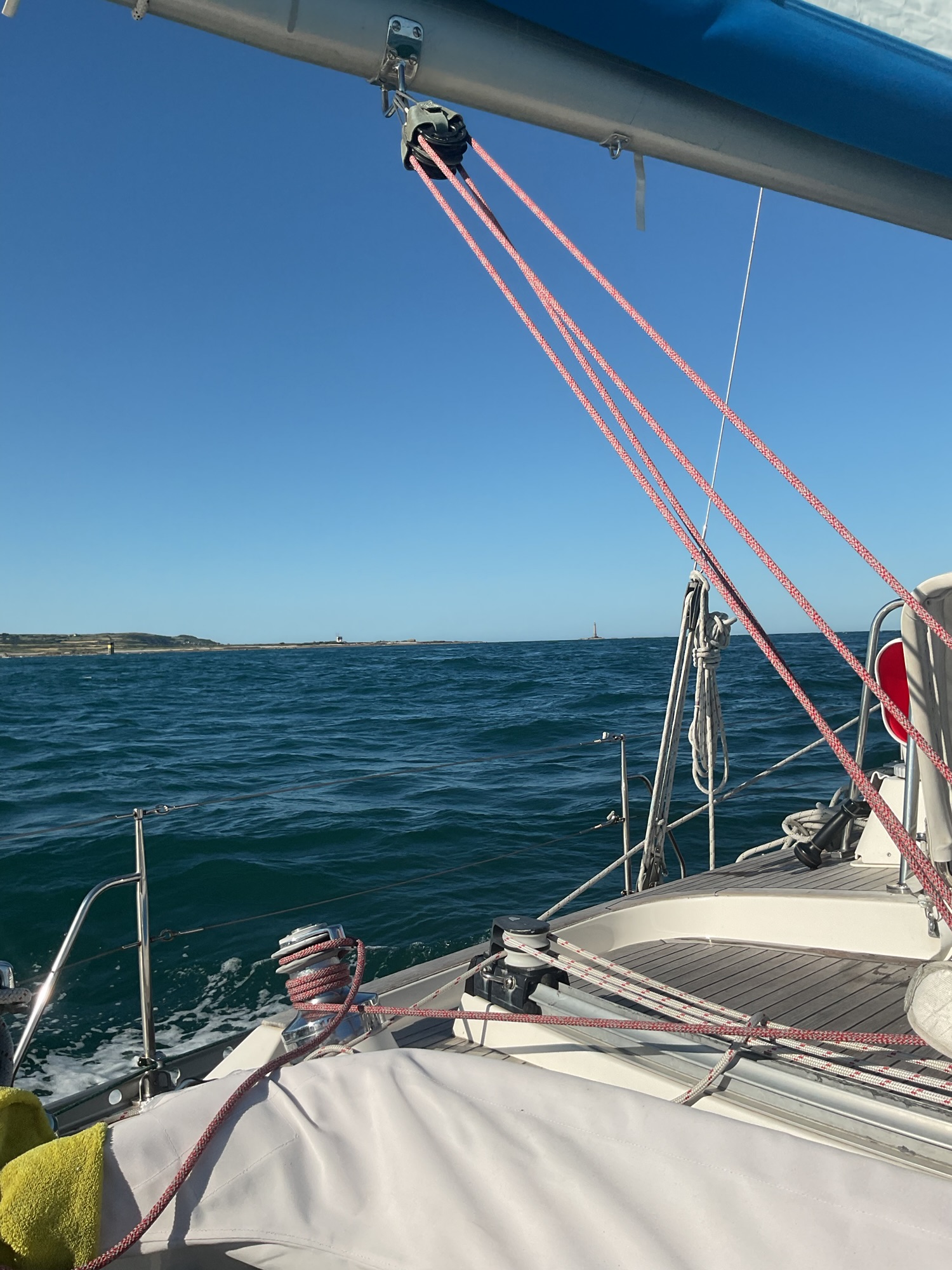
We left Poole on Monday afternoon and headed for Lymington, where we arrived in time for some excellent fish and chips. We stayed in the Yacht Haven, rather than the Berthon, as they had room. My father used to keep a boat here in the late 90s that I used to sail regularly. The marina has expanded somewhat since then and is now the home to a lot of charter power boats as well as the local sailing boats. The size of the boats, especially the powerboats is surprising, especially after the French coast where we were on the big side, and big powerboats were very scarce. Not so here…
After a day in the marina (avoiding the 25kts blowing in the western Solent), and some grocery shopping, we made our way across to Yarmouth for a night, and dinner at the Beach Hut.
The plan had been to anchor in Colwell Bay, which is opposite Hurst spit on at the western end of the Island, just before the Needles. the restaurant runs a tender service and will collect you from your boat and deliver you ashore to your table. We’d been texted the day before our booking announcing that in light of the weather forecast they’d not be running the tender service, but would collect us from Yarmouth using their minibus or landrover. This was no surprise – in the forecast weather there was no way I was going to anchor in Colwell Bay, let alone spend a night there after a nice dinner.
The Hut, Colwell Bay
The meal was lovely but twice the price of our Michelin starred meal in France, and whilst well prepared Kathryn thought that her fish was not as fresh as she’d become used to. It was, however, a lovely experience and a nice closing chapter to our trip.
We spent another day, Thursday, in Yarmouth to avoid more weather – a steady 38kts in the western Solent at one point, and made a very quick passage back to Birdham in 14-20kts on Friday. We arrived with just enough water to get to the lock and were on our berth by early afternoon. We did a quick tidy, grabbed the essentials and took the train back to our London flat, where we had a take away from our local, and excellent, Chinese, the River View.
Saturday saw us drive back down to the boat so we could load up with all the stuff to come off the boat and give her a proper clean before heading back to London on Sunday morning. We’d meant to have lunch at Itchenor sailing club with a friend from the club, but due to an ambiguous message exchange we thought he’d had to cancel and heade home. He’d meant that he couldn’t have lunch but would meet us for a drink… so we had a FaceTime chat once we were all back at our homes. He’s just had a hip replaced so I feel a bit guilty about having made him walk to the club and back. Nonetheless he’s invited me to apply to become a member of the Royal Cruising Club, which is a great honour. I may not make it through the selection process, but I’m rather pleased.
Port Tudy drove home what I’d been noticing for some time: whilst Trouper is perhaps a little larger than average around the Solent but at 43′, she’s hardly large, and 50’+ boats are common; here we are definitely heading for outsize. When we had dinner with our friend’s brother in law, a lifelong sailor, the other week he’d suggested that there was no need for a boat larger than 10m (33’ish) south of Brest. Most ‘big’ cruising boats here are 30′-35′ and moorings are much more limited for boats over 12m (40′). Boats in the 20-30′ range are still common. This feels much more like my childhood sailing in the Solent in the 70s and 80s. At some point in the 90s boats started to get really big.
The last of my families ‘big’ cruising boats was bought in 1980, and sold in 1987 when I went to University and my father lost his crew, and was 26′. A family of four on board was snug. We had a single hand pump for a fresh water tap and no hot water beyond that the that kettle would supply. In those days a 32′ boat was a big boat and 40’ers were scarce. Given that Trouper was built in 1989 it’s clear that there were bigger boats around, but at 43′ Trouper was then far from the smallest boat in Swan’s range, and Swan were then, and still are, pretty much the definition the premium end of sailing boat construction. Swan have in the last couple of years introduced a new small boat into their cruising range at 48′ after years of not making anything much smaller than 54′.
The prevalence of smaller boats brings the costs down considerably and makes access to boating much more affordable. It is very noticeable that in my childhood boat ownership was affordable for people of reasonable means – at least two of my secondary school teachers had boats – but I can’t imagine a modern teacher being able to afford a boat in the UK these days. I suspect a combination of the early skill development and exposure to sailing, a national obsession with fishing, and more affordable boats makes mucking about in boats much less of a privileged elite’s hobby in France.
We left Port Tudy a little after 9 – when we had to go in order to let someone on the inside of the raft out. The timing suited us as I was very keen to have time in the middle of the day to have a good look at the Glenan. These islands are famous because of the sailing school set up there post war. It’s original aim was to rehabilitate former resistance fighters but it has grown and become the centre of a huge sail training operation. The Glenan’s teaching philosophy is set out in its sailing manual, that was available in the 80s and 90s in English translation, which is where I was first exposed to it by my father, who I think got his copy in the now sadly defunct nautical bookshop at Bursledon on the Hamble river. The approach is what I’d now know to describe as experiential: starting in dinghies and slowly supplying equipment such as masts, sails, centre boards, boom and ultimately rudder so that students developed a deep seated understanding of the forces that acted on a boat and the controls available. The RYA’s ‘five essentials’ in the dinghy scheme tries to deliver the equivalent knowledge. I suspect the Glenan’s approach could be resource and time intensive, but I’m sure it pays dividends – and I’ve seen plenty of sailing school groups using elements of it whilst we’ve been here.
The Glenan
We arrived in the Glenan late morning and initially anchored in about 3m of water to the west of Penfret. We had lunch and I fitted the outboard on the tender. I almost never tow the tender with an engine on, and take the engine off every night after a memorable childhood experience of waking on mid river piles at Bucklers Hard (now sadly pontoons joined to the main marina) to discover that the rear half of the Avon dinghy had deflated lowering the 2hp Yamaha 2 stroke outboard (a great little machine) into the water overnight. A fresh water flush and drying out and it was actually fine.
I took the tender up to Saint Nicholas, dodging fleet after fleet of sailing school dinghies – which felt odd given that we were are 10 miles offshore. It was a bit bumpy upwind against a small chop and with the boat on the plane at about 12-15 kts I had to sit on the floor, and play the throttle to stay secure and keep everything balanced. I was quite enjoying myself. Once in ‘La Chambre’ the moorings on the south side of the island the little chop, that was a little uncomfortable where we were anchored, eased up and, to my surprise for a Friday in August, there were many free moorings. So I motored the mile and a half back to Trouper and we lifted the hook and towed the dinghy (the first time ever with the engine on, I think!) up to the moorings. Once secure we took the tender ashore onto Saint Nicholas for a look around.
Once we’d clambered up from the side of the rough concrete jetty where we’d tied up with some other dinghies the first shock was the crowds. We got ashore as the queues started to form for the last couple of tourist boats back to the mainland, and there were hundreds of people queuing clearly keen not to miss the last ride home. Under foot it was deep soft sand which turned into wooden walkways to protect the delicate fauna once we got clear of the few buildings on the island. There were still lots of people around. After a lap of the island we retreated to the boat, had dinner and watched some of the Netflix documentary about the Tour de France – it seemed fitting.
Queue for the Verdette home.Bay on the North side with wing foil schoolWalkway to beach over dunesVerdettes queuing with dinghy fleet in the distance.
The following morning (Saturday) we picked up the anchor and headed to the east and then north of St Nicholas to regain the deep water. As we did it one of the big verdettes steamed past us heading straight for a row of rocks, only to confidently motor through a 30m wide gap at a steady 10kts. We stuck to a bigger gap.
Once clear we made our way across Benodet bay to arrive at Benodet with the start of the rise of the tide to explore the Odet river, which all the pilot books call out as very pretty indeed. Once we’d got under the 30m air draft bridge (our rig is a bit over 20m with the instruments and antennas on the top), we headed on up the river. There’d been no wind at all so we’d motored all the way, and in the process our nice big alternator has taken the battery from 65%, to over 85% at the entrance to the river. By the end of the afternoon the batteries were at 100% once more. We worked up the river on the tide and the wooded banks steepened and the river narrowed. We stopped for a late lunch on some visitors moorings but we were too big to stay there overnight and we carried on upriver to explore a little side creek, which the pilots reported as lovely spot for the night. It was gorgeous but with two other boats in there and not a lot of depth there just wasn’t room for us, so we headed back out to the main river.
Anse de St Cadou – our possible anchorage
We tried to anchor in the river nearby a couple of times but the bottom was bare rock scoured clean by the tide – there is a huge flow in the river – and we couldn’t get the anchor to bite. The muddier spots were either too shallow or occupied. So we headed down river as the tide started to ease and found a spot to anchor for the night just before the bridge. I deflated the tender and stowed it back in the forepeak, which is rather full of kit and toys. As an aside when I came to use the tender in Etel I checked the pressure of the tubes and floor with the new electric pump, having inflated them by foot pump and it very quickly got them up to the proper pressure. I’ve high hopes for the new pump.
We left at about 0715 on Sunday morning to head out of Benodet bay, past Pointe de Penmarc’h and out towards the Raz du Seine. We were motor sailing in very little breeze and what little there was was on our nose once we turned north at Pointe de Penmarc’h.
Our passage plan for Sunday
Most of the way to the Raz we saw evidence of pod of dolphins hunting: lots of dorsal fins breaking the water and turning rapidly with frenzied fish jumping to the delight of packs of gulls. We also had them come and join us repeatedly, and I finally got some photos and a video – we’ve seen them at some point most days this trip.
Pair of Common Dolphins alongsideMore dolphins at the bowAnd some more dolphins..And again…
We arrived, as planned at the Raz as the tide turned in our favour, but even then it was quite bumpy for a couple of miles as the tide whistles between the island and the headland, with a ridge of rocks extending out underwater.
Trouper doing her thing when faced by an unruly wave in the Raz.The Pointe du Raz
After that it was a relatively simple 12 nm or so north and round a headland into Cameret, just before the entrance to the Rade de Brest. We’d picked up a small vibration that you could feel through the boat and was very noticeable on the wheel. We tried going astern a couple of times and the vibration intensified. Clearly there was something on the prop. I was bracing myself to get a diver or a boat lift when we got in, and trying to justify it to myself as at least we’d get the hull cleaned too (reducing drag). Approaching the marina once the sails were down I tried going astern one more time, mainly to check that I’d got manoeuvring control and after a moment of more acute vibration the vibration stopped and Kathryn reported seeing some seaweed appearing in our wash. After that all seemed well, so hopefully that problem is resolved.
Sadly the remote control for the autopilot also stopped working during the afternoon: it turns on works when the battery cover is off, but not when it is on and the device is thus waterproof. Hardly ideal. I’ll have to see if I can get it repaired as it’s 20 years old and not readily replaceable – modern stuff works to a different set of standards and replacing the autopilot could lead you into replacing the whole instrument system as the current pilot is tightly integrated into the B&G H2000 Hercules processor. And the current displays won’t work with new processors so you could quite easily end up with a £20k bill to replace all of our, admittedly old, very high end instruments. However there is a firm in Lymington who I’m pretty sure will be able to help.
We left Trinité-Sur-Mer on Tuesday heading for Etel. Etel is to the North of the Quiberon peninsular and this marks the start of our progress back towards home and the end of our trip. But that’s not till the start of September so there’s no time pressure and we plan to meander our way back.
Etel is interesting as the entrance to the river has a shifting bar and there is a huge tidal flow that can create difficult conditions. The deep water passage moves around too much to be marked in the conventional way, with buoys, so they have a novel system with a semaphore tower. The tower is manned when there is enough water in the channel and talks you in by radio, though they retain the old pointer system for boats without radios.
Semaphore Tower at Etel, note the big red pointer on the rear tower.
The guy was very friendly and helpful, apologising that his English wasn’t great. It was better than my French – using a radio in a foreign language adds a whole new set of specialist vocabulary, and is a bit intimidating.
We had a lovely couple of days in Etel, with a nice meal out, where Kathryn had her first ‘fruits der mer’ of the trip. We took the tender across the harbour to the beach on the other side of the entrance on the second afternoon (whilst the morning’s laundry dried), and Kathryn had a swim in the rather chilly water.
Etel is a holiday town, with a long fishing history, and still has a fleet of tuna boats that head out into the Atlantic. It’s not a big racing centre, but a measure of the French obsession with offshore racing is that even here, in the fishmongers, there was a framed set of foul weather gear from a Vendee round the world race, in much the same way that you might see a football shirt in the UK.
Waterproofs from PRB’s 2020 Vendee Globe
Entertainingly I use the same foulies (probably OTT for my use) and picked up the matching jacket in Trinite-Sur-Mer where there was a North Sails store I could try them on in. North’s run a mainly mail order model and it’s hard to get the sizing right and pick over the features. I was a bit concerned that the jacket didn’t have fleece lined handwarmer pockets, which are much loved on my existing Mustos as they weren’t listed on the features, and the pared down racing ethic might have gone too far for my tastes. Happily I was able to establish that there were hand warmers, and that I needed a large (normally a medium) so a purchase was made. The colour is not to everyone’s tastes but it’s chosen to be visible in the water.
North’s are primarily a sailmaker (and made our funky high tech moulded seam free sails) but have an apparel line which in the last few years has started to include foul weather gear. Until then, in my view the best kit was made by Musto, who used to be a sailmaker (Musto and Hyde) in the 70s and 80s before the sail and clothing businesses split. My first generation HPX (their top of the line, and the first Gore-Tex sailing gear – normal Gore-Tex can’t cope with salt water) from 2000 has arguably lasted better and is more robust than my later stuff (which is a bit lighter weight, which has its virtues) and I still use it in London on the Thames. Keith Musto, the son of the founder, who I think had been an Olympic sailor, ran the clothing business which had been an awesome firm to deal with – their service team in Southend put new cuffs on my first HPX jacket in the mid 00s when I wore through them for about £30. Famously HPX came with a lifetime warranty – which has replaced both trousers and jacket of my second set when they delaminated. Manufacturing later moved abroad and in my experience the quality dropped a bit, ultimately Helly Hansen bought up Mustos in the late 2010s at some point. Last time I looked both were actually onwed by a Canadian teacher’s pension fund. Keith Musto has however reappeared, presumably after some non-compete clause had expired, as the designer of the North’s range, complete with his trademark collar system that keeps water out and your ears warm. The Norths stuff feels like the next evolution – it’s very comfortable and pared down to keep it light without sacrificing the features you actually need (like the handwarmers!). A ludicrous purchase on a sunny day when it was heading for 30Deg C, but should last me a decade or more.
Whilst in La Trinite, on 1 August (the half way point), we finished the first gas bottle on board. This has been the source of some thought when coming away. Trouper carries two 6Kg Calor Propane bottles. You effectively buy the bottle and then pay an fee to exchange it for a full one when empty. Camping Gaz operates in a similar way across Europe using a mix of propane and butane, but does not have any bottles as large as 6Kg. We have a ‘universal’ gas regulator that will accept propane, butane or a mix – essentially it’s a compromise that does all of them equally badly. We have adaptors for different bottles on board, and could switch over to Camping Gaz. But I’m not sure there is room in the locker for both and I’m loath to throw away a Calor cylinder – they are expensive and it’s hardly very green. Gas is very dangerous stuff on boats and has led to a number of nasty explosions, including one in the 90s in Poole harbour that cost someone I used to know a little their lower leg. The problem is that the gas is heavier than air and if it leaks accumulated in the boat forming an explosive mix with air. Then it just needs a spark to ignite it. We keep the gas in a sealed locker (together with the outboard fuel) that has a low level drain over the side. There is a solid copper pipe from the regulator to the cooker, and an electrically operated isolating valve at the regulator that means that the gas pipe is only pressurised when the stove is in use. There is a gas detector mounted low by the stove and it is connected to an alarm that also cuts the gas at the isolating valve. Ideally I want to have one cylinder in use and to swap the empty for a full spare as soon as possible. But Calor isn’t available here, so I was relieved that the bottle that was in use for a few weekends before we left made it to the half way point. It should mean that we can get back to the UK without needing any more – though if it starts to feel too light I might pick up a Camping Gaz as a backup – I think I can stow it safely and the prospect of not being able to make tea (or cook) is unappealing.
We left Etel on the late afternoon tide, you’re advised to leave just before high water, after two nights there and headed 10 miles (all distances are in Nautical miles – the distance described by 1 minute of arc of latitude, so a bit longer than a stature mile and about 1.8km) or so down the coast to a bay just past Lorient that had looked like a good place to spend the night before heading on a further 20 miles to the Isle Glenan the following day. Sadly the sheltered bit of the bay was now full of mooring buoys, which all looked too small for us, and outside the shelter it was a bit rolly and wouldn’t have been a pleasant night. We had backup plans, either heading into Lorient or over to Isle De Groix. we chose Port Tudy in Isle De Groix, which was about 40 minutes away, and arrived early evening. The harbour master met us in little rib (tiller steered sitting on the sponson, or standing, as is the custom here) and led us into the outer basin where boats moor rafted secured fore and aft to mooring buoys. He said once we were alongside he’d run the lines for us, though we were towing the tender so we could have been self sufficient. However the gap he led us into proved to be such a snug fit that we ended up secured alongside on both sides connecting two rafts. There was no need for lines to the buoys, which was as well as with breast ropes and springs on both sides and one longer line tied up towing the tender I was running out of mooring lines. Those who have sailed with me will know that this is a bit of an extreme event – I do like to make sure I’ve enough rope for any circumstance, as indeed did the previous owner of Trouper. Whilst I’ve retired one of his lines due to chafe damage, I’ve only added two long lines in our ownership. Following this trip and a bit of chafe in places I think one of this winter’s jobs will be making up a new set of mooring warps.
Port Tudy, before another couple of people arrived behind us.
We left Cherbourg on Wednesday, filling up with diesel before we left at the self service pumps. The 300Euro maximum for a card transaction filled one tank and took the other to 92% so we left it at that and headed off. We took a fair tide to Cap de la Hauge and saw a fair bit of water over the deck, though never in the cockpit, in the overfalls as we motor sailed into the Alderney race.
Our straight line course to Treguier took us down the Big Russel channel between Sark and Herm passing lots of fond memories – more than one involving food on a beach – before a fairly dull 40 mile stretch towards the French coast with the engine thumping away all the time. It was uneventful except for some dolphins joining us mid afternoon just after I’d gone for a nap – Kathryn had no hesitation in banging on the cockpit sole to summon me back on deck, and I was glad of it. As ever the dilemma was whether to just soak up the moment or to go and find a camera to get a record. This time we both settled on just enjoying the moment, which was over all too soon.
Tregieur entrance is a bit wiggly and needed some attention at the end of a long day – we were easily 12 hours in by then, though had both had naps.
But once in, and up the river a bit, it is very snug and sheltered. We elected to anchor as we planned to be off the following day. We picked a lovely spot a little downriver from the town and across the river from a Chateau. A quick shower followed by a long sleep was in order.
I am very pleased to report that the coolant leak seems to have been a loose hose clip on the shut off valve for the hot water calorifier (domestic hot water is heated using the engine cooling circuit, when the engine is running, or, on Trouper, by an immersion heater when plugged into the shore, or from our diesel heating). We’ll probably now carry the remaining 4.5l of coolant around as a talisman against leaks for the foreseeable future.
On Thursday morning we had a leisurely start to the day and I got our newish solar panel array out for it’s first real test in bright conditions.
The FlinKite solar array is very neat – it hoists out of it’s storage bag on a spinnaker halyard and plugs in on the back of the forward dorade box. It has a notional 200W capacity, and can be orientated to point at the sun and operate as efficiently as possible. Without any real care in pointing it, it was generating 180-200W, as you can see from the display. For us that’s great news as it means it will outpace our electricity consumption at anchor and remove any need to run the engine for battery charging. At sea there is a big 225 Amp alternator managed by the battery management system that can very quickly put charge back into the 660 Amp hour LFP battery bank. The great thing about LFP battery chemistries is their very high charge acceptance: it will accept pretty much as much as we can generate.
The holding was excellent in the river and despite all the pilot books’ warnings about the strength of the tide, albeit at neaps, we barely troubled the anchor all night. I put 40m of chain out and even when the tide turned I don’t think we pulled it straight in the mud. It certainly took some cleaning.
Anchor Watch Display
We left on Thursday lunchtime for a smaller hop down the coast to Roscoff where we plan to spend a few days, partly to do chores such as laundry, and partly to let some weather blow through. Finally on this leg we were able to actually sail for at least half the passage and were making a nice 6.4kts in 10kts of breeze on a beam reach for a period. It was so lovely to be at sea without the thrum of the engine. Kathryn made a lovely dinner of trout fillets, new potatoes and veg which I’m sure tasted all the better for the noise of the water gurgling past Trouper’s transom.