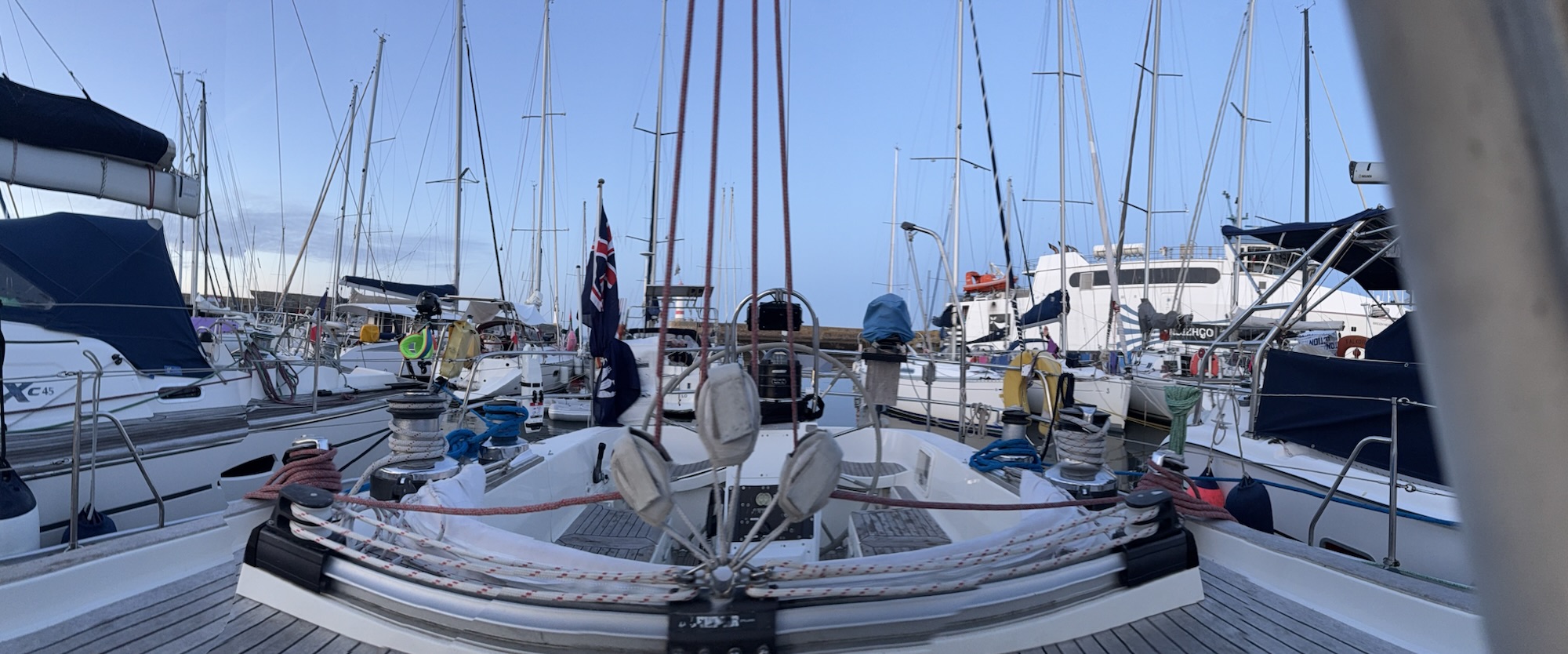
Port Tudy drove home what I’d been noticing for some time: whilst Trouper is perhaps a little larger than average around the Solent but at 43′, she’s hardly large, and 50’+ boats are common; here we are definitely heading for outsize. When we had dinner with our friend’s brother in law, a lifelong sailor, the other week he’d suggested that there was no need for a boat larger than 10m (33’ish) south of Brest. Most ‘big’ cruising boats here are 30′-35′ and moorings are much more limited for boats over 12m (40′). Boats in the 20-30′ range are still common. This feels much more like my childhood sailing in the Solent in the 70s and 80s. At some point in the 90s boats started to get really big.
The last of my families ‘big’ cruising boats was bought in 1980, and sold in 1987 when I went to University and my father lost his crew, and was 26′. A family of four on board was snug. We had a single hand pump for a fresh water tap and no hot water beyond that the that kettle would supply. In those days a 32′ boat was a big boat and 40’ers were scarce. Given that Trouper was built in 1989 it’s clear that there were bigger boats around, but at 43′ Trouper was then far from the smallest boat in Swan’s range, and Swan were then, and still are, pretty much the definition the premium end of sailing boat construction. Swan have in the last couple of years introduced a new small boat into their cruising range at 48′ after years of not making anything much smaller than 54′.
The prevalence of smaller boats brings the costs down considerably and makes access to boating much more affordable. It is very noticeable that in my childhood boat ownership was affordable for people of reasonable means – at least two of my secondary school teachers had boats – but I can’t imagine a modern teacher being able to afford a boat in the UK these days. I suspect a combination of the early skill development and exposure to sailing, a national obsession with fishing, and more affordable boats makes mucking about in boats much less of a privileged elite’s hobby in France.
We left Port Tudy a little after 9 – when we had to go in order to let someone on the inside of the raft out. The timing suited us as I was very keen to have time in the middle of the day to have a good look at the Glenan. These islands are famous because of the sailing school set up there post war. It’s original aim was to rehabilitate former resistance fighters but it has grown and become the centre of a huge sail training operation. The Glenan’s teaching philosophy is set out in its sailing manual, that was available in the 80s and 90s in English translation, which is where I was first exposed to it by my father, who I think got his copy in the now sadly defunct nautical bookshop at Bursledon on the Hamble river. The approach is what I’d now know to describe as experiential: starting in dinghies and slowly supplying equipment such as masts, sails, centre boards, boom and ultimately rudder so that students developed a deep seated understanding of the forces that acted on a boat and the controls available. The RYA’s ‘five essentials’ in the dinghy scheme tries to deliver the equivalent knowledge. I suspect the Glenan’s approach could be resource and time intensive, but I’m sure it pays dividends – and I’ve seen plenty of sailing school groups using elements of it whilst we’ve been here.

We arrived in the Glenan late morning and initially anchored in about 3m of water to the west of Penfret. We had lunch and I fitted the outboard on the tender. I almost never tow the tender with an engine on, and take the engine off every night after a memorable childhood experience of waking on mid river piles at Bucklers Hard (now sadly pontoons joined to the main marina) to discover that the rear half of the Avon dinghy had deflated lowering the 2hp Yamaha 2 stroke outboard (a great little machine) into the water overnight. A fresh water flush and drying out and it was actually fine.
I took the tender up to Saint Nicholas, dodging fleet after fleet of sailing school dinghies – which felt odd given that we were are 10 miles offshore. It was a bit bumpy upwind against a small chop and with the boat on the plane at about 12-15 kts I had to sit on the floor, and play the throttle to stay secure and keep everything balanced. I was quite enjoying myself. Once in ‘La Chambre’ the moorings on the south side of the island the little chop, that was a little uncomfortable where we were anchored, eased up and, to my surprise for a Friday in August, there were many free moorings. So I motored the mile and a half back to Trouper and we lifted the hook and towed the dinghy (the first time ever with the engine on, I think!) up to the moorings. Once secure we took the tender ashore onto Saint Nicholas for a look around.
Once we’d clambered up from the side of the rough concrete jetty where we’d tied up with some other dinghies the first shock was the crowds. We got ashore as the queues started to form for the last couple of tourist boats back to the mainland, and there were hundreds of people queuing clearly keen not to miss the last ride home. Under foot it was deep soft sand which turned into wooden walkways to protect the delicate fauna once we got clear of the few buildings on the island. There were still lots of people around. After a lap of the island we retreated to the boat, had dinner and watched some of the Netflix documentary about the Tour de France – it seemed fitting.


The following morning (Saturday) we picked up the anchor and headed to the east and then north of St Nicholas to regain the deep water. As we did it one of the big verdettes steamed past us heading straight for a row of rocks, only to confidently motor through a 30m wide gap at a steady 10kts. We stuck to a bigger gap.
Once clear we made our way across Benodet bay to arrive at Benodet with the start of the rise of the tide to explore the Odet river, which all the pilot books call out as very pretty indeed. Once we’d got under the 30m air draft bridge (our rig is a bit over 20m with the instruments and antennas on the top), we headed on up the river. There’d been no wind at all so we’d motored all the way, and in the process our nice big alternator has taken the battery from 65%, to over 85% at the entrance to the river. By the end of the afternoon the batteries were at 100% once more. We worked up the river on the tide and the wooded banks steepened and the river narrowed. We stopped for a late lunch on some visitors moorings but we were too big to stay there overnight and we carried on upriver to explore a little side creek, which the pilots reported as lovely spot for the night. It was gorgeous but with two other boats in there and not a lot of depth there just wasn’t room for us, so we headed back out to the main river.

We tried to anchor in the river nearby a couple of times but the bottom was bare rock scoured clean by the tide – there is a huge flow in the river – and we couldn’t get the anchor to bite. The muddier spots were either too shallow or occupied. So we headed down river as the tide started to ease and found a spot to anchor for the night just before the bridge. I deflated the tender and stowed it back in the forepeak, which is rather full of kit and toys. As an aside when I came to use the tender in Etel I checked the pressure of the tubes and floor with the new electric pump, having inflated them by foot pump and it very quickly got them up to the proper pressure. I’ve high hopes for the new pump.
We left at about 0715 on Sunday morning to head out of Benodet bay, past Pointe de Penmarc’h and out towards the Raz du Seine. We were motor sailing in very little breeze and what little there was was on our nose once we turned north at Pointe de Penmarc’h.

Most of the way to the Raz we saw evidence of pod of dolphins hunting: lots of dorsal fins breaking the water and turning rapidly with frenzied fish jumping to the delight of packs of gulls. We also had them come and join us repeatedly, and I finally got some photos and a video – we’ve seen them at some point most days this trip.


We arrived, as planned at the Raz as the tide turned in our favour, but even then it was quite bumpy for a couple of miles as the tide whistles between the island and the headland, with a ridge of rocks extending out underwater.


After that it was a relatively simple 12 nm or so north and round a headland into Cameret, just before the entrance to the Rade de Brest. We’d picked up a small vibration that you could feel through the boat and was very noticeable on the wheel. We tried going astern a couple of times and the vibration intensified. Clearly there was something on the prop. I was bracing myself to get a diver or a boat lift when we got in, and trying to justify it to myself as at least we’d get the hull cleaned too (reducing drag). Approaching the marina once the sails were down I tried going astern one more time, mainly to check that I’d got manoeuvring control and after a moment of more acute vibration the vibration stopped and Kathryn reported seeing some seaweed appearing in our wash. After that all seemed well, so hopefully that problem is resolved.
Sadly the remote control for the autopilot also stopped working during the afternoon: it turns on works when the battery cover is off, but not when it is on and the device is thus waterproof. Hardly ideal. I’ll have to see if I can get it repaired as it’s 20 years old and not readily replaceable – modern stuff works to a different set of standards and replacing the autopilot could lead you into replacing the whole instrument system as the current pilot is tightly integrated into the B&G H2000 Hercules processor. And the current displays won’t work with new processors so you could quite easily end up with a £20k bill to replace all of our, admittedly old, very high end instruments. However there is a firm in Lymington who I’m pretty sure will be able to help.