We’ve been members of Itchenor SC for about 15 years. We joined when we got involved in sailing XODs – wonderful Edwardian day boats that are raced very hard indeed. We’ve remained members partly because I’ve always planned to go back to sailing XODs when I get time, but also to support the place as it is the most extraordinary dinghy club. I’m used to places like the Hythe sailing club of my teenage years, or Wilsonian on the Medway from my 20s. These are basic places (Wilsonan didn’t even have mains electricity) with big dinghy parks and catering, bar and racing all run by the members. Wilsonian’s start line was a garden shed installed on a platform built on top of a WWII pill box. I may have helped build the shuttering and pour the concrete for part of the seawall by it.
Itchenor has a full time staff team, hotel standard en-suite rooms, if needed, lovely bar and excellent food. We were won over by the dayboat racing finishing in time to be back to the club for tea and (excellent) cake. It has a fleet of 6 or 7 RIBs, and three committee boats, the largest of which, Betivuka, is good sized 28′ launch, with excellent facilities.
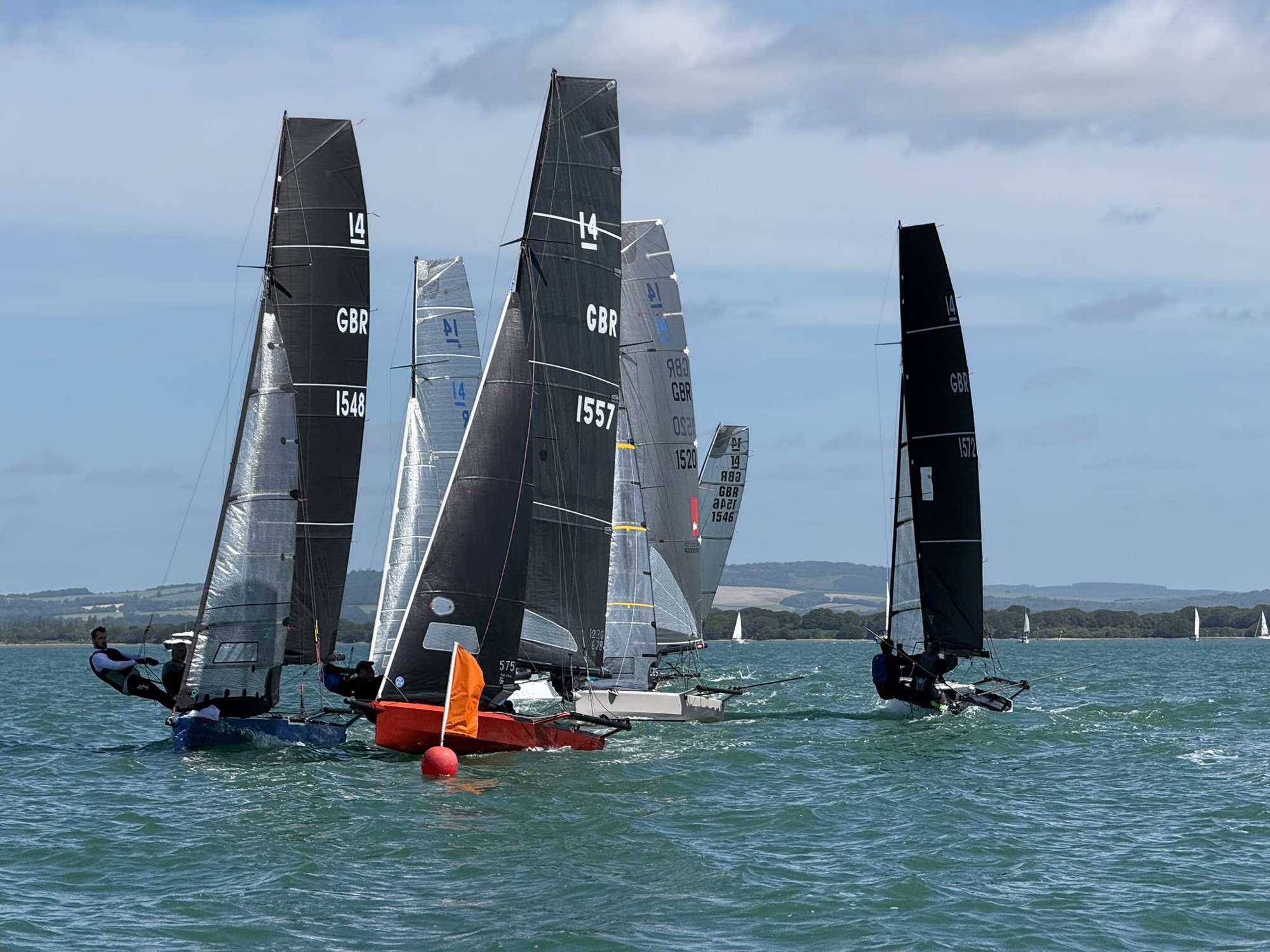
Whilst most of Itchenor is run by a very professional staff team, there are nonetheless on the water duties for members to run the racing operations – either on the committee boat or the RIBS. We try to get our duty days each year to align with a day when the 14s are racing out of the harbour – as I find it much more fun and the 14s can really stretch their legs on open water. The club, like many, has a number of class fleets, and no handicap racing. The International 14 is the highest performance boat in the club and they are fantastic machines. They are a development class, so any boat that meets a set of design parameters is class legal, resulting on a fair bit of variety. The boats have evolved very significantly over the near 100 years of the class – a modern 14 is a very low profile carbon skiff hull, with racks, twin trapeze, a carbon mast and retractable bowsprit that almost doubles the boat’s 14′ length. The rudder is a T foil that is actually used not for lift, but to hold the transom in the water off the wind. They can exceed 20kts off the wind. The club is home to one of the UK’s larger fleets, and includes a few internationally dominant sailors.
Mid June saw our duty weekend roll round. Sadly the racing was in the harbour as not enough boats had confirmed in time to commit the resources needed to race out of the harbour. Nonetheless it there was some great sailing, and I rather enjoyed looking after the mark laying for the fleet, and providing safety cover.
Saturday saw a westerly that allowed a windward leeward course from the Itchenor channel up past Hayling, and then a reach into the Emsworth channel; whilst Sunday saw a southwesterly that backed southerly during the first race, resulting in a hasty re-laying of the windward mark on the eastern edge of the East Head anchorage. The video above is from the second race with the repositioned top mark.
The harbour authorities have been cracking down on powerboat speed in the harbour – in many ways with good cause – but this has now extended to club safety boats. We may now only exceed the speed limit of 8kts if we believe someone is in trouble and in need of urgent assistance. I think that the huge problem with this is that with a fairly small number of boats in a fast fleet (like 10 Int 14s), that need a large course area, you just can’t stay close enough at 8kts (the speed limit) to even know if they are in trouble. I lost sight of one and only realised it had capsized when they’d recovered themselves and emerged from behind some moored craft. At 8kts you can’t keep up, or even open up the angles to keep them in sight as they navigate the harbour. 9 times out of 10 a 14 capsize is routine, and the last thing they want is you getting in the way, but as twin trapeze boats with no air pocket when inverted the risks of entrapment and drowning are very real. As a (very?) experienced safety boat cox I want to have good eyes on and be counting heads long before the 3 minutes post capsize that could mark the start of irreversible brain damage from hypoxia.
I appreciate the harbourmaster’s dilemma. Not many of the people doing their club duties have my experience – last year I had to help a different club’s safety boat recover a swamped capsized dinghy as they didn’t know how. But equally I felt very uncomfortable on the Saturday with a big course, where I couldn’t keep sight of what was going on. You might think that the solution is zonal safety boats each looking after a portion of the course. That would work but would have needed at least six safety boats for a 10 boat Int 14 fleet on Saturday. On Sunday there was a bit less breeze and with that and the wind angles the course area was smaller, which helped.
Even then, on Sunday I did break the speed limit. A Laser 2000, that was not part of the Itchenor fleet, had passed me with a father and two sub teen children on board. The boat looked like a sailing club rental boat, and wasn’t part of a fleet, just out for a lovely sail. Just after one of the last 14s rounded the top mark there was a gust that saw them overpowered as they hoisted their kite, and they went swimming. The Laser 2000 had their kite up too, and wasn’t able to depower fast enough either. Both were about 500m from me, and about the same distance apart. I got the safety boat up on the plane, checked for heads on the 14 (who were fine) and headed for the Laser 2000. They were Ok too, with the daughter not just with dry hair but also clutching a collection of water bottles and stuff that had floated out of the boat. She clearly hadn’t been put off! I stood by to windward and ultimately held their bowsprit to let the boat blow out to leeward once they’d got it righted but hadn’t yet got back on board. The father thanked me and said he’d been very pleased to see me there.